
- Home
- Tutorials
- SQL Database
- Joins Overview
SQL Joins Visual Guide: Relational Algebra & Join Types
In normalized relational databases, data is intentionally segregated into separate, logical tables to avoid duplicate entries (e.g., storing customer data in customers and order data in orders). A SQL JOIN connects these tables together on the fly based on a shared relationship (typically Primary Key = Foreign Key).
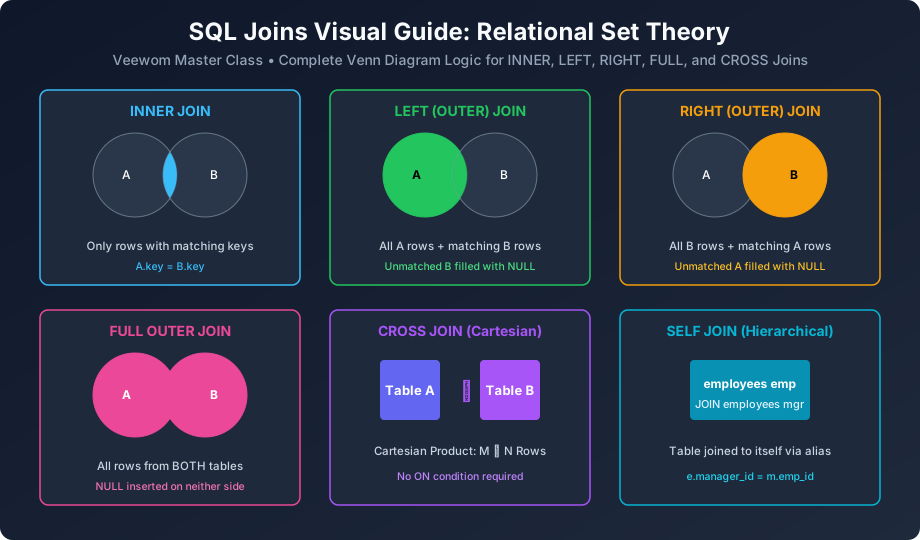
Figure 3.1: Visual Venn diagram guide to INNER, LEFT, RIGHT, FULL OUTER, CROSS, and SELF Joins.
The 5 Core SQL Join Types At a Glance
| Join Type | Relational Logic & Row Inclusion | Direct Class Link |
|---|---|---|
| INNER JOIN | Returns only rows that have matching values in both tables. | Learn INNER JOIN » |
| LEFT (OUTER) JOIN | Returns all rows from the left table, plus matched values from the right table (NULL if no match). | Learn LEFT JOIN » |
| RIGHT (OUTER) JOIN | Returns all rows from the right table, plus matched values from the left table (NULL if no match). | Learn RIGHT JOIN » |
| FULL OUTER JOIN | Returns all records when there is a match in either left or right table. | Learn FULL JOIN » |
| CROSS & SELF JOIN | Cartesian product ((M \times N)) or joining a table to itself hierarchically. | Learn CROSS & SELF JOIN » |
Sample Tables for Our Joins Masterclass
Throughout this module, we will work with two related university tables: departments (parent) and students (child):
-- Sample departments (3 rows)
-- dept_id: 10 (IT), 20 (Business), 30 (Arts - No students yet!)

-- Sample students (4 rows)
-- Aman (dept_id 10), Pooja (dept_id 20), Rohan (dept_id 10), Vikram (dept_id NULL - Unassigned!)
Let us start with the most widely used join: SQL INNER JOIN!
Frequently Asked Questions (FAQ)
A JOIN is a SQL operation that queries and combines data columns from two or more tables based on a related logical column between them (typically matching a Primary Key in one table to a Foreign Key in another).
The 5 primary join types are: (1) INNER JOIN (only matching rows), (2) LEFT OUTER JOIN (all left rows + matched right rows), (3) RIGHT OUTER JOIN (all right rows + matched left rows), (4) FULL OUTER JOIN (all rows from both tables), and (5) CROSS JOIN (Cartesian product of all row combinations).
To eliminate data redundancy, prevent update anomalies, optimize storage space, and enforce data integrity through normalization (1NF, 2NF, 3NF). SQL Joins allow reconstructing unified reporting views on demand.
Next Step in Your SQL Database Learning Path:
Proceed to the next class in sequence to build production mastery of relational database architecture.
Continue to Class 34: INNER JOIN → Previous: ← HAVING Clause | Full Syllabus
Related SQL Masterclass Lessons & Recommended Next Topics
INNER JOIN Mastery →
Matching rows across tables with common key equality.
LEFT JOIN Mastery →
Preserving all rows from the left table and detecting missing matches.
RIGHT JOIN →
Preserving all rows from the right table.
FULL OUTER JOIN →
Preserving all rows from both tables simultaneously.
Primary & Foreign Keys →
The architectural relational keys underpinning every join.
Join Index Optimization →
Indexing foreign keys to prevent disastrous nested loop table scans.


You may also like this!
© Veewom.com. | Managed by PinePL
