
- Home
- Tutorials
- SQL Database
- Transactions & ACID
SQL Transactions: BEGIN, COMMIT, ROLLBACK & Isolation Levels
In multi-user database environments, hundreds of concurrent users read and modify records simultaneously. A Transaction guarantees that related database operations execute reliably as an indivisible unit of work, strictly adhering to the ACID model.
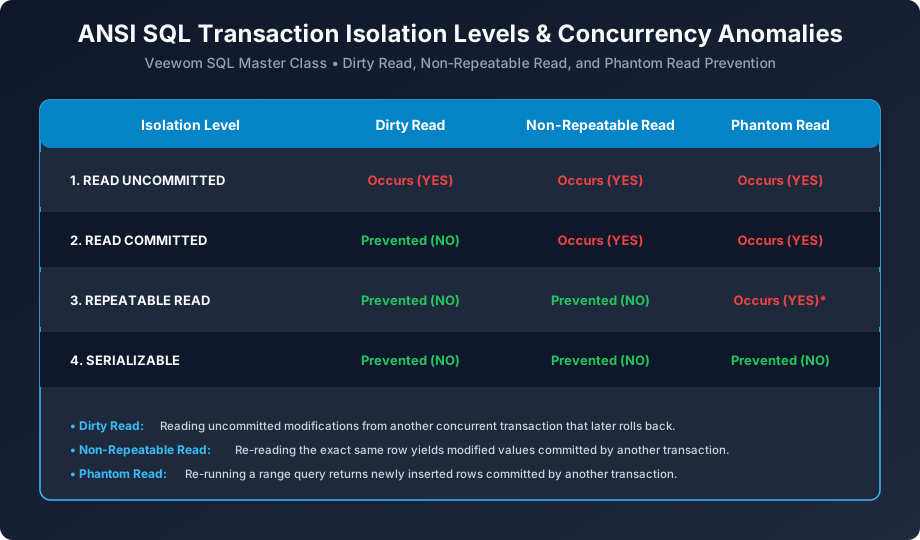
Figure 4.4: Matrix of ANSI SQL Isolation Levels vs Dirty Read, Non-Repeatable Read, and Phantom Read anomalies.
Transaction Control Language (TCL) Statements
• START TRANSACTION / BEGIN: Demarcates the boundary of an atomic transaction.
• COMMIT: Permanently saves all modifications made during the transaction to non-volatile disk.
• ROLLBACK: Aborts the transaction and restores all modified records to their pre-transaction state.
• SAVEPOINT: Marks a partial milestone within a long-running transaction.
Hands-on Implementation: Atomic Bank Fund Transfer
-- Atomic Transfer of $500 from Account 101 to Account 202
START TRANSACTION;

-- Step 1: Deduct from Account 101
UPDATE bank_accounts
SET balance = balance - 500.00
WHERE account_id = 101 AND balance >= 500.00;

-- Step 2: Credit Account 202
UPDATE bank_accounts
SET balance = balance + 500.00
WHERE account_id = 202;

-- If both succeeded, permanently commit:
COMMIT;

-- If any error occurred, execute:
-- ROLLBACK;
The 4 ANSI SQL Isolation Levels
Isolation controls the degree to which a transaction is protected from concurrent modifications by other transactions:
| Isolation Level | Dirty Read | Non-Repeatable Read | Phantom Read |
|---|---|---|---|
| 1. READ UNCOMMITTED | Allowed | Allowed | Allowed |
| 2. READ COMMITTED (Postgres default) | Prevented | Allowed | Allowed |
| 3. REPEATABLE READ (MySQL InnoDB default) | Prevented | Prevented | Prevented via MVCC |
| 4. SERIALIZABLE | Prevented | Prevented | Prevented |
Next, let us learn how to encapsulate reusable backend procedural routines using SQL Stored Procedures & Functions!
Frequently Asked Questions (FAQ)
A transaction is a logical unit of database processing consisting of one or more SQL statements that are executed together atomically (either all succeed and commit, or all fail and rollback).
A SAVEPOINT establishes a partial checkpoint within an active transaction, allowing you to rollback a portion of the transaction (ROLLBACK TO SAVEPOINT) without discarding previous successful statements.
A Dirty Read occurs when Transaction A reads uncommitted modifications made by Transaction B. If Transaction B subsequently rolls back, Transaction A operated on invalid data that never technically existed.
Next Step in Your SQL Database Learning Path:
Proceed to the next class in sequence to build production mastery of relational database architecture.
Continue to Class 47: Stored Procedures → Previous: ← Indexes & B-Tree | Full Syllabus
Related SQL Masterclass Lessons & Recommended Next Topics
ACID Principles in RDBMS →
Atomicity, Consistency, Isolation, and Durability explained.
Locks, Isolation & Deadlocks →
How isolation levels dictate shared and exclusive locking.
Transactions in Stored Procs →
Implementing transactional error handling with ROLLBACK.
Transaction Log Overhead →
Keeping transactions small to prevent WAL / Undo log bloat.


You may also like this!
© Veewom.com. | Managed by PinePL
