
Python Tutorial for Beginners: Complete Step-by-Step Mastery Guide
Welcome to the complete, beginner-to-advanced Python Programming Masterclass on Veewom. Python is a versatile, high-level, interpreted programming language celebrated worldwide for its clean syntax, rapid development speed, and batteries-included standard library. Whether you are a BCA or Computer Science university student preparing for semester exams, a blogger automating workflows, or an aspiring software engineer preparing for technical job interviews, this step-by-step curriculum is engineered to build rock-solid programming foundations.
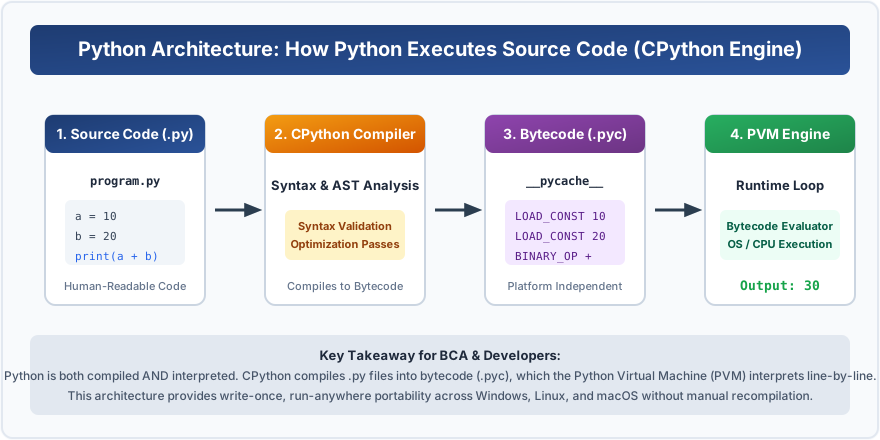
Figure 1.1: Complete CPython execution pipeline showing source code (.py) compilation into bytecode (.pyc) and PVM interpretation.
Why Learn Python in Modern Computing?
Created by Guido van Rossum and first released in 1991, Python was intentionally built with one core philosophy: Readability counts. While languages like Java or C++ require verbose boilerplate code simply to print text to the screen, Python achieves the same in a single readable line:
# Printing text in Python vs other languages
print("Hello, Welcome to Veewom Python Tutorial!")
Key architectural advantages that make Python the #1 programming language across global developer surveys:
• Clean, Human-Readable Syntax: Eliminates curly brackets {} and semicolons ; in favor of clean whitespace indentation (PEP 8).
• Multi-Paradigm Programming: Seamlessly supports Procedural, Object-Oriented Programming (OOP), and Functional programming paradigms.
• Dynamic Typing & Automatic Garbage Collection: You never need to declare explicit data types; memory references are managed automatically by reference counting and cyclic generational garbage collectors.
• Cross-Platform Portability: Write your Python scripts once on Windows, and execute them without code changes on macOS, Linux, Ubuntu, or cloud servers.
• Massive Open-Source Ecosystem: Over 500,000 packages on PyPI powering Artificial Intelligence (TensorFlow, PyTorch), Data Analytics (Pandas, NumPy), and Web Frameworks (Django, FastAPI).
Who Is This Tutorial Designed For? (Audience & Prerequisites)
Prerequisites: Absolute zero prior coding experience is required. Basic familiarity with operating a computer (creating folders, saving files, and browsing the web) is all you need.
Target Audience:
• BCA, BSc IT & BTech Students: Clear semester lab practicals, theory exams, viva question banks, and university assignments.
• Aspiring Developers & Job Seekers: Build coding confidence, crack technical coding rounds, and master Python data structures.
• Bloggers & Digital Marketers: Learn how to scrape websites, automate bulk image processing, and automate Excel sheets.
Complete 8-Module Step-by-Step Curriculum Roadmap
To ensure systematic learning without cognitive overload, all 41 tutorial classes are synchronized into a logical progression:
Hands-on Practice Session: Your First Python Program
Let us test your environment right away. Open your terminal or Python IDLE and write a script that calculates a student's total percentage:
# Program: Calculate Student Percentage in Python
student_name = "Rahul Sharma"
marks_math = 88
marks_cs = 94
marks_physics = 82

total_marks = marks_math + marks_cs + marks_physics
percentage = (total_marks / 300) * 100

print(f"Student: {student_name}")
print(f"Total Marks: {total_marks} / 300")
print(f"Percentage: {percentage:.2f}%")
Expected Output:
Student: Rahul Sharma
Total Marks: 264 / 300
Percentage: 88.00%
Frequently Asked Questions (FAQ)
Q1: Why is Python preferred over C++ or Java for beginners?
Q2: What is the latest stable version of Python?
Q3: Can I run Python on my smartphone or browser?


You may also like this!
© Veewom.com. | Managed by PinePL
