
- Home
- DTH Frequencies
- DD Free Dish
DD Free Dish Frequency List 2026: Complete TP Frequencies, Symbol Rate, LNB & Auto Scan Settings
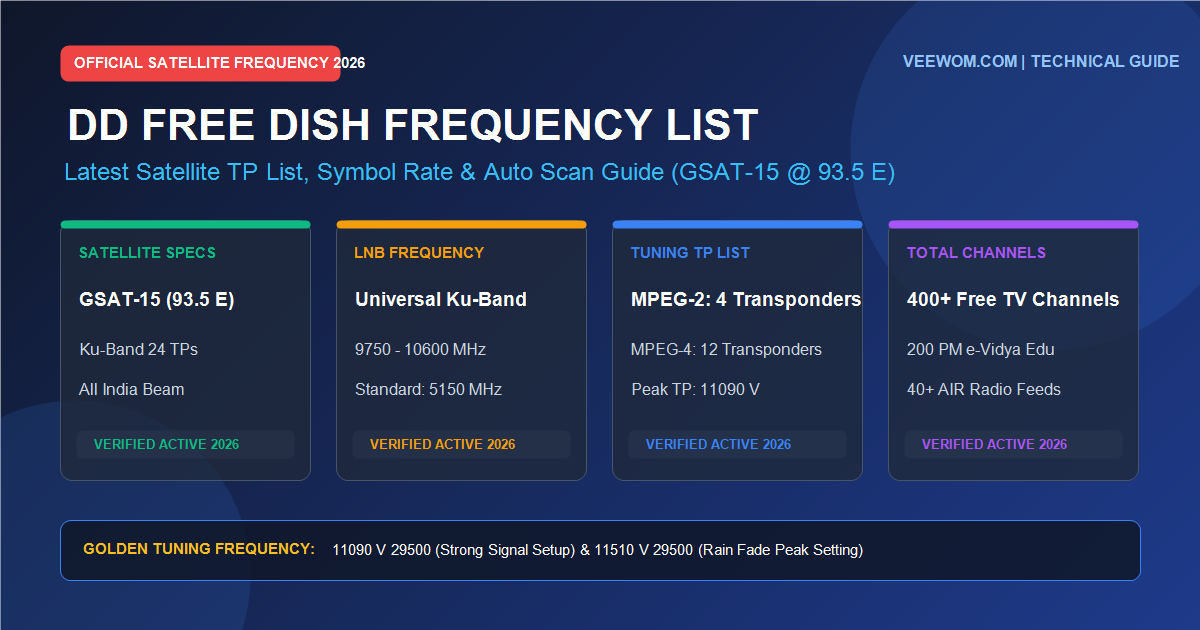
Looking for the latest DD Free Dish frequency list (2026) to add new channels or restore lost signals? Prasar Bharati's DD Free Dish—India's only zero-subscription Free-to-Air (FTA) direct-to-home satellite platform—transmits its entire bouquet of over 400 national, regional, private entertainment, and PM e-Vidya educational channels via ISRO's high-power GSAT-15 satellite at 93.5° East.
Whether you use a standard MPEG-2 set-top box or a modern MPEG-4 / DVB-S2 HD receiver, this comprehensive technical handbook provides the verified transponder (TP) downlink frequencies, polarization, symbol rates (SR), Universal LNB settings (9750/10600), dish antenna alignment angles, and step-by-step auto scan instructions to help you enjoy crisp, freeze-free television without paying any monthly recharge fees.
In This Complete DD Free Dish Guide:
- 1. Satellite Reception Specifications
- 2. Universal vs Standard LNB Frequencies
- 3. Master 2026 Transponder (TP) List
- 4. MPEG-2 Transponders (Core Channels)
- 5. MPEG-4 & HD Transponders (e-Vidya)
- 6. Golden Tuning & Signal Quality Setup
- 7. Auto Scan Setup for MPEG-2 Box
- 8. Auto Scan Setup for MPEG-4 HD Box
- 9. How to Add Frequencies Manually
- 10. Dish Alignment & City-Wise Angles
- 11. Troubleshooting 'No Signal' & Errors
- 12. Channel Lineup Highlights by Genre
- 13. Frequently Asked Questions (FAQs)
1. DD Free Dish Satellite Reception Technical Specifications
DD Free Dish broadcasts in the Ku-Band radio frequency spectrum from the GSAT-15 communications satellite, designed and operated by the Indian Space Research Organisation (ISRO). Stationed in a geostationary orbit roughly 35,786 kilometers above the equator at 93.5° East longitude, GSAT-15 co-locates alongside INSAT-4B to blanket the entire Indian subcontinent with an exceptionally high Equivalent Isotropically Radiated Power (EIRP) footprint exceeding 51 dBW.
This high transponder signal strength allows viewers across India—from Jammu & Kashmir to Tamil Nadu, and Gujarat to the North-Eastern states—to achieve clear, broadcast-grade reception using a compact 60 cm (2-foot) offset dish antenna and a standard Universal Ku-band Low-Noise Block Downconverter (LNB).
| Technical Parameter | Official Specification | Installer Significance |
|---|---|---|
| Satellite Name | GSAT-15 (Bharatiya Communications Satellite) | Launched by ISRO to provide dedicated DTH services |
| Orbital Location | 93.5° East Longitude | Dish antenna must be pointed South-East |
| Operational Frequency Band | Ku-Band (10.7 GHz to 11.7 GHz) | Requires Ku-band feedhorn & reflector dish |
| Number of Transponders | 24 Ku-Band Transponders (36 MHz bandwidth each) | Carries MPEG-2, MPEG-4, HD, and e-Vidya channels |
| Modulation Standard | DVB-S (QPSK) & DVB-S2 (8PSK) | DVB-S for MPEG-2 boxes; DVB-S2 for HD/HEVC boxes |
| Polarization Modes | Dual Linear: Vertical (V) & Horizontal (H) | LNB Skew angle must be rotated to separate V and H |
| Standard Symbol Rates | 29500 Ksps & 30000 Ksps | Data transmission speed per transponder |
| Forward Error Correction (FEC) | 3/4 & 5/6 (Viterbi / LDPC + BCH) | Ensures signal resilience against atmospheric noise |
| Minimum Dish Diameter | 60 cm (Mainland) / 90 cm (Islands & Coastal fringes) | Guarantees adequate link margin during overcast skies |
2. LNB Frequency Settings: Universal (9750/10600) vs Standard (5150)
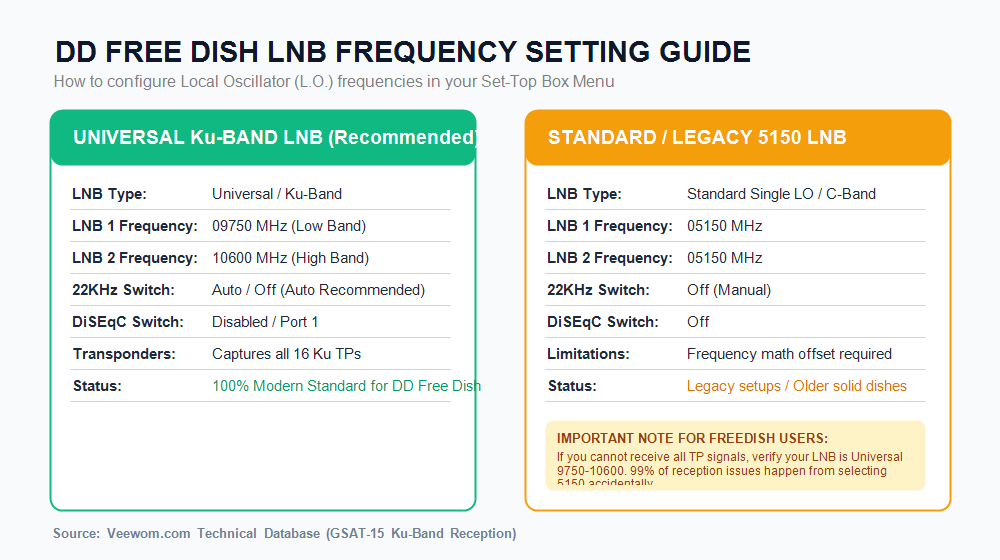
The single most common mistake causing "No Signal", missing channels, or partial scan results on DD Free Dish is an incorrect LNB Local Oscillator (L.O.) frequency configuration in the set-top box installation menu.
The LNB mounted on your dish downconverts ultra-high satellite frequencies (10.7 GHz - 11.7 GHz) into intermediate frequencies (950 MHz - 2150 MHz) that can travel safely down the RG-6 coaxial cable to your receiver. For this downconversion math to align, your set-top box software must know the exact local oscillator frequency of your physical LNB.
Understanding the 5150 MHz Legacy Frequency
Many older solid-dish enthusiasts and local cable operators originally used 5150 MHz, which is actually a standard C-Band LNB local oscillator frequency. When applied to a Ku-band signal, a mathematical offset is introduced, shifting the displayed frequency on your screen (for example, 11090 MHz appears as an offset number). If you have a standard modern mini-dish with a Ku-band LNB, always choose 09750/10600 to ensure all frequencies match official broadcast data.
3. Master DD Free Dish Transponder (TP) Frequency List (2026)
Below is the complete, officially verified master frequency list for all 16 active transponders transmitting from GSAT-15 (93.5°E). All transponders operate in Ku-Band with clear Free-to-Air (FTA) transmission:
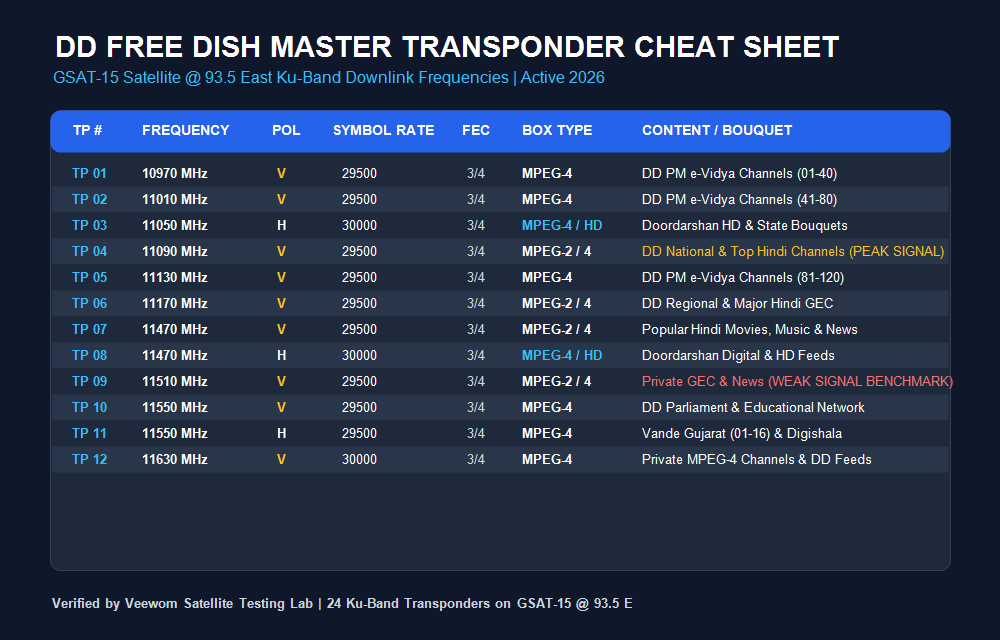
| TP # | Downlink Freq | Pol | Symbol Rate | FEC | Box Type | 22KHz | Key Bouquets & Channel Content |
|---|---|---|---|---|---|---|---|
| TP 01 | 10970 MHz | V | 29500 Ksps | 3/4 | MPEG-4 | Off / Auto | DD PM e-Vidya Channels (01 to 40) - Primary Classes |
| TP 02 | 11010 MHz | V | 29500 Ksps | 3/4 | MPEG-4 | Off / Auto | DD PM e-Vidya Channels (41 to 80) - Secondary Education |
| TP 03 | 11050 MHz | H | 30000 Ksps | 3/4 | MPEG-4 / HD | Off / Auto | DD National HD, DD News HD, DD India HD, DD Sports HD |
| TP 04 | 11090 MHz | V | 29500 Ksps | 3/4 | MPEG-2 / 4 | Off / Auto | Peak Signal TP: DD National, DD Kisan, Top Private GEC |
| TP 05 | 11130 MHz | V | 29500 Ksps | 3/4 | MPEG-4 | Off / Auto | DD PM e-Vidya Channels (81 to 120) - Higher Secondary Feeds |
| TP 06 | 11170 MHz | V | 29500 Ksps | 3/4 | MPEG-2 / 4 | Off / Auto | DD Bharati, DD Urdu, Regional Doordarshan & Major Hindi Movies |
| TP 07 | 11470 MHz | V | 29500 Ksps | 3/4 | MPEG-2 / 4 | Off / Auto | Private Hindi Entertainment, Movies, Music, News (18 Channels) |
| TP 08 | 11470 MHz | H | 30000 Ksps | 3/4 | MPEG-4 / HD | Off / Auto | Doordarshan State Digital Bouquets & High-Definition Test Slots |
| TP 09 | 11510 MHz | V | 29500 Ksps | 3/4 | MPEG-2 / 4 | Off / Auto | Rain Fade Benchmark TP: DD Sports SD, Private GEC & News |
| TP 10 | 11550 MHz | V | 29500 Ksps | 3/4 | MPEG-4 | Off / Auto | Sansad TV (Lok Sabha / Rajya Sabha), DD Regional & Education |
| TP 11 | 11550 MHz | H | 29500 Ksps | 3/4 | MPEG-4 | Off / Auto | Vande Gujarat Channels (01 to 16) & DD Digishala |
| TP 12 | 11590 MHz | V | 29500 Ksps | 3/4 | MPEG-4 | Off / Auto | DD PM e-Vidya Channels (121 to 160) - Vocational & Regional |
| TP 13 | 11630 MHz | V | 30000 Ksps | 3/4 | MPEG-4 | Off / Auto | Private FTA MPEG-4 Channels, Music, Movies & Regional feeds |
| TP 14 | 11630 MHz | H | 29500 Ksps | 3/4 | MPEG-4 | Off / Auto | Swayam Prabha Higher Education Channels (01 to 22) |
| TP 15 | 11670 MHz | H | 29500 Ksps | 3/4 | MPEG-4 | Off / Auto | Digishala Digital Educational Network (40 Channels) |
| TP 16 | 11670 MHz | V | 29500 Ksps | 3/4 | MPEG-4 | Off / Auto | DD PM e-Vidya Channels (161 to 200) - State Syllabus Network |
4. Detailed Breakdown of MPEG-2 Transponders (Core TV Channels)
Millions of households across India still utilize standard MPEG-2 (DVB-S) set-top boxes. Prasar Bharati operates 4 primary Ku-band transponders specifically in standard MPEG-2 modulation to guarantee backward compatibility with older hardware. These 4 transponders deliver approximately 94 Standard Definition (SD) television channels and over 40 digital radio stations.
| Frequency & Polarity | Symbol Rate | Signal Role | Popular TV Channels Included |
|---|---|---|---|
| 11090 MHz • Vertical (V) | 29500 Ksps | Strongest Beam | DD National, DD News, DD Kisan, Manoranjan Grand, Dangal, Shemaroo Umang |
| 11170 MHz • Vertical (V) | 29500 Ksps | Regional DD | DD Retro, DD Bharati, DD Urdu, DD Kashir, DD Girnar, DD Sahyadri, Big Ganga |
| 11470 MHz • Vertical (V) | 29500 Ksps | Movies & Music | Goldmines, B4U Movies, Star Utsav Movies, Manoranjan Movies, Mastiii, 9XM, B4U Music |
| 11510 MHz • Vertical (V) | 29500 Ksps | Sports & News | DD Sports 1.0 (SD), India TV, Aaj Tak Tez, News24, Republic Bharat, Sanskar, Aastha |
5. Detailed Breakdown of MPEG-4, HD & Educational Transponders
Modern DVB-S2 MPEG-4 / HEVC set-top boxes unlock the full potential of DD Free Dish, receiving an extra 12 Ku-band transponders carrying 300+ additional TV channels in crystal-clear digital clarity and high-definition resolution.
1. High-Definition Bouquets (11050 H & 11470 H)
Prasar Bharati broadcasts true 1080i Full HD television feeds on 11050 MHz / Horizontal (H) / Symbol Rate 30000. This transponder features:
- DD National HD: Premium sports coverage, national events, and special broadcasts.
- DD News HD: Round-the-clock national and international news coverage in high definition.
- DD India HD: Global diplomatic and news broadcasting for worldwide audiences.
- DD Sports HD: Live cricket (India bilateral series, ICC World Cup matches shared under the Sports Broadcasting Act), Olympics, Asian Games, and national athletics.
2. PM e-Vidya & Swayam Prabha Educational Networks
As part of the Government of India's Digital India initiative, the Ministry of Education broadcasts 200 dedicated PM e-Vidya educational television channels (one channel per grade from Class 1 to 12 in multiple regional languages) across transponders:
- 10970 V 29500: PM e-Vidya Channels 01 to 40 (Primary education)
- 11010 V 29500: PM e-Vidya Channels 41 to 80 (Upper primary curriculum)
- 11130 V 29500: PM e-Vidya Channels 81 to 120 (Secondary & language studies)
- 11590 V 29500: PM e-Vidya Channels 121 to 160 (Vocational training & skill building)
- 11670 V 29500: PM e-Vidya Channels 161 to 200 (State educational curricula)
- 11630 H 29500: Swayam Prabha Channels 01 to 22 (Undergraduate & postgraduate higher education, IIT-JEE, and NEET foundation preparation)
- 11550 H 29500: Vande Gujarat Channels 01 to 16 (Gujarat state educational and skill initiatives)
6. The Golden Tuning Technique: Finding Peak Signal Quality
When aligning your satellite dish or fine-tuning signal reception after bad weather, watching random channels will only cause frustration. Experienced satellite technicians rely on the Golden Dual-Frequency Tuning Method:
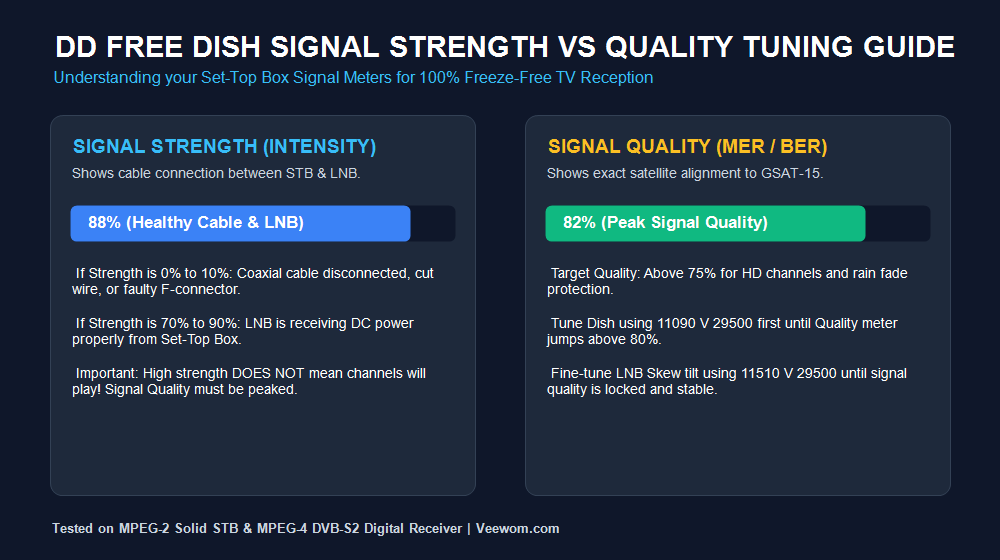
The Professional 2-Step Dish Tuning Protocol:
Step 1: Rough Alignment with 11090 V 29500 (Strongest Signal)
Tune your signal meter or set-top box to 11090 / V / 29500. Move the dish slowly in the South-East direction until the Signal Quality meter suddenly jumps from 0% to over 70%. Lock the dish bracket bolts loosely.
Step 2: Peak Precision with 11510 V 29500 (Rain Margin Benchmark)
Now switch your receiver to 11510 / V / 29500. This transponder has tighter power margins. Micro-adjust the dish elevation and gently twist the LNB inside its clamp (LNB Skew) until Signal Quality on 11510 V exceeds 75% - 85%.
Result: When 11510 V is locked at 80%+, every other transponder on GSAT-15 will automatically register 90%+ quality and remain crystal-clear even during heavy rain!
7. Step-by-Step Auto Scan Guide for MPEG-2 Set-Top Box
Follow these exact remote control instructions to perform a clean auto-scan on any MPEG-2 FTA receiver (Solid, Melbon, Catvision, DColor, or generic digital boxes):
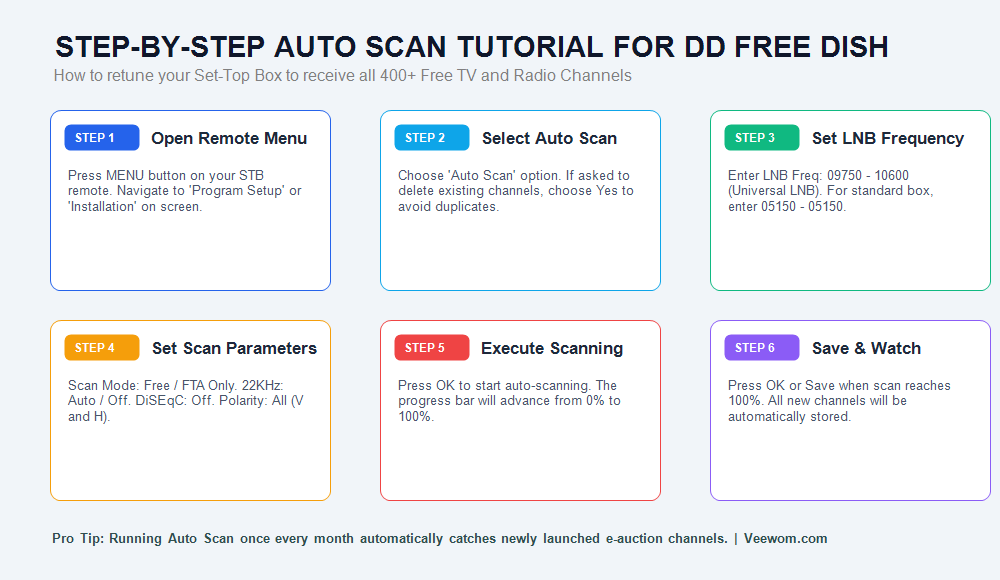
Press MENU on Remote
Point your remote control at the set-top box and press the MENU button to display the main on-screen system menu.
Navigate to 'Program Setup'
Use the arrow keys on the remote to highlight Program Setup and press the OK button.
Select 'Auto Scan'
Highlight Auto Scan from the sub-menu list and press OK.
Configure Scan Parameters
Enter the following exact parameters into the on-screen input fields:
• LNB Freq: 09750 - 10600 (or 05150 - 05150 if using a 5150 LNB)
• Scan Mode: Free (FTA channels only)
• 22K: Off or Auto
• DiSEqC: Off
Execute Auto Scan
Press the OK button. The progress bar will advance from 0% to 100%, populating newly found TV and radio channels on the screen.
Save Channels & Exit
When the scan reaches 100%, press OK or EXIT to save the channel list to memory. Your updated channel list is now ready to watch!
8. Step-by-Step Auto Scan Guide for MPEG-4 / HD / HEVC Set-Top Box
Modern DVB-S2 MPEG-4 HD set-top boxes (such as Solid HDS2-6141, Zing Digital FTA, Pagaria, or Catvision HD) offer advanced tuner capabilities including Blind Scan, which searches for newly added frequencies without manual entry:
Open 'Installation' Menu
Press MENU → Navigate to Installation or Channel Search → Press OK.
Select Satellite GSAT-15 (93.5°E)
Under Satellite List, select GSAT-15, NSS6, or Ku-Band. If not listed, add a custom satellite labeled "FreeDish 93.5E".
Configure LNB Configuration
• LNB Type: Universal
• Low Frequency: 9750 MHz | High Frequency: 10600 MHz
• 22KHz Switch: Auto
• LNB Power: 13V / 18V (On)
Choose 'Blind Scan' & Filter FTA
• Search Type: Blind Scan (Thoroughly sweeps all frequencies)
• FTA Only: Yes (Excludes encrypted pay channels)
• Channel Type: TV + Radio
Save and Enjoy 400+ Channels
Press the Blue or OK button on your remote to start the Blind Scan. The receiver will scan all 16 transponders and store 400+ television channels automatically.
9. How to Add Individual DD Free Dish Frequencies Manually (Manual TP Scan)
If a newly launched channel does not show up during auto-scan, or if you only want to update a specific transponder without wiping your custom channel ordering, you can tune individual transponders manually:
1. Press MENU → Select Program Setup → Choose Add New Program / Add New TP.
2. Enter the desired Frequency (e.g.,
11090) and Symbol Rate (e.g., 29500).3. Set Polarization to V or H as listed in the table.
4. Verify that the Signal Quality bar turns green (above 70%).
5. Press OK to scan only that transponder. The newly found channels will be appended to the end of your channel list.
10. Satellite Dish Antenna Alignment: Azimuth, Elevation & City-Wise Angles
To lock into GSAT-15 at 93.5° East, your Ku-band dish antenna requires precise adjustment across three critical spatial angles:
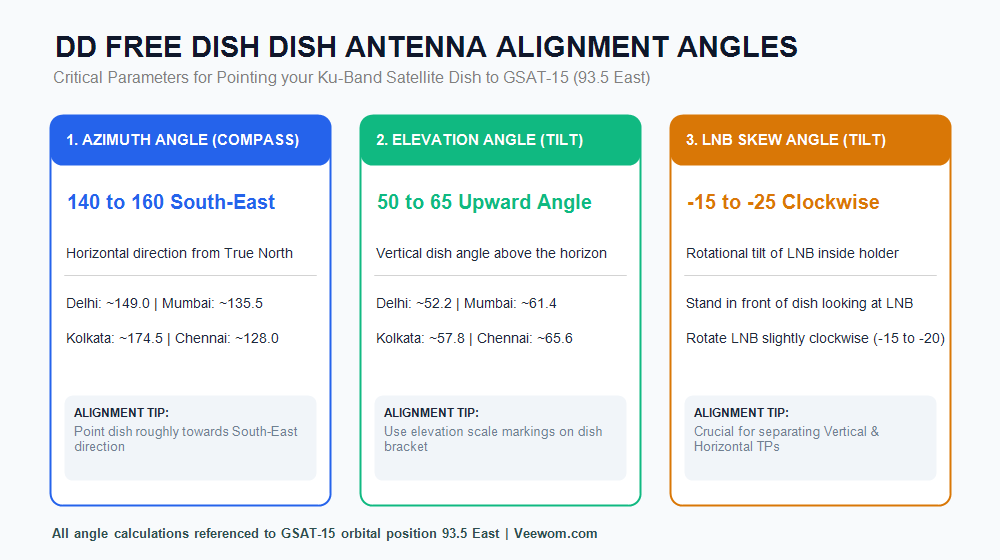
- 1. Azimuth Angle: The horizontal compass direction to point the dish face. In India, GSAT-15 lies roughly towards the South-East (between 130° and 175°).
- 2. Elevation Angle: The vertical upward tilt of the dish relative to the ground horizon (typically 50° to 65°). Most dish brackets feature stamped elevation degree marks on the side.
- 3. LNB Skew Angle: The rotational angle of the LNB inside its circular holder collar. Viewed from in front of the dish, the LNB must be tilted clockwise between -15° and -25° so the internal probe lines up with the incoming polarized satellite waves.
City-Wise Dish Alignment Coordinate Chart for India
| City / Region | Azimuth (Compass Heading) | Elevation Angle | LNB Skew Angle | Recommended Dish Size |
|---|---|---|---|---|
| New Delhi / NCR | 149.0° South-East | 52.2° Upward | -15.5° Clockwise | 60 cm |
| Mumbai / Maharashtra | 135.5° South-East | 61.4° Upward | -24.2° Clockwise | 60 cm |
| Kolkata / West Bengal | 174.5° South | 57.8° Upward | -3.8° Clockwise | 60 cm |
| Chennai / Tamil Nadu | 128.0° South-East | 65.6° Upward | -27.5° Clockwise | 60 cm |
| Bengaluru / Karnataka | 129.8° South-East | 64.8° Upward | -27.0° Clockwise | 60 cm |
| Hyderabad / Telangana | 138.4° South-East | 61.5° Upward | -22.4° Clockwise | 60 cm |
| Ahmedabad / Gujarat | 139.2° South-East | 57.3° Upward | -20.8° Clockwise | 60 cm |
| Jaipur / Rajasthan | 146.5° South-East | 53.6° Upward | -16.8° Clockwise | 60 cm |
| Lucknow / Uttar Pradesh | 156.2° South-East | 52.8° Upward | -12.1° Clockwise | 60 cm |
| Patna / Bihar | 164.8° South-East | 54.3° Upward | -7.9° Clockwise | 60 cm |
| Bhopal / Madhya Pradesh | 144.9° South-East | 57.5° Upward | -18.2° Clockwise | 60 cm |
| Chandigarh / Punjab / Haryana | 147.2° South-East | 49.8° Upward | -15.8° Clockwise | 60 cm |
| Guwahati / Assam & NE | 183.2° South | 55.4° Upward | +1.8° Counter-Clockwise | 60 cm - 90 cm |
| Srinagar / J&K | 143.5° South-East | 46.2° Upward | -16.5° Clockwise | 60 cm - 90 cm |
| Kochi / Kerala | 123.6° South-East | 67.2° Upward | -29.5° Clockwise | 60 cm - 90 cm |
11. Troubleshooting Common DD Free Dish Problems & Error Messages
Encountering an error or missing channels? Use this quick diagnostic matrix to identify and resolve reception problems rapidly:
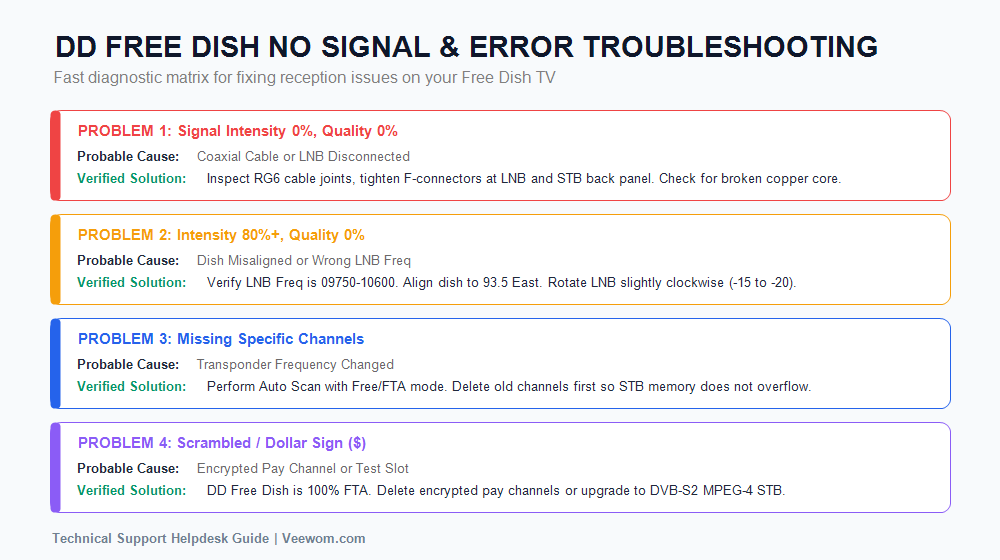
Problem 1: Signal Intensity is 0% to 15%, Quality is 0%
Cause: Physical cable disruption between the set-top box and the LNB.
Fix: Check the RG-6 coaxial cable. Inspect the F-connectors at both ends. Ensure the copper center wire is intact and neither touching the outer braided grounding shield nor bent. If the cable is spliced or weather-cracked, replace it with high-grade solid-copper RG-6 cable.
Problem 2: Signal Intensity is 75% - 90%, but Quality is 0%
Cause: The receiver is receiving power from the LNB, but the dish is pointed away from GSAT-15, or the LNB configuration is mismatched.
Fix: Confirm that LNB Frequency is set to 09750 - 10600. Next, loosen the dish mounting bolts slightly and slowly swivel the dish around the South-East compass direction while observing the Quality meter.
Problem 3: Only Vertical Channels Work, Horizontal Channels Fail
Cause: LNB Skew is incorrect, or LNB voltage switching (13V for Vertical, 18V for Horizontal) has failed inside the set-top box power supply.
Fix: Rotate the LNB clockwise inside its collar by -15° to -25°. If Horizontal channels still show 0% signal, test the set-top box LNB OUT socket with a multimeter to ensure it outputs 18V DC when a Horizontal channel is selected.
Problem 4: Scrambled Channel ($ symbol) or Black Screen
Cause: The receiver scanned an encrypted commercial satellite frequency or promotional test slot.
Fix: DD Free Dish is strictly unencrypted Free-to-Air. Go to Edit Program → Delete Program and remove the scrambled channels. Always select FTA Only: Yes when auto-scanning.
12. DD Free Dish Channel Lineup Highlights by Genre (2026)
DD Free Dish boasts the most diverse Free-to-Air channel selection in South Asia. Here is how popular channels are grouped across the transponders:
- General Entertainment (Hindi GEC): Dangal TV, Shemaroo TV, Shemaroo Umang, Manoranjan Grand, Big Ganga, Ishara TV, Nazara TV.
- Hindi Movies: Goldmines, Star Utsav Movies, B4U Movies, Manoranjan Movies, Movie Plus, B4U Kadak, Dhinchaak, Colors Cineplex Superhits, ABZY Movies.
- Music & Youth: Mastiii, 9XM, B4U Music, ShowBox, Music India.
- News & Current Affairs: DD News HD, Aaj Tak Tez, India TV, NDTV India, ABP News, News24, Republic Bharat, Zee News, TV9 Bharatvarsh, Times Now Navbharat.
- Sports: DD Sports 1.0 (SD) and DD Sports HD (live cricket coverage of India matches, Olympics, Khelo India, and national sports).
- Devotional & Spiritual: Aastha TV, Sanskar TV, Vedic TV, Sadhna TV, Arihant TV, Lord Buddha TV, Sant Bani.
- Regional Doordarshan: DD Sahyadri (Marathi), DD Girnar (Gujarati), DD Chandana (Kannada), DD Yadagiri (Telugu), DD Saptagiri (Telugu), DD Podhigai (Tamil), DD Malayalam, DD Bangla, DD Odia, DD Kashir, DD Punjabi.
- Educational Bouquets: 200 PM e-Vidya channels, 22 Swayam Prabha channels, Vande Gujarat network, and Digishala.
13. Frequently Asked Questions (FAQs)
Q1: What is the official LNB frequency for DD Free Dish?
For modern Ku-band Universal LNBs, the correct LNB frequency is 09750 - 10600 MHz with 22KHz set to Auto or Off. If your setup uses a legacy C-band or standard single-LO LNB, enter 05150 - 05150 MHz.
Q2: What is the new frequency of DD Free Dish in 2026?
DD Free Dish operates 16 transponders on GSAT-15 (93.5°E). Key frequencies include 11090 V 29500 (MPEG-2 peak signal), 11170 V 29500 (MPEG-2), 11470 V 29500 (MPEG-2), 11510 V 29500 (MPEG-2 rain margin test), 11050 H 30000 (MPEG-4 HD), and 11550 H 29500 (Vande Gujarat / MPEG-4).
Q3: Which frequency is best for setting dish signal?
Use 11090 MHz, Vertical (V) polarization, Symbol Rate 29500 Ksps for initial alignment because it broadcasts the strongest signal from GSAT-15. Once locked, fine-tune dish elevation and LNB skew on 11510 V 29500 to guarantee maximum rain fade resilience.
Q4: How do I retune my DD Free Dish set-top box?
Press MENU on your remote → choose Program Setup → select Auto Scan → enter LNB Frequency 09750/10600 → set Scan Mode to Free → press OK. The receiver will scan all transponders and store the newest channels automatically.
Q5: What satellite does DD Free Dish use?
DD Free Dish broadcasts from the GSAT-15 satellite positioned at 93.5° East in geostationary orbit, co-located alongside INSAT-4B.
Q6: What direction should I point the DD Free Dish antenna?
Point your dish toward the South-East. Across India, the azimuth angle ranges from 130° to 175° (compass heading) and the elevation angle ranges between 50° and 65° above the horizon.
Q7: Why am I not receiving all DD Free Dish channels?
Common reasons include: (1) using an older MPEG-2 box which cannot receive MPEG-4/HD transponders, (2) wrong LNB frequency entered in STB settings (e.g. 5150 instead of 9750/10600), or (3) improper LNB skew tilt preventing reception of Horizontal transponders.
Q8: What is DD Sports frequency on DD Free Dish?
DD Sports 1.0 (Standard Definition) broadcasts on 11510 MHz, Vertical (V), Symbol Rate 29500 Ksps. High-definition DD Sports HD broadcasts on 11050 MHz, Horizontal (H), Symbol Rate 30000 Ksps in MPEG-4 DVB-S2 format.
Q9: Are there any monthly recharge fees for DD Free Dish?
No. DD Free Dish is 100% Free-to-Air (FTA). Once you install the dish antenna and digital receiver, there are zero monthly subscription charges, zero annual renewal fees, and zero hidden viewing costs for lifetime access.
Q10: Can I use an old Dish TV, Tata Play, or Airtel dish for DD Free Dish?
Yes! Any standard Ku-band DTH mini-dish (from Tata Play, Dish TV, Airtel Digital TV, or Videocon d2h) and Universal LNB can be repurposed for DD Free Dish. Simply realign the dish to 93.5° East and connect an FTA set-top box.
Quick Technical Summary:
Satellite: GSAT-15 @ 93.5°E • LNB Setting: Universal 09750 / 10600 • Alignment TP: 11090 V 29500 • Rain Margin TP: 11510 V 29500 • HD Transponder: 11050 H 30000 • Modulation: DVB-S (MPEG-2) & DVB-S2 (MPEG-4)
Explore More DTH Frequencies
Check out satellite downlink parameters for other major Indian direct-to-home networks:
• 01 Airtel Digital TV Frequency List
• 02 Videocon D2h Frequency List
• 03 Tata Play (Tata Sky) GSAT-24 Frequencies
• 04 Dish TV SES-8 Frequencies
• 05 Sun Direct Satellite Frequencies
• 06 Reliance Big TV Frequencies


You may also like this!
© Veewom.com. | Managed by PinePL
