
PHP Arrays Master Guide: Memory Model, Array Types & Operations
In computer programming, a standard scalar variable can store only one piece of information at any given moment (e.g. $score = 95;). If you need to manage a list of 100 student names, declaring 100 individual variables ($student1, $student2...) would be virtually impossible to maintain. An array is a specialized, composite data structure capable of holding multiple values under a single identifier name.
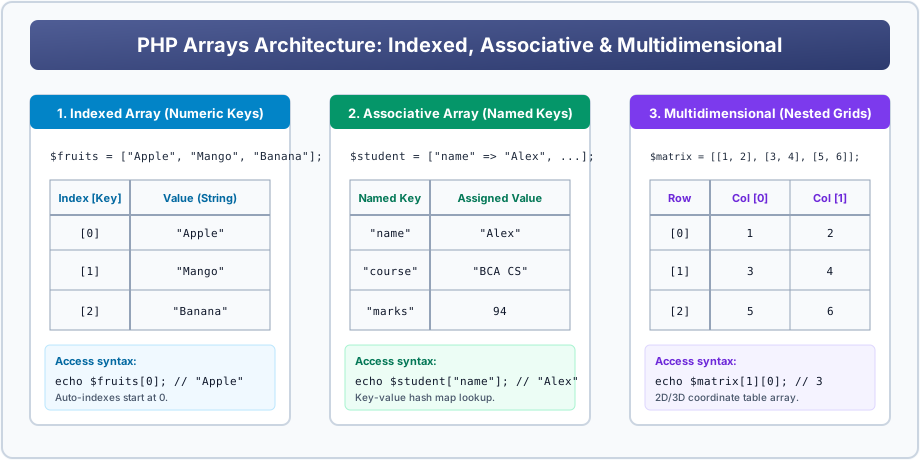
Figure 4: Visual memory architecture comparing Indexed, Associative, and Multidimensional Arrays in PHP.
The Three Primary Types of PHP Arrays
In PHP, all arrays fall into one of three classifications based on their key structure:
| Array Classification | Key Type & Characteristics | Quick Code Example |
|---|---|---|
| Indexed Array | Uses auto-incrementing numeric keys (0, 1, 2, 3...). Ideal for ordered sequential lists. | $fruits = ["Apple", "Mango", "Banana"]; |
| Associative Array | Uses named string keys (Key → Value). Ideal for dictionary and record structures. | $user = ["name" => "Alex", "age" => 21]; |
| Multidimensional Array | Contains nested arrays within an outer array. Ideal for 2D grids, tables, and matrices. | $matrix = [[1, 2], [3, 4], [5, 6]]; |
Modern Array Declaration: [] vs array()
Originally in PHP 5, arrays were instantiated using the array() construct. Modern PHP 7 and 8 provide the clean, square-bracket short array syntax [], which is the universal standard in contemporary frameworks:
<?php
    // Modern Short Syntax (Recommended)
    $languages = ["PHP", "JavaScript", "Python", "SQL"];

    // Legacy Syntax (Still supported for backward compatibility)
    $frameworks = array("Laravel", "Symfony", "CodeIgniter");
?>
Determining Array Length: count() and sizeof()
To count how many elements reside inside an array, use the built-in count() function (or its alias sizeof()):
<?php
    $students = ["Priya", "Sunil", "Aakash", "Meena"];
    echo "Total Enrolled Students: " . count($students); // Outputs: 4
?>
Modern PHP Array Destructuring (Shorthand Unpacking)
PHP supports clean array destructuring, allowing you to unpack array elements directly into variables:
<?php
    $studentRecord = [101, "Rahul Sharma", 94.5];

    // Destructure array into standalone variables
    [$id, $name, $percentage] = $studentRecord;

    echo "ID: $id | Name: $name | Score: $percentage%";
?>
BCA / CS University Exam Corner
High-Frequency Exam Question:
Q: What data types can be stored inside a PHP array?
A: In PHP, arrays are heterogeneous (dynamically typed). A single array can store a mixture of strings, integers, floats, booleans, objects, resources, and even other nested arrays all within the same container!
Interactive Student Practice Session
Exercise 21.1: Create an array storing the names of 6 subjects in your current semester. Display the count and print the first and last subject.
Exercise 21.2: Write a script that checks whether an array contains a specific value using in_array().


You may also like this!
© Veewom.com. | Managed by PinePL
