
PHP Tutorial: Complete Step-by-Step Guide for Beginners to Advanced
PHP (Hypertext Preprocessor) is a widely-used, open-source server-side scripting language specifically engineered for web development. Because PHP code executes directly on the web server and seamlessly embeds into HTML, it enables developers, students, and bloggers to build highly responsive, secure, and dynamic web applications—ranging from personal blogs and e-commerce stores to enterprise cloud portals.
Welcome to the Updated 2026 Veewom PHP Master Series
This comprehensive course is custom-tailored for BCA Students, Computer Science Engineers, Bloggers, and Professional Developers. Every lesson combines theoretical foundations, real-world source code, interactive dry-run traces, university exam corners, and Google-optimized best practices.
What is PHP? (Full Form & Architectural Definition)
Originally created in 1994 by Rasmus Lerdorf, PHP initially stood for Personal Home Page Tools. As it evolved into a full-fledged programming language, its name became a recursive acronym: Hypertext Preprocessor. Unlike client-side languages like JavaScript (which execute inside the user's browser), PHP is strictly server-side. When a visitor requests a PHP webpage, the server executes the PHP engine, queries databases, processes logic, and returns pure, clean HTML to the browser.
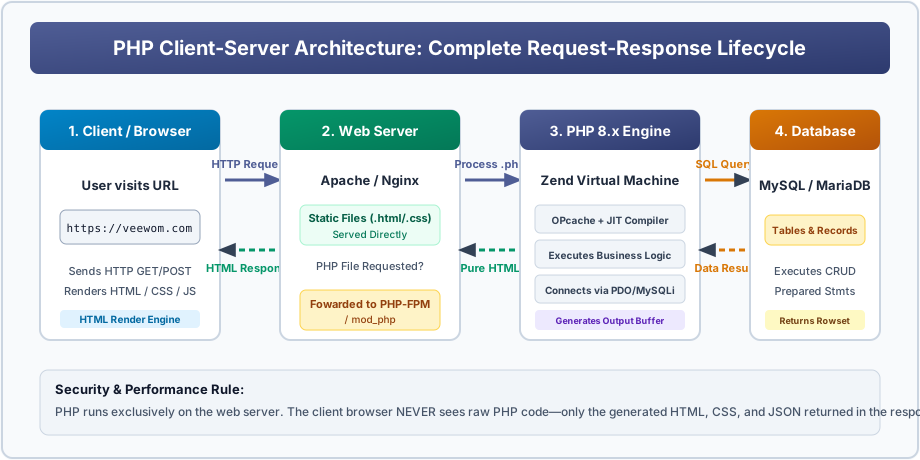
Figure 1: Client-Server Architecture showing how PHP processes HTTP requests and renders dynamic HTML.
Why Learn PHP? Key Advantages for Students & Developers
Despite the rise of multiple alternative backend technologies, PHP continues to dominate the global web infrastructure. Here is why learning PHP is one of the highest-ROI investments you can make:
| Feature | Practical Significance & Student Benefit |
|---|---|
| Huge Market Share | Over 75% of all server-side websites run on PHP, including content management systems (CMS) like WordPress, Joomla, and Drupal. |
| Beginner-Friendly Curve | PHP features intuitive, forgiving syntax heavily inspired by C and Java, allowing beginners to write their first working web script in under 5 minutes. |
| Modern PHP 8 Speed | With PHP 8's Just-In-Time (JIT) compilation, opcode caching, and optimized memory allocation, modern PHP handles high-concurrency enterprise workloads with ease. |
| Cross-Platform Portability | PHP runs natively on Linux (Ubuntu, CentOS, Debian), Windows (XAMPP, WAMP), and macOS (MAMP, Homebrew), ensuring zero vendor lock-in. |
| Native Database Power | Deep native integration with MySQL, MariaDB, PostgreSQL, SQLite, Oracle, and Redis via modern PDO (PHP Data Objects). |
BCA & Computer Science University Syllabus Roadmap
If you are preparing for semester exams in BCA, BSc Computer Science, B.Tech, or MCA, our syllabus is strictly synchronized with university standards:
- Module 1: PHP Basics — Tags, Variables, Operators, Data Types, Echo vs Print, Comments, Constants.
- Module 2: Flow Control — If-Else, Switch, Match expression, While, Do-While, For, and Foreach loops.
- Module 3: Data Structures — Indexed Arrays, Associative Arrays, Multidimensional Arrays, and built-in Array manipulation functions.
- Module 4: Web Forms & State — GET vs POST, Form validation, File uploads, Cookies, and Sessions.
- Module 5: Modern Databases — MySQLi and PDO (PHP Data Objects) with secure Prepared Statements to eliminate SQL injection.
- Module 6: Object-Oriented PHP — Classes, Objects, Inheritance, Encapsulation, Abstract Classes, Interfaces, and Traits.
- Module 7: Modern PHP 8 & APIs — RESTful JSON APIs, Exceptions, Regular Expressions, and Modern PHP 8 features.
Your Very First PHP Script: "Hello, World!"
A PHP script begins with the opening tag <?php and terminates with ?>. Below is the classic introductory program:
<!DOCTYPE html>
<html lang="en">
<head>
    <title>My First PHP Page - Veewom</title>
</head>
<body>
    <h1><?php echo "Hello, World! Welcome to Veewom PHP Tutorial."; ?></h1>
    <p><?php
        $currentYear = date("Y");
        echo "Master PHP Programming in " . $currentYear . " with practical examples.";
    ?></p>
</body>
</html>
Output Rendered in Browser:
Hello, World! Welcome to Veewom PHP Tutorial.
Master PHP Programming in 2026 with practical examples.
BCA / CS University Exam Corner: Viva & Theory Notes
High-Frequency University Exam Question:
Q: Why is PHP classified as an interpreted, loosely typed language?
A: PHP is interpreted because its code is executed line-by-line at runtime by the Zend Engine rather than being pre-compiled into machine binaries prior to deployment. It is loosely typed (dynamically typed) because variables do not require explicit type declarations; the data type is automatically bound depending on the assigned value (though modern PHP 7 and 8 support optional strict typing via declare(strict_types=1);).
Interactive Student Practice Session
Put your foundational understanding to the test with these introductory exercises:
Exercise 1.1: Create a PHP script that prints your university degree name, semester, and favorite programming language using both echo and print.
Exercise 1.2: Write a script that uses PHP's built-in phpversion() function to display the active PHP version running on your server.
Frequently Asked Questions (FAQ)


You may also like this!
© Veewom.com. | Managed by PinePL
