
- Home
- Tutorials
- JavaScript
- Type Coercion & Conversion
JavaScript Type Conversion & Coercion: Implicit Coercion vs Explicit Casting
Because JavaScript is dynamically typed, values frequently transition from one data type to another during program execution. This transformation happens in two distinct ways: Explicit Type Conversion (directed intentionally by the developer) and Implicit Type Coercion (performed automatically by the JavaScript engine).
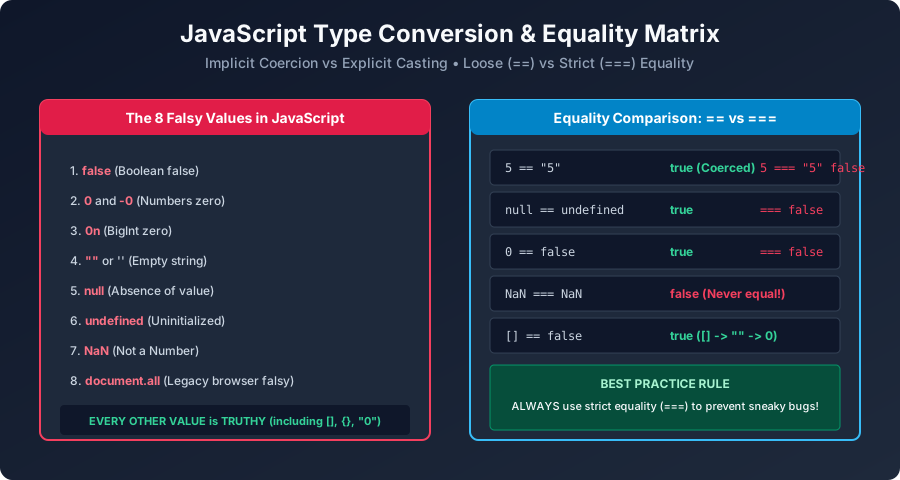
Figure 3: Summary of JavaScript 8 Falsy values and Strict (===) vs Loose (==) Equality matrix.
1. Explicit Type Conversion (Casting)
Writing clear, predictable code requires explicit conversion using built-in wrapper constructors:
A. Converting to Number
// 1. Number() constructor (Strict)
Number("42");        // 42
Number("3.14");      // 3.14
Number("");          // 0
Number("Hello");     // NaN
Number(true);        // 1
Number(false);       // 0
Number(null);        // 0
Number(undefined);   // NaN

// 2. parseInt() and parseFloat()
parseInt("100px", 10); // 100 (Parses leading digits with base-10 radix)
parseFloat("12.5rem"); // 12.5

// 3. Unary Plus Operator (+)
+"99"; // 99 (Fast concise shorthand for Number())
B. Converting to String
// 1. String() constructor
String(123);         // "123"
String(true);        // "true"
String(null);        // "null"
String(undefined);   // "undefined"

// 2. .toString() method (Fails on null & undefined!)
let num = 255;
num.toString(16);    // "ff" (Converts to hexadecimal string!)
C. Converting to Boolean (Truthy vs. Falsy)
In JavaScript, every value is intrinsically either truthy or falsy when evaluated in a boolean context:
// The ONLY 8 Falsy Values:
Boolean(false);      // false
Boolean(0);          // false
Boolean(-0);         // false
Boolean(0n);         // false (BigInt zero)
Boolean("");         // false (Empty string)
Boolean(null);       // false
Boolean(undefined);  // false
Boolean(NaN);        // false

// EVERYTHING ELSE IS TRUTHY! (Notice common beginner traps):
Boolean([]);         // TRUE! (Empty array is truthy)
Boolean({});         // TRUE! (Empty object is truthy)
Boolean("0");        // TRUE! (Non-empty string is truthy)
Boolean("false");    // TRUE! (Non-empty string is truthy)
2. Implicit Type Coercion (Engine Autopilot)
Implicit coercion occurs when operators encounter unexpected data types. JavaScript silently converts one or both operands to find common ground:
| Expression | Output | Under-the-Hood Coercion Mechanics |
|---|---|---|
"5" + 2 |
"52" |
Plus operator with a string triggers string concatenation. Number 2 is coerced to "2". |
"5" - 2 |
3 |
Minus operator only works mathematically. String "5" is coerced to Number 5. |
"10" * "2" |
20 |
Multiplication forces numeric coercion on both strings. |
true + 5 |
6 |
Boolean true coerces to 1. (1 + 5 = 6). |
false + null |
0 |
false coerces to 0; null coerces to 0. (0 + 0 = 0). |
[] + {} |
"[object Object]" |
Array converts to empty string ""; Object converts to "[object Object]". |
University Exam Corner (BCA / B.Sc CS)
Frequent Exam Trap: "Explain the output of: console.log([] == ![]);"
1. Logical NOT (
!) has higher precedence than ==.2. An empty array
[] is truthy, so ![] evaluates to boolean false.3. The expression is now:
[] == false.4. When comparing an object/array to a boolean, both coerce to numbers.
5. Boolean
false coerces to 0.6. Array
[] converts to string "", which coerces to number 0.7.
0 == 0 evaluates to true!Conclusion: This demonstrates why loose equality (
==) is dangerous and strict equality (===) is mandatory in production.
Next Step
How do you document your code and keep it clean for team collaboration? Proceed to: JavaScript Comments & JSDoc Standards →


You may also like this!
© Veewom.com. | Managed by PinePL
