
Artificial Intelligence Tutorial: Complete 2026 Master Curriculum
Welcome to the Veewom Artificial Intelligence Master Tutorial — a complete, rigorous, and practical curriculum designed for university students (BCA, MCA, B.Tech, Computer Science), software developers, data scientists, and advanced web architects. Artificial Intelligence has evolved from theoretical symbolic reasoning and search trees into the defining technological paradigm of our era, powering autonomous vehicles, multimodal foundation models, robotics, and generative software systems.
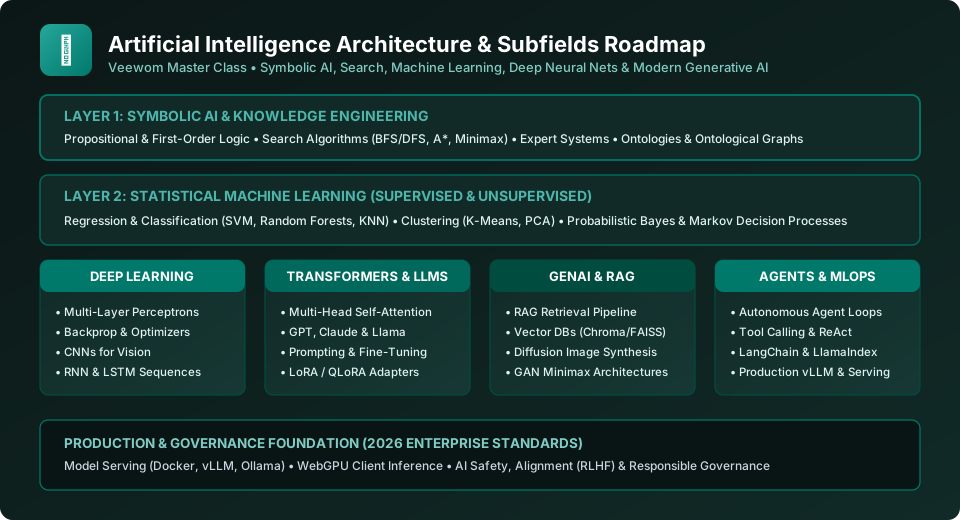
Figure 1.1: Complete Architectural Roadmap of Modern Artificial Intelligence — From Symbolic Logic to Foundation Models & Autonomous Agents.
Why This AI Curriculum Is Unique
Unlike surface-level tutorials that only explain basic terminology or show one-line API calls, this 52-class tutorial connects classical mathematical foundations (search trees, logic, probability, optimization) directly with state-of-the-art 2026 production AI systems (Transformers, RAG, Vector DBs, vLLM, Autonomous ReAct Agents, and WebGPU client inference). Every lesson includes executable Python/JavaScript code, formal formulas, visual architecture diagrams, and examination review points.
What is Artificial Intelligence? A Modern Engineering Definition
At its core, Artificial Intelligence (AI) is the science and engineering of creating rational computational agents capable of perceiving their environment, reasoning about state, learning from experience, making optimal decisions, and executing goal-directed actions to maximize utility under uncertainty.
Modern AI is conventionally organized into four complementary perspectives based on how human-like or rational the system acts and thinks:
| Dimension | Thinking Focus | Acting Focus |
|---|---|---|
| Human-Centered | Cognitive Modeling: Systems that simulate human thought processes, neural firings, and psychological heuristics. | The Turing Test Approach: Systems capable of acting indistinguishably from humans in conversational and sensory tasks. |
| Rationality-Centered | Laws of Thought: Formal logic, syllogisms, knowledge deduction, and sound inferential reasoning. | Rational Agent Approach: Systems designed to act to achieve the best expected outcome under uncertainty (PEAS framework). |
The 8 Core Curriculum Modules (52 Step-by-Step Classes)
This master curriculum is logically organized into eight progressive modules designed to guide you step-by-step from beginner concepts to senior production deployment:
Module 1 AI Foundations & Search Algorithms
Classes 1-7: History of AI, Turing tests, Rational Agents, PEAS framework, Uninformed Search (BFS, DFS, UCS), Heuristic Search (Greedy, A*), Adversarial Minimax, and Constraint Satisfaction Problems (CSP).
Module 2 Knowledge Representation & Reasoning
Classes 8-13: Propositional Logic, First-Order Predicate Logic (FOL), Unification & Resolution Refutation, Semantic Networks, Ontologies, Expert Rule Engines (Forward/Backward Chaining), and Bayesian Networks.
Module 3 Classical Machine Learning Foundations
Classes 14-20: Supervised vs Unsupervised learning, Linear & Logistic Regression, Decision Trees, Random Forests, Support Vector Machines (SVM), K-Nearest Neighbors (KNN), K-Means, PCA, and Cross-Validation Diagnostics.
Module 4 Deep Learning & Neural Architectures
Classes 21-27: Biological vs Artificial Neurons, Perceptrons, Backpropagation calculus, Adam optimizer, Convolutional Neural Networks (CNNs), RNNs/LSTMs, Transformers, GANs, and Diffusion Models.
Module 5 NLP & Modern Large Language Models
Classes 28-34: Tokenization (BPE), Vector Embeddings (Word2Vec, GloVe), Transformer LLM pretraining, Advanced Prompt Engineering (CoT, ReAct), RAG architectures, Vector DBs (Chroma, FAISS), and PEFT/LoRA Fine-Tuning.
Module 6 Reinforcement Learning & AI Agents
Classes 35-40: Markov Decision Processes (MDP), Bellman Optimality, Q-Learning, Deep Q-Networks (DQN), Policy Gradients, PPO, RLHF / DPO alignment, Autonomous AI Agents, and LangChain/LlamaIndex.
Module 7 Advance AI for Full-Stack Web Developers
Classes 41-46: Integrating AI APIs in Node.js, Python & PHP, Real-Time Streaming Server-Sent Events (SSE), Tool Calling with Structured JSON, Client-Side WebGPU inference, Production MLOps with vLLM & Docker, and AI Ethics.
Module 8 Practice, Viva, Interview Q&A & Career
Classes 47-52: 30+ Hands-On Lab Exercises in Python, 120+ Technical Interview Q&A, University Viva-Voce guide for BCA/B.Tech, Debugging AI models, Master Cheat Sheet, and Freelance Consulting Blueprint.
Recommended Learning Roadmap & Prerequisites
To get the maximum value from this tutorial series, we recommend having familiarity with basic programming fundamentals (Python or JavaScript), high school mathematics (algebra, probability, and basic matrix operations), and standard data structures (arrays, trees, queues, hash tables). If you are new to programming, you can brush up on our Python Tutorial and JavaScript Tutorial.
Quick Start: Setting Up Your Python AI Environment
To run the practical code examples across this tutorial series, install Python 3.11+ and create a dedicated virtual environment with key AI libraries:
# Create and activate a clean virtual environment
python -m venv ai_env
# On Windows:
ai_env\Scripts\activate
# On Linux / macOS:
source ai_env/bin/activate

# Install essential scientific computing and AI packages
pip install numpy pandas matplotlib scikit-learn torch torchvision transformers datasets langchain chromadb
Frequently Asked Questions (FAQ) - Student & Interview Review
Q1. What is Artificial Intelligence in simple terms for university students?
Q2. How does AI differ from traditional rule-based computer programming?
Q3. What are the prerequisite skills needed to learn AI in 2026?
Q4. Which career paths are available after mastering this AI curriculum?
Explore Related Artificial Intelligence Tutorials & Next Steps
Broaden your foundational and advanced AI knowledge across our curriculum:
From Dartmouth 1956 and Turing tests to modern multimodal foundation models.
Supervised, unsupervised, and reinforcement learning core concepts and algorithms.
The core deep architecture powering modern LLMs, ChatGPT, and Claude.
Master tough interview questions across ML, deep learning, NLP, and MLOps.


You may also like this!
© Veewom.com. | Managed by PinePL
