
React JS Tutorial: Complete Step-by-Step Guide for Beginners to Advanced
React JS (commonly known as React) is a declarative, efficient, and flexible open-source JavaScript library developed and maintained by Meta (Facebook) along with a massive community of individual developers and tech corporations. React revolutionized modern web development by introducing a component-driven architecture and an ultra-fast Virtual DOM reconciliation engine that eliminates slow, manual browser DOM manipulations.
Designed for BCA, Computer Science Students, Bloggers & Professional Engineers
Whether you are preparing for college semester exams (Web Technologies & Full Stack Development), cracking technical coding interviews, or building production-grade web applications, this master tutorial provides verified source code, architectural diagrams, dry-run memory traces, and best practices.
What is React JS? (Architectural Definition)
In traditional web development, modifying web pages required imperative DOM manipulations using plain JavaScript (such as document.getElementById() or jQuery). As web applications grew in size and complexity, tracking state across dozens of nested HTML elements created fragile, slow, and bug-prone codebases.
React completely solves this by adopting a declarative programming paradigm: you simply declare what the user interface should look like for any given state, and React handles the low-level rendering, event listening, and surgical DOM updates automatically.
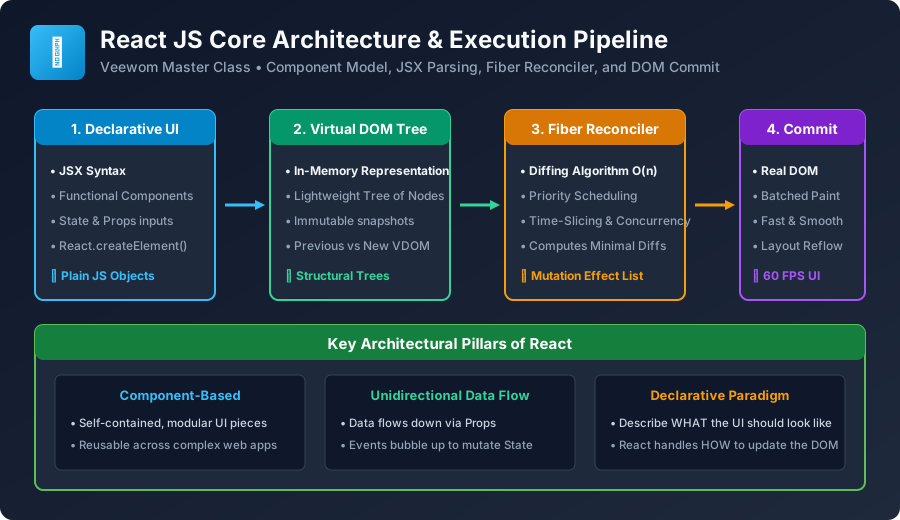
Figure 1: React End-to-End Pipeline: Declarative JSX ➔ Virtual DOM Tree ➔ Fiber Reconciler O(n) Diffing ➔ Real DOM Surgical Commit.
Why Learn React JS? Industry & Academic Advantages
React consistently ranks as the world's most adopted frontend technology according to global developer surveys (Stack Overflow, State of JS). Here are the primary reasons why mastering React is indispensable:
| Feature | Significance for Students, Bloggers & Developers |
|---|---|
| Component Reusability | Build isolated, self-contained UI blocks (Buttons, Navbars, Modal dialogs) once and reuse them across hundreds of pages. |
| Virtual DOM & Fiber Engine | Computes UI differences in memory with an O(n) heuristic diffing algorithm, avoiding expensive browser layout reflows. |
| Unidirectional Data Flow | Data flows cleanly downward from parent to child via immutable Props, preventing unpredictable side-effects. |
| Massive NPM Ecosystem | Seamlessly integrate with thousands of production-tested packages for routing, state, animations, and forms. |
| Cross-Platform Skills | Mastering React's mental model enables you to build native mobile apps using React Native for iOS and Android. |
How React Works: The Mental Model
At its core, React treats UI as a pure mathematical projection of application state:
Whenever the data in State or Props changes, React re-invokes the component function f, generates a new Virtual DOM tree, calculates the exact differences against the previous snapshot, and updates only the modified text or elements on the real web page.
Your First React Component ("Hello, World!")
Here is a complete, modern React functional component written using modern ES6 syntax and React 18/19 createRoot:
// App.jsx - First Modern React Component
import React from 'react';

function WelcomeMessage() {
  const websiteName = "Veewom";
  const studentTrack = "BCA & Computer Science Master Course";

  return (
    <div className="welcome-card">
      <h1>Welcome to {websiteName} React JS Tutorial!</h1>
      <p>Track: {studentTrack}</p>
      <button onClick={() => alert('Happy Coding with React!')}>
        Get Started
      </button>
    </div>
  );
}

export default WelcomeMessage;
Output Preview & Execution Breakdown:
When mounted into the browser HTML root element <div id="root"></div>, React produces:
Welcome to Veewom React JS Tutorial!
Track: BCA & Computer Science Master Course
- Function Declaration:
WelcomeMessage()is a standard JavaScript function that returns JSX markup. - JSX Syntax: Notice how HTML tags and JavaScript variables like
{websiteName}blend seamlessly inside curly brackets. - Event Handling: The
onClickattribute binds a click listener without callingaddEventListener()manually.
Structured Learning Roadmap (42 Classes)
To make your journey smooth and systematic, this tutorial series is synchronized into 7 cohesive sections:
- Classes 1–10: React Fundamentals — Setup, JSX grammar, functional components, props, state, events, conditionals, and keys.
- Classes 11–16: Forms, Styling & Lifecycle — Controlled inputs, useRef, CSS modules, useEffect, custom hooks, and lifecycle.
- Classes 17–22: Intermediate Architecture — Context API, useReducer, React Router v6, portals, error boundaries, and fragments.
- Classes 23–29: Advance Hooks & Performance — useMemo, useCallback, useLayoutEffect, useTransition, lazy loading, and Fiber engine.
- Classes 30–33: Enterprise State & APIs — Redux Toolkit (RTK), Zustand, TanStack Query, and Axios integration.
- Classes 34–39: React 19 & Production — Server Components (RSC), Actions, useOptimistic, Next.js, RTL testing, and security.
- Classes 40–42: Practice & Career — 100+ viva/interview Q&A, real-world capstone projects, and quick reference cheat sheet.
Next Step: Understanding React Core Features
Ready to dive deeper? Click Next below to study React Introduction & Features and understand why top global tech firms choose React over other alternatives.
Explore Related React JS Tutorials
Accelerate your React mastery by studying these tightly connected core tutorials:
Core architecture, declarative UI, and library philosophy.
Quickstart with Vite, Next.js, npm, and CDN methods.
JavaScript XML syntax, embedding expressions, and HTML differences.
Functional vs class components, modular UI architecture.
Stateful UI management and reactive component updates.
Comprehensive exam questions and interview preparation bank.


You may also like this!
© Veewom.com. | Managed by PinePL
