
Node.js Tutorial - Master Server-Side JavaScript From Fundamentals to Production
Welcome to the Veewom Modern Node.js Master Class! Whether you are a college student (BCA, MCA, B.Tech CS), a front-end developer transitioning into full-stack backend development, or an experienced software engineer architecting microservices, this curriculum takes you from running your very first command-line script to deploying hardened, production-ready enterprise backends.
Node.js revolutionized web development by breaking the boundary between browser scripting and server programming. By executing JavaScript on the server via Google Chrome's ultra-fast V8 engine, companies like Netflix, PayPal, Uber, LinkedIn, and Walmart handle millions of concurrent connections with drastically reduced server hardware footprints compared to traditional multi-threaded servers like Java Tomcat or Apache PHP.
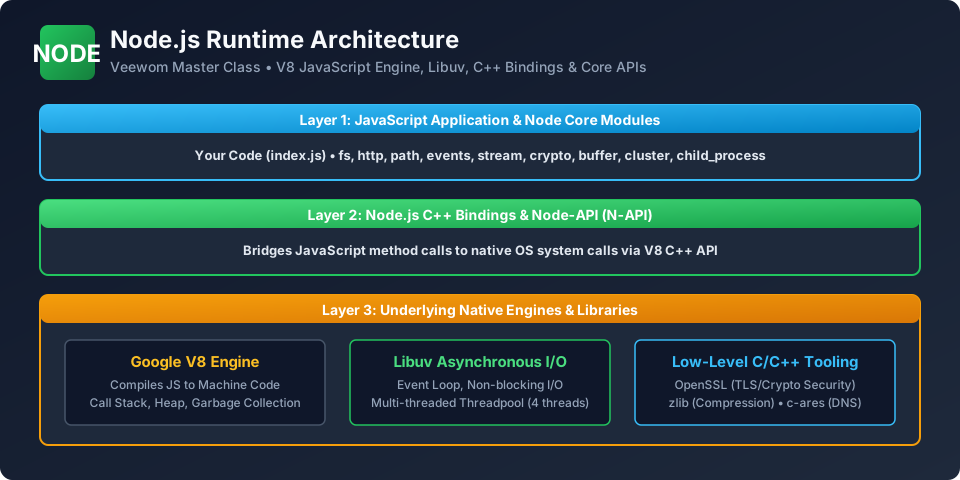
Key Highlights of This Node.js Tutorial Series
- Academics 100% University & BCA Aligned: Theoretical foundations, call stack diagrams, dry runs, university lab programs, and viva interview answers.
- Modern Node.js Latest LTS Standards: Native ESM (import/export), async/await, native fetch, WebStreams, worker_threads, and node:test framework.
- Enterprise Scale Production Architecture: Express REST API design, JWT auth, MongoDB/PostgreSQL, Redis caching, clustering, and Dockerization.
- 8 Visual Architecture SVG Diagrams: Clear visual representations of the Libuv Event Loop, backpressure, JWT auth flow, and PM2 load balancing.
- Practice & Interview Ready: 50+ solved BCA university lab assignments and 100+ technical interview questions with deep answers.
Node.js vs Traditional Backend Runtimes
To understand why Node.js is uniquely fast at handling I/O operations, review how it contrasts with thread-per-request architectures like Java or PHP:
| Feature | Node.js | Python (Django/Flask) | Java (Spring Boot) | PHP (Apache) |
|---|---|---|---|---|
| Concurrency Model | Single-threaded Event Loop + Libuv Thread Pool | Synchronous (WSGI) or Asynchronous (ASGI / asyncio) | Multi-threaded (One thread per HTTP request) | Process-per-request / Multi-process |
| I/O Model | Non-blocking Asynchronous I/O by default | Blocking by default (Async with asyncio) | Blocking I/O (NIO / Virtual Threads optional) | Synchronous Blocking I/O |
| Language Uniformity | JavaScript / TypeScript across full stack | Python (Backend only) | Java (Backend only) | PHP (Backend only) |
| Memory per Request | Extremely Low (~1 KB per connection socket) | Moderate | Higher (~1MB - 2MB per thread stack) | Moderate to High |
| Best For | Real-time chat, REST APIs, Streaming, Microservices | Data science, Machine Learning, CMS | Heavy enterprise transaction processing | Blogging platforms, CMS (WordPress) |
In university theory exams, examiners frequently ask: "Explain the difference between Synchronous and Asynchronous execution in Node.js with an example." Remember that synchronous calls (like fs.readFileSync) freeze the entire thread, halting all pending network requests until disk reading completes, whereas asynchronous calls (fs.readFile) delegate disk reading to the Libuv background thread pool and invoke a callback when complete.
Step-by-Step Learning Roadmap
- Fundamentals & Setup: Installation via NVM, REPL, package.json, npm scripts, and CommonJS vs ES Modules.
- Built-in Core Modules: Exploring
path,os,fs,events,stream,http, andcrypto. - Asynchronous Mastery: Mastering Promises,
async/await, and the inner mechanics of the Libuv Event Loop phases. - Web APIs & Express.js: Structuring enterprise RESTful APIs, router chaining, custom middleware, and error handling.
- Data Persistence: Connecting to MongoDB with Mongoose and relational databases (PostgreSQL/MySQL) with Prisma.
- Concurrency & Scaling: Offloading heavy computations using
worker_threads, clustering across CPU cores, and real-time WebSockets. - Production Security: JWT stateless authentication, password hashing with bcrypt, rate limiting, and CORS headers.
- Deployment & DevSecOps: Docker containerization, PM2 process management, and Nginx reverse proxy configuration.
Frequently Asked Questions (FAQ) - Student & Interview Review
Q1. What is Node.js and why should I learn it in 2026?
Q2. Is Node.js single-threaded or multi-threaded?
Q3. Is this Node.js tutorial suitable for BCA, B.Tech, and university students?
Q4. Which Node.js version is recommended for new projects in 2026?
Explore Related Node.js Tutorials & Next Steps
Boost your server-side JavaScript proficiency by studying these closely connected core modules:
Understand single-threaded execution, Libuv threadpool, and event-driven non-blocking I/O.
Install Node LTS via NVM, verify npm/npx, and configure VS Code.
Master require() vs import, package.json type module, and top-level await.
Design high-performance Express APIs with controllers, validation, and JSON replies.


You may also like this!
© Veewom.com. | Managed by PinePL
