
- Home
- Difference
- 3G vs 4G
Difference Between 3G And 4G Cellular Networks
Quick Summary: The transition from 3G (Third Generation) to 4G LTE (Long-Term Evolution) represents one of the most monumental leaps in mobile telecommunications history. While 3G relied on wide-area cell-based CDMA2000 and UMTS architectures with separate circuit-switched voice channels, 4G transitioned entirely to an All-IP packet-switched architecture utilizing OFDMA modulation. This delivered a 10x-50x boost in real-world throughput, sub-30ms latency, high-definition VoLTE voice calling, and paved the road for 5G New Radio (NR).
Understanding wireless network generations is essential for students in computer networks, telecommunications engineering, and mobile development. Below is the comprehensive comparison covering physical layer modulation, forward error correction (FEC), spectrum allocation, and core architecture.
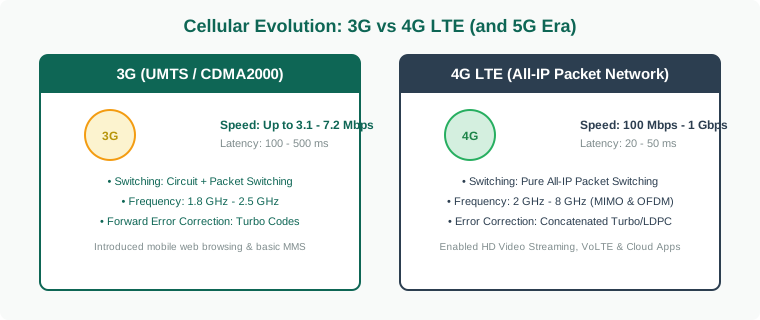
Evolution of Cellular Standards
Each generation of wireless communication standard represents a paradigm shift governed by the International Telecommunication Union (ITU) and 3GPP:
- 3G (IMT-2000): Introduced in the early 2000s to bring mobile web browsing, MMS, and basic video calling to cellphones through technologies like UMTS, HSPA, and EV-DO.
- 4G LTE (IMT-Advanced): Commercialized around 2010 to deliver true mobile broadband capable of streaming 1080p video, cloud gaming, and crystal-clear VoLTE calling with an all-IP flat core network (EPC).
- 5G (IMT-2020): The current generation engineered for massive IoT density, autonomous vehicles, and gigabit fiber-like speeds using Sub-6GHz and Millimeter Wave (mmWave) spectrum.
Detailed Side-by-Side Comparison: 3G vs 4G
FEATURES |
3G |
4G |
|---|---|---|
Data Throughput |
UP to 3.1Mbps With an average speed range between 0.5 to 1.5 Mbps. |
Practically speaking, 2 to 12 Mbps (Telstra in Australia claims up to 40 Mbps) but potential estimated at a range of 100 to 300 Mbps. |
Peak Upload Rate |
5 Mbps |
500 Mbps |
Switching Technique |
Packet Switching |
Packet Switching,Message Switching |
Network Architecture |
Wide Area Cell Based |
Integration of wireless LAN and Wide area. |
Services And Applications |
CDMA 2000, UMTS, EDGE etc |
Wimax2 and LTE-Advance |
Forward error correction (FEC) |
3G uses Turbo codes for error correction. |
Concatenated codes are used for error corrections in 4G. |
Peak Download Rate |
100 Mbps |
1 Gbps |
Frequency Band |
1.8 – 2.5 GHz |
2 – 8 GHz |
Typical Network Latency |
100 ms to 150 ms (noticeable lag during web surfing). |
20 ms to 40 ms (fluid video calls and multiplayer gaming). |
Voice Calling Mechanism |
Circuit-Switched Voice (data drops or throttles during a phone call). |
VoLTE (Voice over LTE) packet-based voice with concurrent high-speed data. |
Key Conceptual Takeaways
- All-IP Transition: 4G completely abolished dedicated circuit-switching hardware from the core network, standardizing on pure IP packets for both voice (VoLTE) and data.
- Spectral Efficiency: By adopting Orthogonal Frequency Division Multiple Access (OFDMA) and MIMO antenna arrays, 4G squeezed significantly more megabytes per megahertz of airwave spectrum.
- The 5G Next Step: While 4G maxes out around 1 Gbps, 5G scales up to 10-20 Gbps with sub-1ms ultra-reliable low-latency communication (URLLC).
Looking Ahead: 3G vs 4G vs 5G Quick Comparison
Here is how the cellular generations compare at a glance:
| Parameter | 3G (UMTS/HSPA) | 4G (LTE-A) | 5G (NR) |
|---|---|---|---|
| Peak Download Speed | 14 to 42 Mbps | 1 Gbps | 10 to 20 Gbps |
| Average Latency | 100 ms | 30 ms | < 1 ms |
| Modulation Scheme | WCDMA / QAM | OFDMA / SC-FDMA | OFDMA (Flexible Numerology) |
| Device Density | ~10,000 / km² | ~100,000 / km² | 1,000,000+ / km² |
| Status | Sunset / Decommissioned | Global Mainstream | Rapid Global Expansion |
Interactive Practice Session (MCQs)
1. What does the term "All-IP" mean in 4G LTE network architecture?
A) The network uses IP addresses only for billing
B) Both voice calls and data packets are routed exclusively using Internet Protocol (IP) packets
C) Users must manually enter an IP address to make phone calls
D) It only connects to websites written in HTML5
Explanation: Unlike 3G which required legacy circuit-switched networks for telephone calls, 4G routes voice as VoIP packets (VoLTE) across an All-IP core (Evolved Packet Core).
2. Which multiplexing technology enabled 4G LTE to achieve vastly superior spectral efficiency over 3G?
A) Frequency Modulation (FM)
B) Orthogonal Frequency Division Multiple Access (OFDMA)
C) Time Division Multiplexing (TDM)
D) Amplitude Shift Keying (ASK)
Explanation: OFDMA splits the radio carrier into hundreds of narrow orthogonal subcarriers, preventing interference and maximizing multi-user data throughput.
3. What Forward Error Correction (FEC) mechanism was famously introduced in 3G networks?
A) Parity Bits
B) Turbo Codes
C) MD5 Hashes
D) RSA Encryption
Explanation: 3G standardized Turbo codes, which approach the theoretical Shannon channel capacity limit for error correction over noisy wireless channels.
Viva Voce & Technical Interview Questions
Q1: Why are telecommunication carriers shutting down (sunsetting) 3G networks globally?
Answer: Telecom operators are sunsetting 3G to re-farm the valuable low-band and mid-band radio frequencies (such as 900 MHz, 1800 MHz, and 2100 MHz). Reallocating this spectrum to 4G LTE and 5G NR provides dramatically higher data speeds, capacity, and energy efficiency for millions of subscribers.
Q2: What is the role of MIMO in 4G LTE networks?
Answer: MIMO (Multiple-Input Multiple-Output) uses multiple transmit and receive antennas simultaneously. By exploiting spatial multiplexing, MIMO transmits separate data streams over the same radio channel, multiplying throughput without consuming extra frequency spectrum.
Q3: What is the difference between 4G LTE and 4G LTE-Advanced?
Answer: Standard LTE (Release 8) was originally classified as 3.9G because it fell slightly short of ITU's strict 1 Gbps IMT-Advanced definition. LTE-Advanced (Release 10) officially met the 4G standard by introducing Carrier Aggregation (combining multiple spectrum bands), 8x8 MIMO, and Relay Nodes.
Q4: How does 4G handle mobile voice calling without 2G/3G fallback?
Answer: Without legacy networks, 4G handles voice exclusively through VoLTE (Voice over LTE), which uses the IMS (IP Multimedia Subsystem) framework and SIP signaling to transmit prioritized voice packets with HD voice codecs (AMR-WB).
Q5: What is Network Slicing in 5G compared to 4G?
Answer: While 4G provides a one-size-fits-all network pipe, 5G network slicing uses software-defined networking (SDN) and network functions virtualization (NFV) to carve physical infrastructure into multiple dedicated virtual networks tailored for specific needs (e.g., one slice for autonomous cars needing 1ms latency, another for smart utility meters).
Related Difference Classes
Explore synchronized companion classes across our telecommunications and mobile series:
Frequently Asked Questions (FAQ)


You may also like this!
© Veewom.com. | Managed by PinePL
