
- Home
- Difference
- Android vs iOS
Difference Between Android and iOS Mobile Operating Systems
Quick Summary: Android (developed by Google) and iOS (developed by Apple) power over 99% of all smartphones globally. Android is an open-source, Linux-kernel-based operating system designed for hardware diversity, extensive personalization, and multi-vendor ecosystems running on the Android Runtime (ART). iOS is a proprietary, closed-source Unix/Darwin-based operating system engineered for vertical integration with Apple's custom silicon, delivering hardware-optimized performance, strict sandboxing, and unified software update delivery.
For computer science students and mobile engineers, understanding the architectural and philosophical divergence between Android and iOS is critical for choosing native tech stacks (Kotlin vs Swift), designing responsive UIs, and navigating app store distribution pipelines.
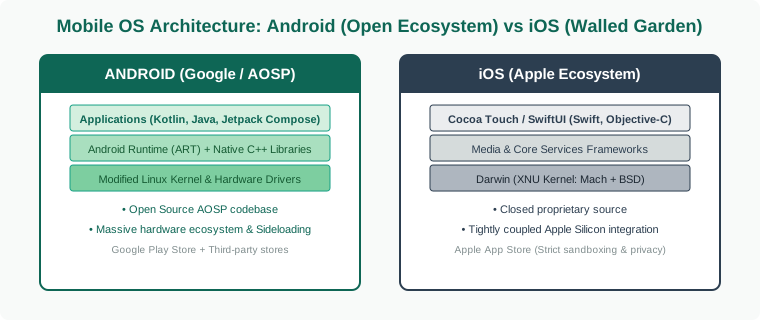
Core Architectural Philosophies
The differences between Android and iOS stem from their foundational philosophies:
- Google Android (AOSP): Built on the open-source Linux kernel. Google distributes the Android Open Source Project (AOSP), enabling hundreds of device manufacturers (Samsung, Xiaomi, Motorola) to build unique hardware with custom skins (One UI, HyperOS). Developers write code in Kotlin or Java, compiled to DEX bytecode and executed via the Android Runtime (ART) with profile-guided AOT and JIT compilation.
- Apple iOS: Engineered as a tightly integrated vertical product. Apple manufactures both the custom silicon (A-series Bionic chips) and the operating system (Darwin/XNU Mach kernel). Developers write in Swift or Objective-C, compiled Ahead-Of-Time (AOT) through the LLVM compiler into native ARM machine code with Automatic Reference Counting (ARC) memory management.
Detailed Side-by-Side Comparison: Android vs iOS
FEATURES |
ANDROID |
IOS |
|---|---|---|
Developer |
Google Inc. (Open Handset Alliance) |
Apple Inc. |
Initial Release |
September 23, 2008 (HTC Dream / T-Mobile G1) |
July 29, 2007 (iPhone OS 1.0) |
Source Model |
Open Source: Core OS is open source (AOSP) with proprietary Google Mobile Services (GMS). |
Closed Source: Proprietary with open-source kernel components (WebKit, Darwin). |
Customizability |
A lot. Can Change Almost Anything (launchers, default apps, custom ROMs, icon packs). |
Limited Unless Jailbroken (widgets, shortcuts, lock screen customization in recent versions). |
App Store |
Google Play Store (plus third-party stores: Galaxy Store, F-Droid, APK side-loading). |
Apple App Store (exclusive distribution; regional EU alternate marketplaces under DMA). |
Messaging |
Google Messages (RCS standard), historically Google Hangouts. |
iMessage (proprietary end-to-end encrypted protocol with RCS fallback). |
Video Chat |
Google Meet (formerly Google Hangouts / Duo). |
FaceTime (with web browser support for external platforms). |
OS Family |
Linux: Modified monolithic Linux kernel with Binder IPC. |
OS X, Unix: Darwin XNU hybrid kernel based on Mach and BSD. |
Programming in |
Kotlin (preferred modern standard), Java, C, C++ (via NDK). |
Swift (preferred modern standard), Objective-C, C, C++. |
Internet Browsing |
Google Chrome (Blink engine, supports third-party engines like Gecko). |
Mobile Safari (WebKit engine mandated for all iOS web browsers globally, EU exceptions). |
Voice Commands |
Google Assistant / Gemini AI (historically Google Now). |
Siri / Apple Intelligence. |
Maps |
Google Maps. |
Apple Maps. |
Languages |
100+ Languages (originally 32 languages in early releases). |
40+ Languages with extensive global regional localization. |
Version History & Evolution |
Evolved from Nougat 7.0 (2016) to modern Android 15 (Vanilla Ice Cream). |
Evolved from iOS 10.3.1 (2017) to modern iOS 18 with Apple Intelligence. |
Key Conceptual Takeaways
- Native vs Virtualized Execution: iOS compiles directly to native ARM machine instructions using Swift and LLVM, while Android executes DEX bytecode through the ART (Android Runtime) environment.
- Ecosystem Control: Apple commands total end-to-end integration across hardware, silicon, and software. Android offers unmatched hardware choice, price accessibility, and manufacturer diversity.
- Developer Choice: Learn Kotlin + Jetpack Compose for Android; learn Swift + SwiftUI for iOS. Cross-platform frameworks like Flutter and React Native allow single-codebase targeting of both.
Security & Sandboxing Architectures
Both operating systems implement state-of-the-art sandboxing mechanisms, but achieve security through different abstractions:
- Android Multi-User UID Sandboxing: Android assigns every installed application a unique Linux User ID (UID). Because the Linux kernel prevents user A from reading user B's process memory and files, Android apps are completely isolated from one another unless explicit Content Providers or IPC permissions are granted.
- iOS Seatbelt Sandboxing: In iOS, applications run under a common mobile user account, but the Darwin kernel enforces Mandatory Access Control (MAC) via Apple's Seatbelt sandbox profile. Each app is locked inside its own cryptographically sealed container directory (UUID path) with zero access to system files or other app containers.
Interactive Practice Session (MCQs)
1. Which execution runtime replaced the legacy Dalvik VM in Android?
A) Node.js
B) ART (Android Runtime)
C) JVM HotSpot
D) SpiderMonkey
Explanation: Android 5.0 (Lollipop) replaced the Dalvik JIT interpreter with ART (Android Runtime), introducing Ahead-Of-Time (AOT) compilation and advanced garbage collection for smoother performance.
2. What memory management technique is used by Swift in iOS applications?
A) Stop-the-world Garbage Collection
B) Automatic Reference Counting (ARC)
C) Manual malloc() and free() only
D) Mark-and-Sweep Heap Cleaner
Explanation: Swift uses ARC at compile time to automatically track and insert retain/release calls, freeing memory deterministically without background garbage collection pauses.
3. What is the fundamental IPC (Inter-Process Communication) mechanism used in Android?
A) Named Pipes
B) Binder Driver
C) Apple Mach Messages
D) Shared Memory RAM
Explanation: Android relies on a specialized Linux kernel driver called Binder to perform high-speed, secure RPC/IPC between apps, system services, and background activities.
Viva Voce & Technical Interview Questions
Q1: What is the main cause of UI frame drops (stutter) on Android compared to iOS?
Answer: On iOS, the UI rendering thread runs at the highest real-time priority in the Darwin kernel, guaranteeing immediate response to touch gestures. In earlier Android versions, UI rendering shared priority with background GC threads and event loops, leading to frame drops. Modern Android has largely solved this via dedicated RenderThread and Vulkan graphics rendering.
Q2: What is the Android NDK and when should mobile developers use it?
Answer: The NDK (Native Development Kit) allows Android developers to write performance-critical modules in C or C++. It is widely used in 3D game engines (Unreal, Unity), real-time audio synthesis, computer vision (OpenCV), and cryptographic algorithms to bypass ART runtime overhead.
Q3: How do Android and iOS handle background tasks differently?
Answer: Android provides flexible background processing via WorkManager, Foreground Services (with persistent notification), and BroadcastReceivers. iOS enforces strict background limitations via BGTaskScheduler, suspending apps almost immediately after they lose focus unless they belong to specific background modes (audio, navigation, VoIP).
Q4: What is the difference between Dalvik Bytecode (.dex) and Java Bytecode (.class)?
Answer: Standard Java bytecode is designed for stack-based execution engines. Android's Dalvik Executable (DEX) bytecode is designed for a register-based virtual machine, reducing instruction counts and memory consumption on mobile hardware.
Q5: What are the main modern declarative UI frameworks for Android and iOS?
Answer: Android modern UI is built using Jetpack Compose (declarative Kotlin UI toolkit). iOS modern UI is built using SwiftUI (declarative Swift UI toolkit). Both frameworks eliminate imperative XML/Storyboard layouts in favor of reactive state-driven code.
Related Difference Classes
You have completed the full 16-class Difference curriculum! Explore other synchronized classes:
Frequently Asked Questions (FAQ)


You may also like this!
© Veewom.com. | Managed by PinePL
