
- Home
- Difference
- C vs C++
Differences Between C and C++ Programming Languages
Quick Summary: C is a structural, procedural programming language created by Dennis Ritchie in 1972 at Bell Labs focused on functions, step-by-step logic, and raw memory access. C++ was created by Bjarne Stroustrup in 1979 as an extension ("C with Classes"), introducing Object-Oriented Programming (OOP), strong type safety, operator overloading, virtual functions, and the Standard Template Library (STL).
Both C and C++ are foundational pillars of computer science, operating systems, compiler construction, and embedded systems. While C++ retains high backwards compatibility with C syntax, the design philosophy of both languages represents two distinct programming paradigms: Procedural Decomposition versus Object-Oriented Modeling.
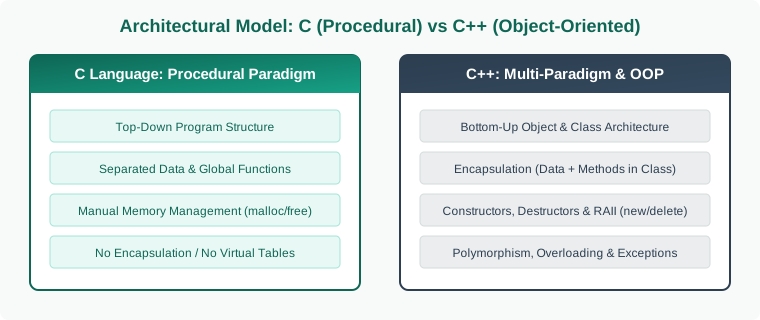
Comprehensive Comparison: C vs C++
Below is the detailed side-by-side comparison highlighting key architectural, syntax, and operational differences between C and C++:
C PROGRAMMING |
C++ PROGRAMMING |
|---|---|
Programming Paradigm: C is a purely Procedural / Structured programming language focused on functions and algorithms. |
Programming Paradigm: C++ is a Multi-Paradigm language supporting Object-Oriented (OOP), Procedural, and Generic programming. |
Virtual Functions: No virtual functions or runtime dynamic polymorphism are present in C. |
Virtual Functions: Virtual functions and virtual method tables (vtable/vptr) provide runtime polymorphism in C++. |
Operator Overloading: Operator overloading is not possible in C; operators have fixed built-in definitions. |
Operator Overloading: Operator and function overloading are core features in C++, allowing user-defined types to redefine operator behavior. |
Program Design Approach: Top-down approach is used in program design (breaking complex tasks into smaller functions). |
Program Design Approach: Bottom-up approach is adopted in program design (building reusable classes and objects that interact). |
Global Variable Declarations: Multiple tentative declarations of global variables are allowed without an explicit |
Global Variable Declarations: Multiple declarations of global variables in the same scope are strictly prohibited in C++ (violates One Definition Rule). |
Data and Function Mapping: Mapping between data and functions is difficult and complicated because data is separated from functions. |
Data and Function Mapping: Data and functions are seamlessly bound together within "Objects" via Encapsulation. |
Calling |
Calling |
Variable Declaration Scope: Standard C (C89/C90) requires all variables to be declared at the beginning of a block/scope before executable statements. |
Variable Declaration Scope: C++ allows variable declarations anywhere in the scope, right at the point of first use. |
Data Types Supported: Supports built-in primitive data types and |
Data Types Supported: Supports built-in primitive types as well as rich user-defined data types (classes with methods, constructors, destructors). |
Exception Handling: In C, structured exception handling is absent; error handling relies on return error codes, |
Exception Handling: C++ provides built-in structured exception handling using |
Memory Management: Dynamic memory is managed via runtime library functions: |
Memory Management: Managed via language operators: |
Standard I/O Streams: Uses formatted functions from |
Standard I/O Streams: Uses type-safe stream objects from |
Namespaces: C lacks namespace support, causing global symbol name collisions in large software libraries. |
Namespaces: C++ includes |
Side-by-Side Code Example: C vs C++
Notice how C requires standalone functions to manipulate a struct, whereas C++ packages both state and behavior into an encapsulated class with access control:
1. Procedural Approach in C
#include <stdio.h>

/* C Structure: Only holds data, no methods */
struct Student {
    int rollNumber;
    float marks;
};

/* Standalone function to display data */
void displayStudent(struct Student s) {
    printf("Roll: %d | Marks: %.2f\n", s.rollNumber, s.marks);
}

int main() {
    struct Student s1; /* struct keyword mandatory unless typedef used */
    s1.rollNumber = 101;
    s1.marks = 88.5f;
    displayStudent(s1);
    return 0;
}
2. Object-Oriented Approach in C++
#include <iostream>

// C++ Class: Encapsulates private attributes with public methods
class Student {
private:
    int rollNumber;
    float marks;

public:
    // Constructor initializes state automatically
    Student(int r, float m) : rollNumber(r), marks(m) {}

    // Member function bound directly to the object
    void display() const {
        std::cout << "Roll: " << rollNumber << " | Marks: " << marks << std::endl;
    }
};

int main() {
    Student s1(101, 88.5f); // Automatically calls constructor
    s1.display();
    return 0;
}
Key Takeaways for Students & Developers:
- Choose C when: You are writing operating system kernels (Linux kernel), hardware device drivers, deeply embedded microcontrollers with minimal RAM, or high-performance C-API libraries.
- Choose C++ when: You are developing large-scale desktop software, game engines (Unreal Engine), real-time graphics (OpenGL/DirectX), financial high-frequency trading platforms, or GUI applications where OOP and STL algorithms shine.
Practice Session & Self-Assessment Quiz
Test your conceptual understanding of C vs C++ with these university and competitive exam questions:
Q1: Which of the following is valid in C but results in a compilation error in standard C++?
Click to Reveal Answer & Explanation
Correct Answer: B
In C, void* is automatically converted to any other pointer type. In C++, implicit conversion from void* to typed pointers is disallowed to guarantee type safety; you must write int *p = (int*)malloc(sizeof(int)); or preferably use new int;.
Q2: Why does C not support function overloading?
Click to Reveal Answer & Explanation
Correct Answer: A
C++ uses name mangling (encoding function parameter types into the symbol name) so the linker can identify multiple functions with the same name. C saves the symbol name unmodified, preventing two functions from sharing a name.
Q3: What happens when new operator fails to allocate memory in C++ by default?
Click to Reveal Answer & Explanation
Correct Answer: C
Unlike C's malloc() which returns NULL on failure, C++'s standard new operator throws a std::bad_alloc exception unless std::nothrow is explicitly supplied.
Top Viva & Technical Interview Questions
1. What is the fundamental difference between a struct in C and a struct in C++?
In C, a struct can only contain data members (variables) and cannot contain member functions or access specifiers (public/private). In C++, a struct is identical to a class, with the only distinction being that its members and base classes are public by default, whereas in a class they are private by default.
2. What is RAII and why does it exist in C++ but not in C?
RAII stands for Resource Acquisition Is Initialization. In C++, when an object leaves its scope, its destructor is automatically called by the runtime, ensuring files, mutexes, and dynamic memory are safely freed. Because C lacks constructors and destructors, resource cleanup must be performed manually.
3. What is the purpose of extern "C" in C++?
extern "C" informs the C++ compiler to disable name mangling for specific function declarations, allowing C++ code to link directly with compiled C object code or legacy C libraries.
Frequently Asked Questions (FAQs)
Can C code compile directly in a C++ compiler?
Most valid C code will compile, but C++ enforces stricter type rules, eliminates implicit conversion from void*, and introduces new reserved keywords (such as class, new, delete, template) that cannot be used as variable identifiers.
Why does C run slightly faster than C++ in certain micro-benchmarks?
C code has virtually zero runtime abstraction overhead. C++ can match C's performance ("zero-overhead abstraction"), but features like virtual tables (dynamic dispatch), runtime type information (RTTI), and exception table unwinding can introduce minor latency if not compiled with optimizations.
Is C a subset of C++?
C is largely an ancestor and near-subset of C++, but strictly speaking, neither is a complete subset of the other. C allows multiple global variable declarations and implicit void pointer casts that modern C++ compilers strictly reject.
Related Difference Classes to Explore


You may also like this!
© Veewom.com. | Managed by PinePL
