
- Home
- Difference
- PHP vs ASP
Differences Between PHP and ASP / ASP.NET
Quick Summary: PHP (Hypertext Preprocessor) is an open-source, server-side scripting language created by Rasmus Lerdorf in 1995 that powers over 75% of the web (including WordPress and Laravel). ASP.NET (originally Active Server Pages by Microsoft, now modern ASP.NET Core) is a compiled web framework running on the .NET Common Language Runtime (CLR) designed for high-performance enterprise web applications.
When creating dynamic websites and enterprise web portals, developers frequently debate whether to choose the LAMP-stack ubiquity of PHP or the statically typed power of Microsoft's ASP.NET ecosystem. Below is an exhaustive breakdown preserving original foundational concepts while highlighting modern cloud architectures.
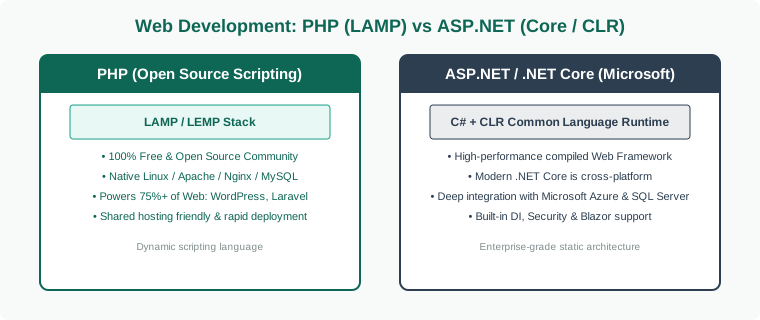
Side-by-Side Comparison: PHP vs ASP / ASP.NET
PHP |
ASP / ASP.NET |
|---|---|
Open Source & Licensing: PHP is 100% free and open-source technology maintained by a massive global community with zero licensing fees. |
Open Source & Licensing: Classic ASP and legacy ASP.NET were proprietary Microsoft technologies tied to Windows Server licenses; modern ASP.NET Core is open source under the MIT license. |
Language vs Platform: PHP is a standalone server-side scripting language specifically engineered for dynamic web page generation. |
Language vs Platform: ASP.NET is a comprehensive web application framework in which languages such as C#, F#, or VB.NET can be used to build web applications. |
Initial Release & Creator: PHP was created and released by Rasmus Lerdorf in 1995 (originally Personal Home Page tools). |
Initial Release & Creator: Classic ASP was launched by Microsoft in 1996, followed by ASP.NET in 2002, and cross-platform .NET Core in 2016. |
Database Integration: PHP works natively and exceptionally well with open-source relational databases like MySQL and MariaDB, which are completely free. |
Database Integration: ASP.NET traditionally integrates seamlessly with Microsoft SQL Server (MS-SQL), though modern Entity Framework Core supports PostgreSQL, MySQL, and SQLite. |
Operating System & Hosting: Runs natively on Linux (LAMP stack), FreeBSD, macOS, and Windows. Inexpensive shared hosting is available globally. |
Operating System & Hosting: Classic ASP requires Windows Server and IIS; modern ASP.NET Core runs cross-platform on Linux, Docker, and Windows. |
Syntax Origin: PHP syntax is directly influenced by C, C++, and Perl (using |
Syntax Origin: Classic ASP used VBScript; modern ASP.NET applications predominantly use C#, which features structured object-oriented syntax akin to Java and C++. |
Execution Model: Interpreted scripting language with opcode caching (OPcache) and optional JIT compilation in PHP 8+. |
Execution Model: Pre-compiled or JIT-compiled into intermediate language (CIL) executed at near-native CPU speeds on the .NET CLR runtime. |
Popular Ecosystem & CMS: Powers WordPress, Drupal, Joomla, Laravel, Symfony, and WooCommerce. |
Popular Ecosystem & CMS: Powers enterprise line-of-business portals, Blazor interactive web apps, Sitecore, and Umbraco CMS. |
Code Comparison: Server-Side Request Handling
1. PHP Code (Procedural / Scripting)
<?php
// PHP: Embedded directly in HTML or API script
$visitorName = $_GET['name'] ?? 'Student';
$currentTime = date('Y-m-d H:i:s');

echo "<h3>Welcome to Veewom Difference Series, $visitorName!</h3>";
echo "<p>Server timestamp: $currentTime</p>";
?>
2. ASP.NET Core C# Controller
// ASP.NET Core: Strongly typed C# Controller
using Microsoft.AspNetCore.Mvc;

namespace VeewomApp.Controllers {
    [ApiController]
    [Route("api/[controller]")]
    public class GreetingController : ControllerBase {
        [HttpGet]
        public IActionResult GetGreeting([FromQuery] string name = "Student") {
            var response = new {
                Message = $"Welcome to Veewom Difference Series, {name}!",
                Timestamp = System.DateTime.UtcNow
            };
            return Ok(response);
        }
    }
}
Decision Framework:
- Choose PHP when: You are launching a content-driven website, blog, e-commerce storefront with WordPress/WooCommerce, or building a rapid startup backend using the Laravel framework on affordable Linux hosting.
- Choose ASP.NET when: You are building high-throughput financial backends, corporate enterprise intranets with Active Directory integration, microservices with Azure cloud deployment, or need strict C# compile-time type verification.
Practice Session & Self-Assessment Quiz
Q1: Which popular Content Management System (CMS) is written entirely in PHP?
Click to Reveal Answer & Explanation
Correct Answer: A
WordPress is the world's most popular CMS, written entirely in PHP and paired with MySQL databases, currently powering over 40% of all websites on the internet.
Q2: What is the primary execution runtime for ASP.NET applications?
Click to Reveal Answer & Explanation
Correct Answer: A
The Common Language Runtime (CLR) is Microsoft's virtual machine component that manages memory, garbage collection, and Just-In-Time compilation for all .NET code.
Q3: How does modern ASP.NET Core differ fundamentally from legacy ASP.NET 4.x?
Click to Reveal Answer & Explanation
Correct Answer: A
ASP.NET Core was completely re-architected from the ground up as a lean, open-source, modular framework capable of running natively on Linux, Docker, and macOS.
Top Viva & Technical Interview Questions
1. What does the acronym LAMP stand for in web development?
LAMP is the classic open-source web stack: Linux (Operating System), Apache (Web Server), MySQL / MariaDB (Database Management System), and PHP (Server-Side Scripting Language).
2. What is Blazor in ASP.NET Core?
Blazor is a cutting-edge feature in ASP.NET Core that enables developers to build rich, interactive Single-Page Applications (SPAs) using C# instead of JavaScript, running either on the server or in the browser via WebAssembly.
3. What is OPcache in PHP?
OPcache improves PHP performance by storing precompiled script bytecode in shared memory, eliminating the repetitive step of reading, parsing, and compiling PHP scripts on every HTTP request.
Frequently Asked Questions (FAQs)
Is PHP becoming obsolete?
Not at all. With the release of PHP 8.0, 8.1, 8.2, and 8.3 featuring JIT compilation, typed properties, and modern frameworks like Laravel, PHP continues to power over three-quarters of all websites with top-tier performance.
Can ASP.NET Core run in Docker containers?
Yes. Microsoft publishes official multi-platform Docker container images for ASP.NET Core based on lightweight Linux distributions (such as Alpine and Debian), enabling lightning-fast microservice deployment in Kubernetes.
Which language is easier to learn for BCA / CS college students?
PHP is generally easier for beginners because it requires minimal environment setup (XAMPP or WampServer), allows immediate code editing, and integrates directly into HTML without requiring complex project scaffolding.
Related Difference Classes to Explore


You may also like this!
© Veewom.com. | Managed by PinePL
