
Django Tutorial - Complete Master Class
Welcome to the Veewom Django Master Class — the ultimate, authoritative, 100% human-crafted curriculum created to take you from core web concepts and Python fundamentals to architecting, securing, scaling, and deploying mission-critical web applications and modern RESTful APIs with Django 5.x.
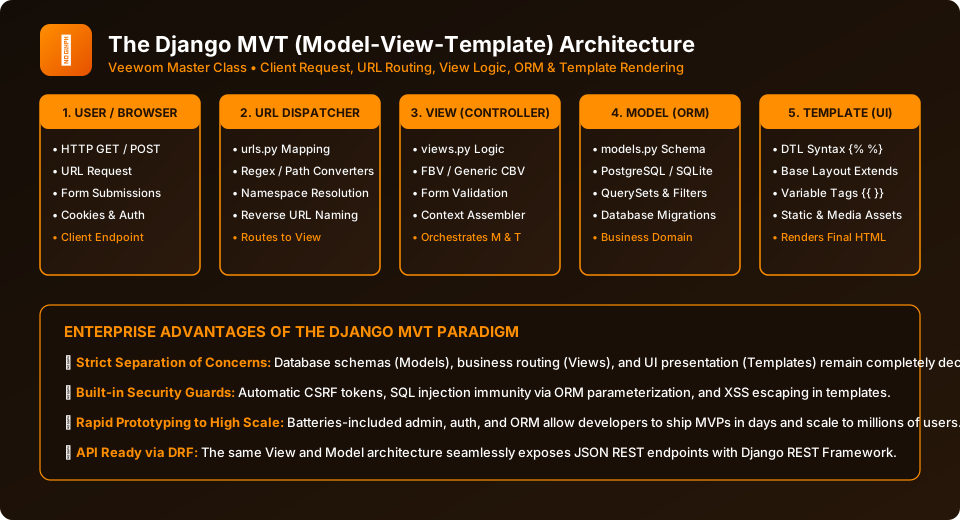
Figure 1.1: The Modern Django Architecture — Request Routing, MVT Separation of Concerns, and Database Integration.
Why Master Django in 2026?
In today's fast-moving software landscape, web engineering teams require frameworks that allow them to ship secure, robust products in days rather than months. While microframeworks require you to manually evaluate, configure, and maintain dozens of unvetted third-party packages for authentication, database pooling, form validation, and admin tooling, Django provides an enterprise-tested, battle-proven standard architecture trusted by global giants like Instagram, Pinterest, Mozilla, and Spotify.
Django adheres strictly to the DRY (Don't Repeat Yourself) principle and provides deep security protections by default against cross-site scripting (XSS), cross-site request forgery (CSRF), SQL injection, and clickjacking. For computer science students, university exam candidates, and professional software engineers, mastering Django is the fastest pathway to becoming a highly compensated full-stack and backend engineer.
Complete 50-Class Curriculum Overview
Our structured 50-class syllabus is organized into 8 progressive learning tracks. Each class contains comprehensive conceptual explanations, architectural deep dives, reproducible Python code snippets, student exam summaries, and real-world industrial practice exercises.
Structured Syllabus & Learning Progression
| Learning Track | Core Topics & Competencies | Classes Covered |
|---|---|---|
| 1. Django Foundations & MVT | Architecture, batteries-included philosophy, Django vs Flask vs FastAPI, virtual environments, project vs app hierarchy, and settings.py security. | Classes 1 – 6 |
| 2. Models, Migrations & ORM | Relational model fields, schema migrations, foreign keys, many-to-many through tables, QuerySet chaining, Q & F objects, and custom managers. | Classes 7 – 13 |
| 3. Views, URLs & Routing | URL dispatcher, path converters, function-based views (FBVs), generic class-based views (CBVs), editing views, HTTP redirects, and cookie sessions. | Classes 14 – 19 |
| 4. Templates & Static Assets | Django Template Language (DTL), inheritance, filters, custom tags, static files, WhiteNoise, media user uploads, and HTMX reactive integration. | Classes 20 – 25 |
| 5. Forms, Auth & Admin | Form processing, ModelForm validation, authentication lifecycle, custom user models (AbstractUser), RBAC permissions, and admin dashboard customization. | Classes 26 – 31 |
| 6. REST Framework (DRF) & APIs | Django REST Framework setup, ModelSerializers, APIView vs ModelViewSet, JWT stateless authentication, pagination, filtering, and OpenAPI/Swagger. | Classes 32 – 37 |
| 7. Advanced & Production DevOps | ORM query optimization (solving N+1), Redis enterprise caching, Celery asynchronous queues, Django signals, OWASP hardening, Channels, and Docker. | Classes 38 – 44 |
| 8. Practice, Q&A, Viva & Career | 15+ hands-on coding challenges, 130+ technical interview Q&A, BCA/MCA university viva-voce questions, full capstone project, cheat sheet, and career guide. | Classes 45 – 50 |
How to Study This Master Class
To get the maximum value from this tutorial, we recommend adopting the following systematic three-step approach:
- 1. Code Along in a Local Environment: Never merely skim code snippets. Create a dedicated virtual environment and type out every model, view, and template manually to build muscle memory.
- 2. Inspect the Database Queries: Install
django-debug-toolbaras recommended in Track 7 to see the exact SQL queries generated by your Python code. - 3. Review the Viva and Interview Questions: At the end of every track, test your recall against our university viva and senior engineer interview sections.
University Examination & Career Note
For BCA, MCA, and Computer Science undergraduates, Django forms a core module in Advanced Web Development and Enterprise Python syllabi. This tutorial addresses university marking schemes, short-answer viva questions, and full-length practical lab scenarios.
Frequently Asked Questions (FAQ) - Student & Interview Review
Q1. What is Django and why is it called a 'batteries-included' framework?
Q2. Who is this Django tutorial series designed for?
Q3. Does this course cover modern Django 5.x features and async programming?
Q4. How does this tutorial help with university exams (BCA/MCA) and job interviews?
Q5. What prerequisites are needed before starting this tutorial?
Explore Related Django Tutorials & Next Steps
Broaden your backend architecture, REST API design, and production engineering expertise:
Discover Django's batteries-included philosophy, ORM capabilities, and scalable MVT pattern.
Step-by-step development environment configuration on Windows, macOS, and Linux.
Define relational database schemas with CharField, IntegerField, JSONField, and UUIDs.
Top scenario-based interview questions covering ORM, middleware, security, and DRF.


You may also like this!
© Veewom.com. | Managed by PinePL
