
Data Science Tutorial - Complete Master Class
Welcome to the Veewom Data Science Master Class — the ultimate, authoritative, 100% human-written curriculum designed to take you from foundational mathematics and Python programming to building, scaling, and deploying state-of-the-art predictive models and high-performance data web applications.
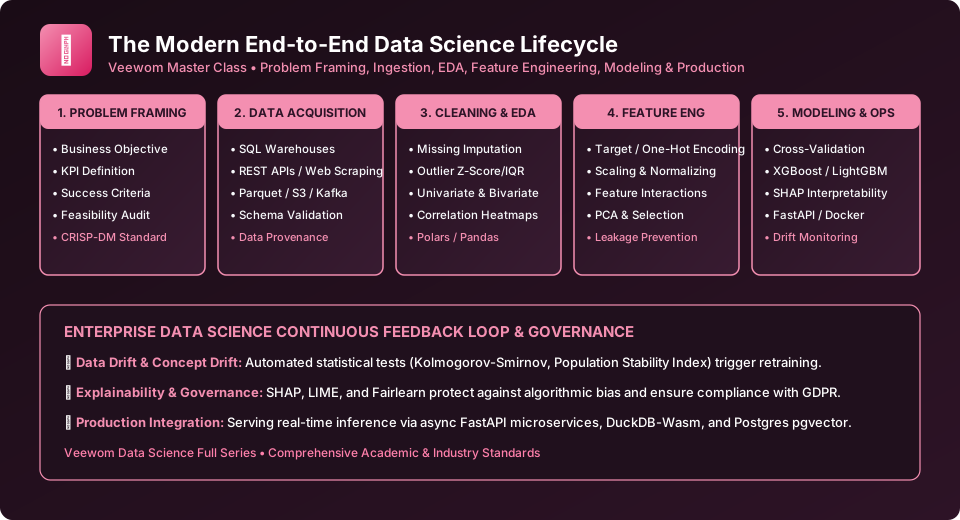
Figure 1.1: The Modern End-to-End Data Science Lifecycle — From Business Problem Framing to Production Inference.
Why Learn Data Science in 2026?
In modern technology stacks, raw data is generated at an astronomical velocity from IoT sensors, cloud telemetry, mobile clicks, e-commerce transactions, and generative AI logs. However, raw data by itself provides zero business value unless it is systematically cleaned, analyzed, modeled, and transformed into high-impact operational decisions.
Data Science bridges the gap between raw data collection and high-level strategy. As organizations transition towards autonomous decision engines, real-time personalization, and predictive automation, data scientists and data-savvy web developers command unmatched industry demand, high salaries, and global career opportunities.
Complete 50-Class Curriculum Overview
Our structured 50-class syllabus is organized into 8 progressive learning tracks. Each class contains comprehensive conceptual explanations, mathematical derivations, reproducible Python/SQL code snippets, student exam summaries, and real-world industrial practice exercises.
Structured Syllabus & Learning Progression
| Learning Track | Core Topics & Competencies | Classes Covered |
|---|---|---|
| 1. Foundations & Statistics | Data science lifecycle (CRISP-DM), tooling (Jupyter, Colab, VS Code), descriptive statistics, probability distributions, hypothesis & A/B testing. | Classes 1 – 6 |
| 2. Math & Linear Algebra | Vectors, matrices, dot products, eigenvalues, SVD, multivariate calculus, experimental design, Bayesian inference, and GDPR data ethics. | Classes 7 – 12 |
| 3. Ingestion & SQL Analytics | Parquet, Feather, JSON, web scraping, API extraction, SQL joins, advanced window functions, retention cohorts, funnels, and MongoDB NoSQL. | Classes 13 – 18 |
| 4. Python & Polars Wrangling | NumPy vectorization, Pandas indexing & GroupBy, Polars lightning-fast engine, missing value imputation, outlier detection, and feature scaling. | Classes 19 – 24 |
| 5. EDA & Visualization | Univariate/bivariate EDA frameworks, Matplotlib, Seaborn, interactive Plotly charts, time-series analysis, GeoPandas, and Streamlit dashboards. | Classes 25 – 30 |
| 6. Predictive Modeling & ML | Cross-validation, data leakage prevention, Ridge/Lasso regression, customer churn classification, ROC-AUC, RFM K-Means, and SHAP explainability. | Classes 31 – 36 |
| 7. Big Data & Web Dev | Hadoop/Spark architecture, PySpark DataFrames, BigQuery, Snowflake, Airflow, FastAPI REST APIs, DuckDB-Wasm in-browser, and pgvector search. | Classes 37 – 44 |
| 8. Labs, Viva & Career | 12+ hands-on practical labs, 130+ technical interview questions, university viva guide, end-to-end capstone project, cheat sheet, and freelancing guide. | Classes 45 – 50 |
The Modern Data Science Competency Triangle
To succeed as a modern professional, you must cultivate balanced expertise across three interconnected pillars:
- Mathematical & Statistical Rigor: Understanding standard deviations, hypothesis testing, linear projections, and loss minimization prevents dangerous misinterpretations of data and spurious correlations.
- Software Engineering & Data Wrangling: Writing clean, maintainable, vectorized Python/SQL code, automating ETL pipelines, and handling edge cases with missing or corrupt records.
- Business Domain & Communication: Translating executive business challenges into quantifiable data problems, measuring financial ROI, and presenting actionable narratives through interactive dashboards.
How to Get the Most Out of This Tutorial
Follow each class sequentially. We strongly recommend setting up a local Python 3.12+ environment or Google Colab notebook and running every code example hands-on. At the end of each track, test your understanding against the provided BCA exam review questions and interview challenges.
University & BCA Student Note
This tutorial series strictly aligns with modern computer science, BCA, and MCA university syllabi across major academic institutions. Essential theoretical questions, standard viva-voce queries, and practical laboratory exercises are highlighted throughout the course.
Frequently Asked Questions (FAQ) - Student & Interview Review
Q1. What is Data Science and why is it essential today?
Q2. Who is this Data Science tutorial designed for?
Q3. What programming languages and tools will I master?
Q4. Are mathematical and statistical foundations covered?
Q5. How does this course prepare students for university exams and interviews?
Explore Related Data Science Tutorials & Next Steps
Broaden your statistical analysis, Python data wrangling, and production engineering expertise:
Understand the end-to-end 6-stage lifecycle from business problem framing to production.
Master the mathematical foundations of summary statistics, IQR, and dispersion.
Practical hands-on guide to DataFrame slicing, filtering, and data manipulation in Python.
Apply real-world data science skills on customer churn, house prices, and fraud datasets.


You may also like this!
© Veewom.com. | Managed by PinePL
