Protecting Client-Side JavaScript in Production Environments
JavaScript is an interpreted language that runs openly inside client web browsers, Node.js runtimes, Electron desktop wrappers, and mobile WebViews. Because JavaScript source code must be downloaded to the client machine to execute, any visitor can right-click, open browser Developer Tools, and inspect your proprietary business algorithms, licensing logic, internal REST endpoints, and custom UI components.
The Veewom JavaScript Obfuscator applies multi-pass compiler transformations to safeguard your intellectual property. By combining Abstract Syntax Tree (AST) restructuring, lexical token mangling, control flow flattening, string array encryption, and anti-tamper mechanisms, our tool makes reverse engineering computationally impractical and prohibitively expensive for unauthorized third parties.
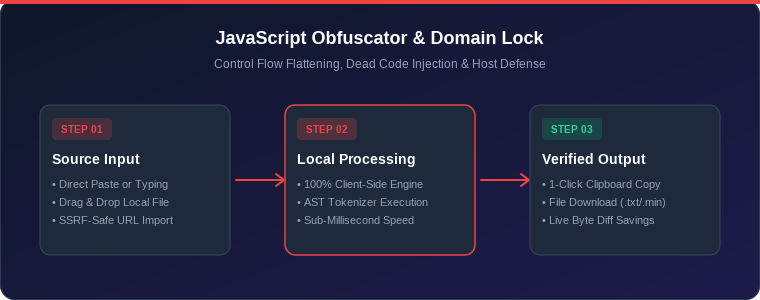
How Advanced Obfuscation Transforms JavaScript Code
Unlike primitive variable scramblers that simply rename `myVar` to `a`, professional obfuscation fundamentally alters code topology while maintaining exact runtime parity:
- Control Flow Flattening: Reorganizes sequential logic, loops, and conditional branches into complex state-machine switch statements. Rather than reading top-to-bottom, execution jumps dynamically between states controlled by an internal state variable, confounding automated decompilers.
- String Array Extraction & Encryption: Scans the entire AST for string literals (such as API keys, error strings, URLs, and object properties), extracts them into a centralized shuffled array, and replaces occurrences with cryptographic accessor functions encoded with Base64 or RC4.
- Dead Code Injection: Injects structurally valid but functionally inert code blocks and false branches into the execution graph, misleading reverse engineers and slowing down automated de-obfuscation algorithms.
- Self-Defending & Anti-Tampering: Embeds runtime verification hooks that detect code formatting. If an attacker attempts to pretty-print or alter the file, the self-defending mechanism enters a protective state, freezing execution or throwing stack overflow traps.
- Domain Locking: Locks script execution strictly to your authorized domain names (e.g.
veewom.com). If stolen and deployed on a competitor's domain, the script halts execution automatically. - Debug Protection: Injects debugger evasion routines that freeze browser Developer Tools if the user attempts to inspect breakpoints or profile memory allocations.
Code Transformation Showcase: Clean vs. Armored JavaScript
Compare how transparent, readable licensing logic is converted into resilient, tamper-resistant obfuscated code:
function verifyLicense(user, key) {
  const secretHash = "vw_2026_auth_sig";
  if (key.startsWith("VW-") && key.length === 16) {
    return { active: true, user: user };
  }
  return { active: false, reason: "Invalid" };
}(function(_0x1a2b,_0x3c4d){const _0x5e=_0x1a2b();while(!![]){try{const _0x6f=-parseInt(_0x5e(0x1a4))/0x1+parseInt(_0x5e(0x1a7))/0x2;if(_0x6f===_0x3c4d)break;else _0x5e['push'](_0x5e['shift']());}catch(_0x7a){_0x5e['push'](_0x5e['shift']());}}}(_0x8b9c,0x4f12));function verifyLicense(_0x4e,_0x2f){const _0x1c=_0x8b9c;...}Production Deployment Best Practices
- Never Obfuscate Server-Side Node.js Code Unnecessarily: Node.js backend files remain on your secure server and are not exposed to the public. Reserve obfuscation for frontend bundles, SDK distributions, Electron desktop apps, and WebView containers.
- Keep Original Source Files in Private Version Control: Never deploy obfuscated code to your team Git repository. Always keep formatted, human-readable source code in your private repository and apply obfuscation as the final build step before deployment.
- Select the Balanced Preset for Web Apps: While Maximum Protection provides impenetrable defense, the additional control flow overhead can impact mobile rendering. The Balanced preset provides optimal security with zero noticeable user latency.
- Pair Obfuscation with Server-Side Authorization: Obfuscation protects intellectual property and deters scrapers, but sensitive financial calculations and master secrets must always be validated on a secure backend server.
Frequently Asked Questions
What is JavaScript obfuscation and how does it protect my intellectual property?
JavaScript obfuscation is an automated compilation technique that transforms human-readable source code into an equivalent, highly complex, and cryptic binary-like text format without changing its runtime execution behavior. It protects proprietary commercial software, licensing algorithms, and API endpoints by mangling variable names, scrambling execution flow with state-machine dispatch loops, encrypting string literals, and injecting self-defending anti-tamper guards.
How does the Domain Lock feature prevent script theft?
When you configure allowed domain names (e.g., "veewom.com, clientdomain.com"), the obfuscator embeds cryptographic host-checking logic that inspects window.location.hostname at runtime. If an unauthorized third party scrapes or hotlinks your JavaScript file and attempts to execute it on a foreign hostname, the script immediately halts execution or triggers an infinite defensive loop, rendering the stolen code useless.
What is the Self-Defending mechanism and how does it prevent pretty-printing?
Self-defending injects runtime code-integrity monitors into the script. If an attacker opens Chrome DevTools and attempts to format (pretty-print) the obfuscated script or tamper with string array lookups, the self-defending mechanism detects the modified whitespace signature and throws memory exhaustion traps or freezes execution, completely frustrating reverse-engineering attempts.
What is Control Flow Flattening and how does it obscure program logic?
Control flow flattening decomposes basic sequential loops, if-else branches, and function bodies into randomized switch statements governed by an internal state variable. While the code computes identical mathematical results, automated decompilers and human analysts cannot reconstruct the original chronological control flow graph.
Will obfuscation increase my JavaScript file size or slow down execution?
Yes, advanced protections like string array encoding, dead code injection, and control flow flattening introduce additional structural code that typically increases byte size by 50% to 150%. For optimal performance, we recommend our "Balanced" preset, which delivers enterprise-grade protection while maintaining smooth 60fps browser execution.
Can obfuscated JavaScript be 100% de-obfuscated or reversed?
Because all client-side JavaScript must ultimately be interpreted by the browser CPU, a highly determined reverse engineer with specialized dynamic analysis sandboxes can theoretically trace memory allocations. However, multi-layered obfuscation raises the technical barrier so high that 99.9% of casual scrapers, competitors, and script copycats are completely deterred.