About Veewom URL Encoder / Decoder
Uniform Resource Identifiers (URIs) and URLs rely on a restricted subset of the US-ASCII character set. Characters such as spaces, question marks `?`, ampersands `&`, slashes `/`, and equal signs `=` have reserved syntactic roles in defining protocol schemes, domain paths, and query string parameters. Transmitting raw characters or non-ASCII international characters in a URL causes broken links, dropped query parameters, and server-side request failures.
The Veewom URL Encoder / Decoder converts unsafe or reserved characters into standard percent-encoded format (`%XX` hexadecimal representations) according to RFC 3986 specifications, and decodes percent-encoded URLs back into clean, readable text.
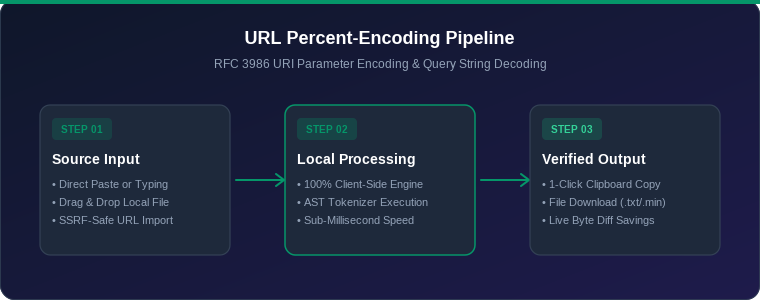
Under the Hood: How the URL Encoder / Decoder Engine Works
The tool implements RFC 3986 compliant encoding algorithms:
1. Percent-Encoding Mechanism: Converts reserved and non-ASCII UTF-8 bytes into a `%` character followed by a two-digit hexadecimal representation (e.g. space becomes `%20`).
2. Query String Plus Handling: When decoding, intelligently translates query parameter plus signs (`+`) into standard spaces as specified by the `application/x-www-form-urlencoded` format.
3. Full Component Support: Safely encodes entire URL parameters, REST path segments, and query values without corrupting UTF-8 multibyte characters (including emojis and Cyrillic/Arabic/Asian scripts).
Live Code Transformation Example
Observe how the engine transforms unformatted or raw input into optimized, standardized output:
https://veewom.com/search?q=HTML Beautifier & Minifier 2026&category=developer tools&filter=active#resultshttps%3A%2F%2Fveewom.com%2Fsearch%3Fq%3DHTML%20Beautifier%20%26%20Minifier%202026%26category%3Ddeveloper%20tools%26filter%3Dactive%23resultsPerformance, Bandwidth & Core Web Vitals Impact
Proper URL encoding is vital for API development, tracking parameters, and analytics:
- Analytics Campaign Tracking: Prevents campaign UTM parameter strings (utm_campaign, utm_source) from truncating when passing complex search phrases.
- OAuth & SSO Redirects: Critical when passing redirect_uri parameters in OAuth 2.0 authorization flows.
- International Domain Names (IDN): Safely encodes international characters for search queries across diverse global languages.
Industry Best Practices for URL Encoder / Decoder
- In JavaScript, use encodeURIComponent() for individual query values, and encodeURI() only when encoding full URL structures.
- Always decode incoming URL parameters on your backend server before querying databases.
- Encode spaces as %20 in URL path segments, while query strings may use either %20 or +.
- Never pass unencoded passwords or secret tokens in GET query strings; use request headers or POST bodies instead.
- Ensure URL lengths remain below 2,048 characters to maintain compatibility with all web browsers and reverse proxies.
Step-by-Step Guide to Using This Tool
- Input Code: Paste your code directly into the left editor pane, click Sample Code to load an example template, upload a local file, or fetch a remote resource via our SSRF-safe URL import tool.
- Set Preferences: Adjust your preferred indentation width (2 spaces, 4 spaces, or Tab) in the toolbar.
- Trigger Action: Click the primary action button (or press Ctrl + Enter) to process your code instantaneously.
- Review & Export: Inspect the live difference stats badge, then click Copy to copy to clipboard or Download to save the file locally.
Frequently Asked Questions
What is the difference between encodeURI() and encodeURIComponent()?
encodeURI() preserves characters with special URL meaning (like :, /, ?, &) and is meant for complete URLs. encodeURIComponent() encodes ALL reserved characters, making it suitable for individual query parameter values.
Why are spaces sometimes encoded as %20 and sometimes as +?
In standard RFC 3986 URI encoding, a space is %20. In HTML form submissions (application/x-www-form-urlencoded query strings), spaces are historically encoded as plus (+). Our decoder handles both seamlessly.
Can this tool encode emojis and foreign languages?
Yes. It converts UTF-8 multi-byte sequences into their corresponding percent-encoded hex sequences (e.g. 😊 becomes %F0%9F%98%8A).
Does this tool track the URLs I encode?
No. Processing happens entirely client-side in your browser with zero server storage or telemetry.
How do I decode an encoded URL back to plain text?
Paste your encoded URL into the editor and click the "Decode URL" button in the toolbar.