
- Home
- Difference
- DBMS vs RDBMS
Difference Between DBMS and RDBMS
Quick Summary: A DBMS (Database Management System) is software that manages data stored primarily as individual files or navigational/hierarchical structures without enforcing relationships between datasets. An RDBMS (Relational Database Management System) is an advanced DBMS based on E.F. Codd's Relational Model that stores data in interconnected two-dimensional tables (relations) governed by primary keys, foreign keys, normalization, and ACID properties.
What is DBMS?
A Database Management System (DBMS) is a software package designed to define, manipulate, retrieve, and manage data in a database. A traditional DBMS generally manages data files directly on disk, handling record formatting, field names, and low-level indexing. While early DBMS systems relieved programmers from writing manual file parsing routines, they lacked relational integrity, cross-table constraints, and concurrent transaction safety.
Common DBMS Examples: File systems, XML documents, dBASE, FoxPro, Microsoft Access (desktop file engine).
What is RDBMS?
RDBMS stands for Relational Database Management System. Introduced by Dr. Edgar F. Codd in 1970 at IBM, the relational model revolutionized data storage by organizing information into structured tables consisting of rows (tuples) and columns (attributes). Tables are interconnected via primary-key and foreign-key relationships, and queries are declared using Structured Query Language (SQL).
Industry Standard RDBMS Systems: MySQL, PostgreSQL, Oracle Database, Microsoft SQL Server, IBM DB2, SQLite.
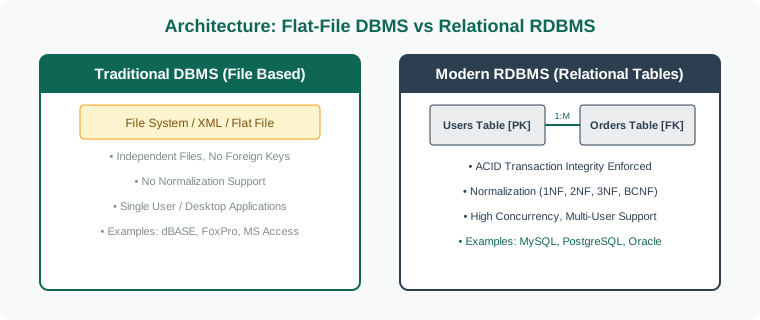
Side-by-Side Comparison: DBMS vs RDBMS
SR.NO |
DBMS |
RDBMS |
|---|---|---|
01 |
DBMS applications store data as flat files or navigational record structures. |
RDBMS applications store data in a tabular form comprising rows and columns. |
02 |
In DBMS, data is generally stored in either a hierarchical form (tree) or a navigational network form without foreign keys. |
In RDBMS, tables have unique identifiers called Primary Keys, and relationships are linked via Foreign Keys. |
03 |
Normalization is not present in DBMS, leading to potential data redundancy and update anomalies. |
Normalization is strictly supported (1NF, 2NF, 3NF, BCNF) to eliminate redundant data and maintain integrity. |
04 |
DBMS does not enforce comprehensive security or transactional constraints with regards to data manipulation. |
RDBMS strictly defines and enforces integrity constraints for ACID properties (Atomicity, Consistency, Isolation, and Durability). |
05 |
DBMS uses file systems to store data, so there are no formal relationship constraints between datasets. |
In RDBMS, data values are stored in tables, and relationships between datasets are mapped and queried via relational JOINs. |
06 |
DBMS provides individual, non-standardized proprietary access routines to fetch stored information. |
RDBMS systems provide standardized SQL (Structured Query Language) to access, filter, aggregate, and manipulate data. |
07 |
DBMS does not natively support distributed database architectures across network clusters. |
RDBMS supports distributed databases, master-slave replication, sharding, and multi-node clustering. |
08 |
DBMS is meant for small applications dealing with modest data; primarily supports single-user access. |
RDBMS is engineered for enterprise-scale workloads, massive datasets, and high-concurrency multi-user transactions. |
09 |
Examples of traditional DBMS include file systems, XML files, dBASE, FoxPro, and Windows Registry. |
Examples of RDBMS include MySQL, PostgreSQL, Microsoft SQL Server, Oracle Database, and SQLite. |
Relational Integrity in Practice: Primary & Foreign Keys
In an RDBMS, data is split into specialized tables to prevent duplication, linked together by keys:
-- Parent Table: Stores unique Department records
CREATE TABLE Departments (
    dept_id INT PRIMARY KEY,
    dept_name VARCHAR(50) NOT NULL
);

-- Child Table: Links to Departments via Foreign Key
CREATE TABLE Students (
    student_id INT PRIMARY KEY,
    student_name VARCHAR(50) NOT NULL,
    dept_id INT,
    FOREIGN KEY (dept_id) REFERENCES Departments(dept_id)
        ON DELETE CASCADE
);
Exam Memory Trick: The ACID Properties of RDBMS
- A - Atomicity: All operations in a transaction succeed, or the entire transaction rolls back ("All or Nothing").
- C - Consistency: Database transitions from one valid state to another, preserving all schema constraints.
- I - Isolation: Concurrent transactions execute independently without dirty reads or phantom writes.
- D - Durability: Once a transaction is committed, its changes persist permanently even through power failure.
Practice Session & Self-Assessment Quiz
Q1: Who introduced the Relational Model upon which modern RDBMS systems are built?
Click to Reveal Answer & Explanation
Correct Answer: B
Dr. E.F. Codd published his seminal paper "A Relational Model of Data for Large Shared Data Banks" at IBM in 1970, establishing the foundation of RDBMS.
Q2: Which ACID property ensures that money transferred between two bank accounts is either fully debited and credited or cancelled completely?
Click to Reveal Answer & Explanation
Correct Answer: A
Atomicity guarantees that a transaction is treated as a single indivisible unit: if any sub-step fails, all previous steps are rolled back.
Q3: Which of the following is considered a traditional file-based DBMS rather than an RDBMS?
Click to Reveal Answer & Explanation
Correct Answer: C
dBASE and FoxPro are classic desktop file-based DBMS software programs that lack relational integrity constraints, foreign key enforcement, and client-server concurrency.
Top Viva & Technical Interview Questions
1. What is Normalization in RDBMS and why is it important?
Normalization is the systematic process of organizing data in a relational database to minimize redundancy and eliminate insertion, update, and deletion anomalies by dividing large tables into smaller, well-structured tables linked by relationships.
2. What is Referential Integrity?
Referential integrity is a relational database constraint ensuring that relationships between tables remain consistent. It prevents foreign key columns from pointing to nonexistent primary key rows in parent tables.
3. What is the difference between a Table and a View in RDBMS?
A Table physically stores data on disk with designated rows and columns. A View is a virtual table defined by a saved SQL query; it does not store physical data itself but dynamically computes and presents data on the fly from underlying base tables.
Frequently Asked Questions (FAQs)
Is Microsoft Access a DBMS or RDBMS?
Microsoft Access is a desktop hybrid. While it provides an intuitive relational UI supporting primary and foreign keys, it stores all tables in a single .accdb file, making it unsuitable for high-concurrency enterprise workloads compared to true client-server RDBMS like PostgreSQL.
Can an RDBMS handle unstructured big data?
RDBMS is optimized for structured data with strict schemas. For massive unstructured or semi-structured data (like social media streams or IoT sensor JSON logs), modern developers pair RDBMS with NoSQL databases (MongoDB, Cassandra).
What are the common Normal Forms taught in BCA/CS curriculums?
The standard normal forms are First Normal Form (1NF: atomic values), Second Normal Form (2NF: no partial dependency), Third Normal Form (3NF: no transitive dependency), and Boyce-Codd Normal Form (BCNF: every determinant is a candidate key).
Related Difference Classes to Explore


You may also like this!
© Veewom.com. | Managed by PinePL
