
- Home
- Difference
- Recursion vs Iterations
Difference Between Recursion and Iteration
Quick Summary: Recursion is a problem-solving technique where a function solves smaller subproblems by repeatedly calling itself until reaching a termination base case. Iteration is a loop-based control structure (such as for, while, or do-while) that repeatedly executes a block of instructions while updating state variables until a boolean condition evaluates to false.
Both recursion and iteration achieve repetitive execution, but their underlying memory footprint and processor mechanics are radically different. Below is a detailed, point-by-point breakdown preserving every fundamental principle while adding algorithmic depth.
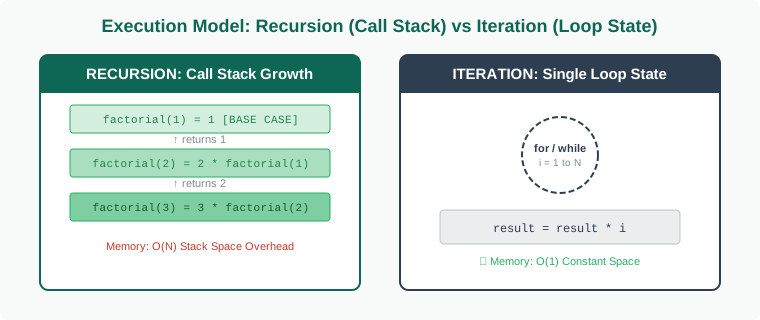
Side-by-Side Comparison: Recursion vs Iterations
RECURSION |
ITERATIONS |
|---|---|
Definition: A recursive function is a function that is defined in terms of itself by invoking itself with modified arguments. |
Definition: Iterative instructions are loop-based repetitions of a process (using |
Control Structure: Recursion uses a selection structure ( |
Control Structure: Iteration uses a repetition structure (loop construct) to govern repeated instruction cycles. |
Infinite Execution Condition: Infinite recursion occurs if the recursion step does not reduce the problem toward the base case condition. |
Infinite Execution Condition: An infinite loop occurs if the loop termination condition never evaluates to false. |
Termination Point: Recursion terminates when a base case is recognized, triggering stack unwinding. |
Termination Point: Iteration terminates when the loop condition test fails or a |
Execution Speed: Usually slower due to the overhead of creating stack frames, pushing arguments, and jumping between memory locations. |
Execution Speed: Faster because it reuses existing CPU registers without function call stack management overhead. |
Memory Consumption: Consumes higher memory: O(N) stack memory where N is the maximum recursion call depth. |
Memory Consumption: Consumes minimal memory: O(1) constant auxiliary space regardless of iteration count. |
Crash / Failure Mode: Infinite recursion crashes the program and system with a Stack Overflow error (memory limit exceeded). |
Crash / Failure Mode: An infinite loop hangs the CPU (100% core utilization), consuming cycles repeatedly without exceeding stack limits. |
Code Compactness: Makes code substantially smaller, more mathematically elegant, and cleaner for tree and graph structures. |
Code Compactness: Makes code longer and requires manual tracking of index counters and state accumulators. |
Code Comparison: Factorial in C
1. Recursive Factorial Implementation
/* Recursive Factorial: Elegant, but pushes N activation frames */
int factorial_recursive(int n) {
    if (n <= 1) // Base Case: stops recursion
        return 1;
    return n * factorial_recursive(n - 1); // Recursive Step
}
2. Iterative Factorial Implementation
/* Iterative Factorial: Fast, uses constant O(1) memory */
int factorial_iterative(int n) {
    int result = 1;
    for (int i = 2; i <= n; i++) { // Loop condition
        result *= i;
    }
    return result;
}
Summary Advice for Students & Interviewees:
- Use Recursion When: The problem is inherently hierarchical or recursive in nature: Binary Tree Traversals (Inorder, Preorder, Postorder), Divide & Conquer (Merge Sort, Quick Sort), Backtracking (N-Queens, Sudoku), and Graph Depth-First Search.
- Use Iteration When: You need high throughput, linear arrays or linked list traversals, or memory limits are tight (embedded microcontrollers, kernel code).
Practice Session & Self-Assessment Quiz
Q1: What happens if a recursive function does not include a base case?
Click to Reveal Answer & Explanation
Correct Answer: B
Without a base case to halt further calls, the function keeps pushing activation frames onto the call stack until memory is exhausted, throwing a Stack Overflow error.
Q2: What is the space complexity of an unoptimized recursive function with depth N?
Click to Reveal Answer & Explanation
Correct Answer: B
Every recursive call allocates an activation frame on the call stack. With a depth of N, there are N simultaneous frames active, yielding O(N) auxiliary space.
Q3: Which of the following is an example of Tail Recursion?
Click to Reveal Answer & Explanation
Correct Answer: B
In tail recursion, the recursive call is the absolute final statement executed in the function, with no pending arithmetic (unlike option A which must multiply by n after returning).
Top Viva & Technical Interview Questions
1. What is the difference between Direct and Indirect Recursion?
In Direct Recursion, function A explicitly calls function A directly. In Indirect Recursion, function A calls function B, which in turn calls function A, forming a cyclic call chain.
2. Why is calculating Fibonacci recursively using fib(n-1) + fib(n-2) extremely inefficient?
It forms an exponential binary recursion tree with O(2^N) time complexity due to redundant recalculations of identical subproblems (e.g., fib(3) is computed multiple times). Iterative or Dynamic Programming approaches calculate it in O(N) time.
3. What is Memoization in recursive algorithms?
Memoization is an optimization technique that caches the return values of expensive recursive function calls in an array or hash map so that subsequent calls with identical arguments return instantly in O(1) time.
Frequently Asked Questions (FAQs)
Can an iterative program cause Stack Overflow?
No. Standard iterative loops (for, while) do not allocate stack frames on each loop iteration. Even an infinite while loop only consumes CPU time, never exceeding call stack memory.
Does Python optimize tail recursion automatically?
No. Guido van Rossum deliberately chose not to include Tail Call Optimization in CPython so that complete stack traces remain intact for debugging. In Python, recursion is capped at 1,000 calls by default.
Why do functional languages like Haskell or Lisp prefer recursion over loops?
Pure functional languages forbid mutable state (changing variable values). Because traditional loops require updating a mutable counter (like i++), functional programming accomplishes all repetitions using recursion.
Related Difference Classes to Explore


You may also like this!
© Veewom.com. | Managed by PinePL
