
Python Variables: Memory Allocation, Object References & Dynamic Typing
In traditional languages such as C, C++, or Java, a variable is a strongly-typed memory container with a fixed size (e.g. int a = 10;). In Python, variables work fundamentally differently: variables are named tags (pointers) bound to objects residing in heap memory. Understanding this reference model is essential to mastering list mutability, function arguments, and memory optimization.
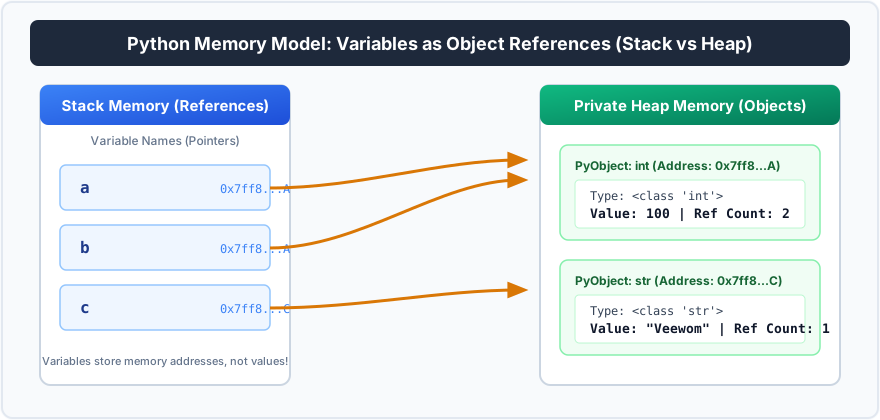
Figure 6.1: Variables 'a' and 'b' pointing to the same int object (100) in heap memory via reference counting.
1. Creating and Assigning Variables in Python
You create a variable simply by assigning a value using the assignment operator (=). You never declare a type:
# Variable assignment in Python
age = 21                  # int object
price = 199.99            # float object
user_name = "Amit Kumar"  # str object
is_enrolled = True        # bool object

print(f"Name: {user_name}, Age: {age}, Price: ₹{price}")
2. Dynamic Typing & Type Re-Assignment
Because Python is dynamically typed, a variable can reference an integer at one moment and reference a string or list later in the same program:
x = 100
print(type(x))  #

x = "Python Programming"
print(type(x))  #
3. The id() Function & Object Identity
Every object created in Python receives a unique memory address. You can inspect this address using the built-in id() function, and compare object identities using the is operator:
# Python integer caching and object identity
x = 250
y = 250

print("id of x:", id(x))
print("id of y:", id(y))
print("x is y:", x is y)  # True (both point to the exact same cached object)
Important Note on CPython Integer Optimization: Python pre-allocates an internal array of integer objects for values between -5 and 256. When you create any integer within this range, Python reuses the existing cached object rather than creating a new one in memory.
4. Multiple and Chained Assignments
Python allows elegant multi-variable assignments in a single readable line:
# Chained assignment (same value to multiple variables)
a = b = c = 50
print(f"a={a}, b={b}, c={c}")

# Multiple assignment (tuple unpacking)
roll, course, marks = 101, "BCA", 94.5
print(f"Roll: {roll}, Course: {course}, Marks: {marks}")

# Swapping two variables without a temporary variable!
x, y = 10, 20
x, y = y, x
print(f"After swap: x={x}, y={y}")  # x=20, y=10
5. Type Casting (Type Conversion)
Type casting converts an object from one type to another using constructor functions:
• Implicit Conversion: Python automatically promotes smaller types to larger types (e.g. int + float -> float) to prevent data loss.
• Explicit Conversion: Using int(), float(), str(), list(), tuple(), set().
# Type conversion example
marks_str = "85"
marks_num = int(marks_str)  # Converts string "85" to integer 85
total = marks_num + 15
print("Total:", total)  # 100
Hands-on Practice Session
Challenge 1: Write a program to take two float inputs from the user, swap their values without using a third variable, and print their memory IDs before and after swapping.
# Solution:
num1 = 12.5
num2 = 45.8

print(f"Before Swap: num1={num1} (ID: {id(num1)}), num2={num2} (ID: {id(num2)})")
num1, num2 = num2, num1
print(f"After Swap:  num1={num1} (ID: {id(num1)}), num2={num2} (ID: {id(num2)})")
University Exam & Interview Questions
Q1 (BCA Exam Question): Differentiate between Mutable and Immutable objects in Python with examples.
Answer: Immutable objects cannot be modified in place after creation (e.g., int, float, str, tuple); any modification creates a brand new object in memory with a new ID. Mutable objects can be modified in place without altering their memory ID (e.g., list, dict, set).
Q2: What happens to unreferenced objects in Python?
Answer: When an object's reference count drops to zero, Python's automatic garbage collector immediately deallocates its memory.
Frequently Asked Questions (FAQ)
Can variable names start with a number in Python?
_). They cannot start with a digit. See our Python Identifiers guide for complete naming rules.
Does Python have constant variables?
const keyword. By PEP 8 convention, variables written in ALL_CAPITAL_LETTERS (e.g., MAX_CONNECTIONS = 100) signal to developers that the value should not be modified.


You may also like this!
© Veewom.com. | Managed by PinePL
