
- Home
- Tutorials
- Cloud Computing
- Deployment Models
Cloud Deployment Models: Public, Private, Hybrid & Community Cloud
While cloud service models (IaaS, PaaS, SaaS) define what computing capabilities are delivered, Cloud Deployment Models define where the infrastructure resides, who owns and manages it, and how access is partitioned across different organizational tenants.
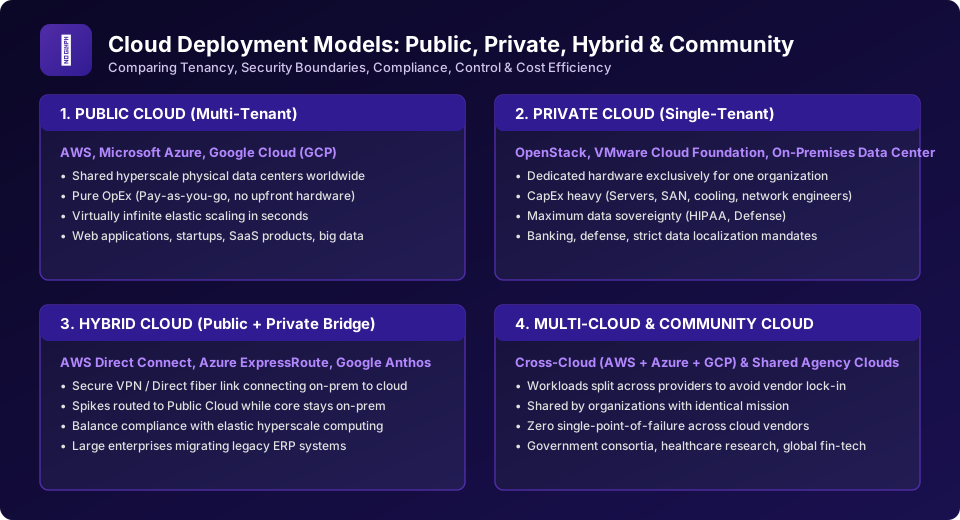
Figure 3: Cloud Deployment Models Architecture: Tenancy boundaries, on-premises bridges, data sovereignty, and multi-vendor redundancy.
1. Public Cloud (Multi-Tenant Hyperscale)
In a Public Cloud, computing resources are owned, operated, and maintained off-site by third-party commercial hyperscalers (such as Amazon Web Services, Microsoft Azure, and Google Cloud). Multiple organizations (tenants) securely share the same physical server clusters and global data center facilities.
- Tenancy: Multi-tenant. Your virtual machines execute on the same physical host hardware as other global companies, isolated via hypervisors.
- Advantages: Zero upfront hardware expenditure (OpEx), virtually limitless elastic scalability, continuous hardware updates, and 99.99%+ SLA availability.
- Disadvantages: Shared network bandwidth fluctuations, potential cloud vendor lock-in, and strict compliance restrictions in certain regulated industries.
2. Private Cloud (Single-Tenant Dedicated)
A Private Cloud is cloud infrastructure provisioned for exclusive use by a single organization comprising multiple business units or departments. It may be owned, managed, and operated by the organization itself, a third-party managed service provider, or a combination of them, and it may exist on- or off-premises.
- Tenancy: Strictly single-tenant. No outside organizations ever share physical host CPUs, RAM, storage SANs, or network switches.
- Advantages: Maximum control over security policies, total compliance with data sovereignty laws (e.g., banking regulations, military defense systems), and predictable network performance.
- Disadvantages: Extremely high upfront capital costs (CapEx), ongoing hardware depreciation, manual data center maintenance, and finite scaling capacity.
3. Hybrid Cloud (The Best of Both Worlds)
A Hybrid Cloud combines on-premises private infrastructure with one or more public cloud services, bound together by standardized network protocols and management tools (e.g., AWS Direct Connect, Azure ExpressRoute, or Google Anthos). This architecture enables Cloud Bursting—where applications run privately under normal load, but automatically overflow into public cloud capacity during seasonal traffic spikes.
4. Community Cloud & Multi-Cloud
- Community Cloud: Infrastructure shared exclusively by several organizations that have shared concerns (e.g., mission, security requirements, regulatory compliance, or jurisdiction). Examples include government agency clouds (AWS GovCloud) and healthcare research consortiums.
- Multi-Cloud Strategy: The modern enterprise practice of using multiple independent public cloud providers (e.g., hosting core microservices in AWS, utilizing Azure for Active Directory and Office integration, and running BigQuery on Google Cloud) to eliminate single-vendor dependency and negotiate competitive pricing.
University Exam Corner (BCA / B.Sc CS)
Question: "What is 'Cloud Bursting' and which deployment model facilitates it?"
Answer: Cloud Bursting is an application deployment configuration in a Hybrid Cloud model where an application runs in a private cloud or on-premises data center during normal operations, and "bursts" seamlessly into a public cloud when demand for computing capacity exceeds private data center limits.
Frequently Asked Questions (FAQ) - Student & Interview Review
Q1. Which cloud deployment model is the most secure?
Q2. What is the difference between Hybrid Cloud and Multi-Cloud?
Q3. What is AWS GovCloud?
Explore Related Cloud Computing Tutorials & Next Steps
Broaden your enterprise cloud architecture and DevOps expertise across our curriculum:
Connect enterprise on-premises data centers with hyperscale clouds using AWS Direct Connect and Azure ExpressRoute.
Master Rehost, Replatform, Refactor, Repurchase, Retain, and Retire strategies for enterprise workload migration.
Architect secure virtual networks, isolated subnets, and hybrid VPN tunnels into your private cloud.
Implement identity-aware perimeter proxies and micro-segmentation across distributed multi-cloud environments.


You may also like this!
© Veewom.com. | Managed by PinePL
