
Cloud Computing Tutorial: Complete Step-by-Step Master Syllabus & Roadmap
Cloud Computing has fundamentally reshaped the global technology landscape. Gone are the days when building a software product required ordering physical rack servers, leasing cooled data center space, configuring hardware firewalls, and managing complex power failover generators. Today, computing power, petabyte-scale storage, managed databases, and global container clusters are delivered instantly as metered utility services over the internet on a pay-as-you-go model.
Welcome to the Updated Veewom Cloud Computing Master Course
Engineered specifically for BCA Students, Computer Science Undergraduates, Bloggers, and Advanced Web Developers. Whether you are studying for university semester exams, preparing for AWS/Azure/GCP certifications, or architecting production Kubernetes clusters, this 50-class curriculum provides 100% verified concepts, architecture diagrams, hands-on CLI configurations, and real-world case studies.
What is Cloud Computing? (NIST Architectural Definition)
According to the gold-standard definition published by the National Institute of Standards and Technology (NIST SP 800-145):
"Cloud computing is a model for enabling ubiquitous, convenient, on-demand network access to a shared pool of configurable computing resources (e.g., networks, servers, storage, applications, and services) that can be rapidly provisioned and released with minimal management effort or service provider interaction."
In simple terms, cloud computing transforms computer hardware from a capital expense (CapEx) that you must buy upfront into an operating expense (OpEx) that you rent dynamically by the second, minute, or hour.
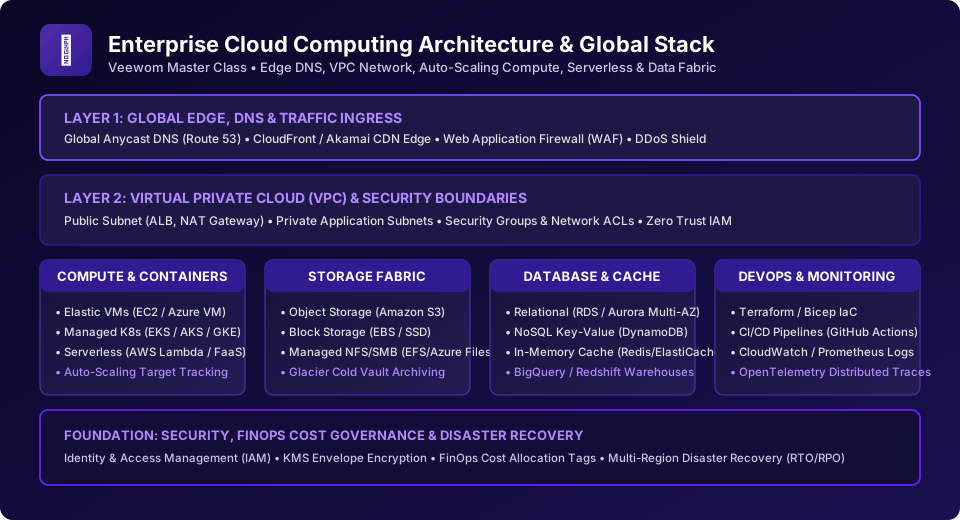
Figure 1: Complete High-Level Cloud Computing Architecture Stack: Global Edge DNS, Ingress WAF, VPC Security, Elastic Compute, Storage Fabric, and DevOps Observability.
Why Learn Cloud Computing in 2026? Academic & Industry Impact
Cloud computing is not just a specialized branch of IT—it is the foundational platform upon which all modern artificial intelligence, mobile apps, web applications, streaming platforms, and financial systems operate. Here is why mastery of the cloud is essential:
| Dimension | Strategic Significance for Students, Engineers & Bloggers |
|---|---|
| On-Demand Elasticity | Scale from 1 virtual machine to 10,000 container instances during flash sales or traffic spikes, and scale back down to zero when idle to save money. |
| Global High Availability | Deploy applications simultaneously across multiple Availability Zones (AZs) and worldwide geographic regions with sub-second latency and automated failover. |
| BCA & Computer Science Curricula | A core compulsory university subject covering distributed systems, hypervisors, virtualization, service models (IaaS/PaaS/SaaS), and deployment architectures. |
| High-Paying Career Opportunities | Cloud Solutions Architects, DevOps Engineers, Site Reliability Engineers (SRE), and FinOps Analysts rank among the highest-paid engineering roles globally. |
| Modern Developer Agility | Leverage managed databases (Postgres, DynamoDB), serverless functions (AWS Lambda), and container engines (EKS/Cloud Run) to ship software in minutes without sysadmin overhead. |
50-Class Cloud Computing Roadmap: What You Will Master
This master curriculum is logically structured into 8 progressive modules designed to take you from foundational basics to advanced enterprise production engineering:
- Module 1: Cloud Fundamentals & Architecture (Classes 1–7): NIST definitions, 5 characteristics, IaaS vs PaaS vs SaaS, public/private/hybrid models, enterprise architecture, and Type-1/Type-2 hypervisors.
- Module 2: Core Infrastructure & Networking (Classes 8–14): Block/File/Object storage (S3/EBS), Virtual Private Clouds (VPC), CIDR subnets, Application Load Balancers, CDNs, Route 53 DNS, HA/DR, and cloud databases.
- Module 3: Major Cloud Providers & Multi-Cloud (Classes 15–20): Deep dives into AWS, Microsoft Azure, Google Cloud Platform (GCP), head-to-head service comparisons, hybrid strategy, and the 6 R's migration framework.
- Module 4: Cloud Native, Containers & Kubernetes (Classes 21–27): 12-factor apps, Docker containerization, Kubernetes control plane and worker nodes, managed K8s (EKS/AKS/GKE), Istio service mesh, and serverless containers.
- Module 5: Serverless & Event-Driven Architecture (Classes 28–33): Function-as-a-Service (FaaS), AWS Lambda, API Gateway, SQS message queues, EventBridge, SAM frameworks, and Kafka event streaming.
- Module 6: DevOps, IaC & CI/CD Automation (Classes 34–39): DevOps culture, Terraform HCL, state management, AWS CloudFormation, Azure Bicep, GitHub Actions pipelines, and ArgoCD GitOps delivery.
- Module 7: Cloud Security, FinOps & Compliance (Classes 40–45): Shared responsibility model, IAM least privilege, KMS envelope encryption, Zero Trust perimeters, SOC2/HIPAA compliance, and FinOps cloud cost optimization.
- Module 8: Practice Labs, Q&A, Viva & Reference (Classes 46–50): 10 hands-on step-by-step real-world projects, 120+ senior technical interview questions, university exam viva voce guide, incident runbooks, and master CLI cheat sheet.
University Exam Corner (BCA / B.Sc CS / MCA)
Standard University Question: "Define Cloud Computing according to NIST. What are the three service models and four deployment models?"
Quick Revision Answer: Cloud computing delivers on-demand computing resources via a multi-tenant shared pool. The three fundamental service models are IaaS (Infrastructure as a Service), PaaS (Platform as a Service), and SaaS (Software as a Service). The four primary deployment models are Public Cloud, Private Cloud, Hybrid Cloud, and Community Cloud.
Getting Started: Verify Cloud CLI Access
Before beginning our architecture deep dive, install the official cloud command-line interfaces on your workstation. Run these commands to verify installation:
# Check AWS CLI version
aws --version
# Output: aws-cli/2.15.0 Python/3.11.6 Windows/10

# Check Azure CLI version
az version
# Output: { "azure-cli": "2.56.0" }

# Check Google Cloud SDK version
gcloud version
# Output: Google Cloud SDK 460.0.0
Frequently Asked Questions (FAQ) - Student & Interview Review
Q1. What is Cloud Computing in simple terms?
Q2. Is this tutorial aligned with the BCA and Computer Science university syllabus?
Q3. Do I need to pay for AWS, Azure, or GCP to follow this course?
Q4. What is the difference between Cloud Computing and Virtualization?
Explore Related Cloud Computing Tutorials & Next Steps
Broaden your enterprise cloud architecture and DevOps expertise across our curriculum:
Understand utility computing, grid computing, and the technological evolution leading to modern cloud platforms.
NIST standard breakdown: On-demand self-service, broad network access, pooling, elasticity, and measured billing.
Clear separation of operational responsibility, software stacks, and cloud service architectures.
Essential interview drills, scenario-based architecture questions, and BCA viva exam questions.


You may also like this!
© Veewom.com. | Managed by PinePL
