
Laravel Service Container: Inversion of Control (IoC) & Auto-Wiring
The Service Container (often called the IoC container) is the very heart and brain of the entire Laravel framework. Almost every component in Laravel (Routing, Database, Validation, Mail, Queues, Cache) is registered, managed, and resolved through this container. Understanding the Service Container separates junior script writers from senior software architects.
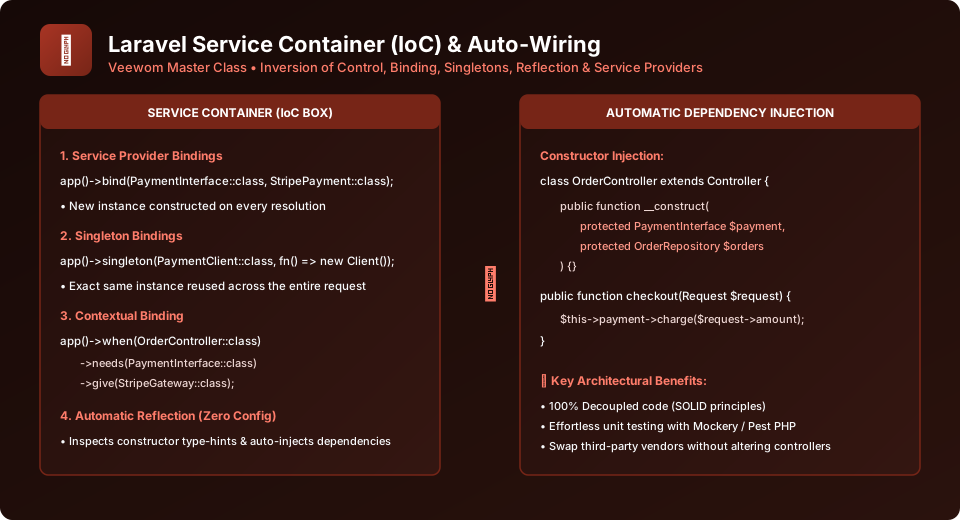
Figure 38.1: Service Container Registration, Auto-Wiring Reflection, and Instance Resolution
1. What is Inversion of Control (IoC)?
In traditional procedural programming, if Class A needs Class B, Class A explicitly instantiates Class B using new ClassB(). This tightly couples the two classes, making testing impossible.
With Inversion of Control, Class A does not instantiate its dependencies. Instead, it simply type-hints an interface or class in its constructor. The Service Container automatically inspects the constructor using PHP Reflection, resolves all dependencies, and injects them automatically (known as Auto-Wiring).
2. Container Bindings: bind vs singleton
You register bindings inside the register() method of a Service Provider (like AppServiceProvider):
use App\Contracts\PaymentGatewayInterface;
use App\Services\StripePaymentGateway;
use App\Services\ExchangeRateApiClient;

public function register(): void
{
    // 1. Basic Binding: Creates a FRESH instance on every resolution
    $this->app->bind(PaymentGatewayInterface::class, function ($app) {
        return new StripePaymentGateway(config('services.stripe.secret'));
    });

    // 2. Singleton Binding: Resolved ONCE; exact same instance is reused across the entire request!
    $this->app->singleton(ExchangeRateApiClient::class, function ($app) {
        return new ExchangeRateApiClient(apiKey: env('EXCHANGE_RATE_API_KEY'));
    });
}
3. Automatic Dependency Injection in Practice
Because the container understands auto-wiring, any controller can request the interface without knowing anything about Stripe:
namespace App\Http\Controllers;

use App\Contracts\PaymentGatewayInterface;
use Illuminate\Http\Request;

class CheckoutController extends Controller
{
    // The container automatically injects StripePaymentGateway!
    public function __construct(
        protected PaymentGatewayInterface $paymentGateway
    ) {}

    public function process(Request $request)
    {
        $receipt = $this->paymentGateway->charge(
            amount: 1499,
            currency: 'INR'
        );

        return response()->json(['receipt' => $receipt]);
    }
}
The Architectural Benefit
If your company later switches from Stripe to Razorpay or PayPal, you only change a single line in your Service Provider: $this->app->bind(PaymentGatewayInterface::class, RazorpayPaymentGateway::class);. Not a single controller or test class needs to be modified!
4. Contextual Binding (Different Implementations for Different Controllers)
If two different controllers require different implementations of the same interface:
$this->app->when(PhotoController::class)
    ->needs(FilesystemInterface::class)
    ->give(fn () => Storage::disk('local'));

$this->app->when(VideoController::class)
    ->needs(FilesystemInterface::class)
    ->give(fn () => Storage::disk('s3'));
Frequently Asked Questions (FAQ) - Student & Interview Review
Q1. How does the Service Container know what parameters a constructor needs without configuration?
Q2. What is the difference between app()->make() and app()->singleton()?
Q3. Can I bind a primitive scalar value (like an API secret string) into the container?
Explore Related Laravel Tutorials & Next Steps
Broaden your backend architecture, REST API design, and enterprise production engineering expertise:
Register container bindings and singletons inside the register() lifecycle.
Type-hint interfaces in controller constructors to see IoC injection in action.
Swap concrete implementations with test doubles using $this->app->instance().
In-depth questions on Inversion of Control, reflection, singletons, and auto-wiring.


You may also like this!
© Veewom.com. | Managed by PinePL
