
Laravel Tutorial: Complete Master Class 2026
Welcome to the Veewom Laravel Master Class (2026 Edition) — the industry's most exhaustive, step-by-step curriculum engineered for computer science students (BCA, MCA, B.Tech), full-stack developers, bloggers, and enterprise backend engineers. Whether you are writing your first PHP controller or architecting distributed microservices with Laravel Reverb and Redis Horizon, this master class takes you from absolute ground zero to principal-level proficiency.
Complete 50-Class Curriculum Overview
Our syllabus is meticulously synchronized across 8 progressive learning modules: Foundations & Setup, Routing & Controllers, Blade & Modern Frontend (Vite, Livewire, Inertia), Database & Eloquent ORM, Forms, Authentication & OWASP Security, RESTful APIs, Sanctum & WebSockets, Advanced Container & Production DevOps, and Automated Testing, 140+ Interview Q&A, University Viva & Full Capstone Project.
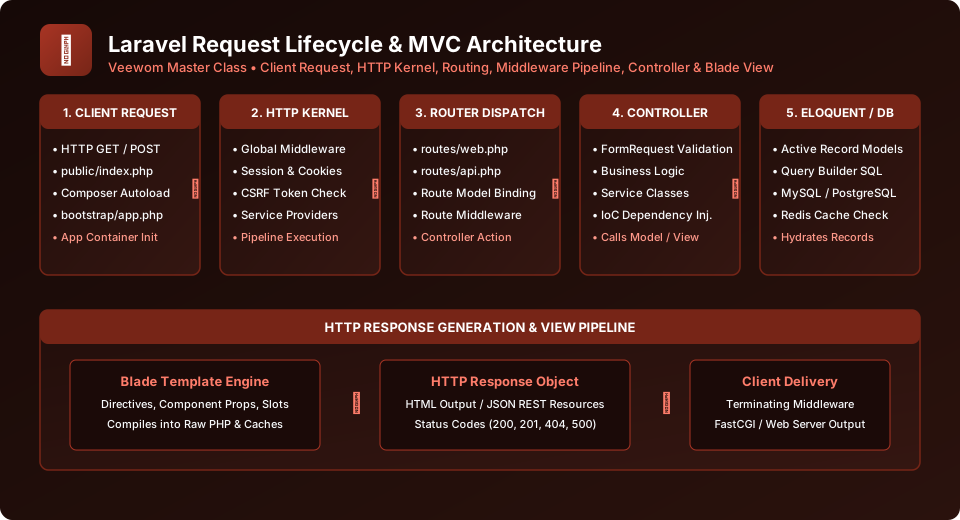
Figure 1.1: Complete Architectural Flow of the Laravel HTTP Request Lifecycle & MVC Engine
Why Laravel Dominates Web Development in 2026
Laravel continues to be the world's most beloved and productive backend framework. Released by Taylor Otwell in 2011, Laravel transformed PHP from a fragmented procedural scripting language into a world-class object-oriented powerhouse. Modern Laravel 11 paired with PHP 8.3+ delivers exceptional execution speeds rivaling Node.js and Go, while retaining the most expressive, human-readable syntax in software engineering.
| Framework Feature | Traditional PHP / Raw Scripts | Laravel 11 Enterprise Platform | Real Developer Advantage |
|---|---|---|---|
| Architecture | Spaghetti procedural scripts | Strict Model-View-Controller (MVC) | Effortless modularity, teamwork & maintenance |
| Database Layer | Manual SQL queries & mysqli loops | Eloquent ORM (Active Record) | Expressive chainable queries, zero SQL injection |
| Frontend Integration | Manual script tags & inline CSS | Vite 5+, Blade, Livewire 3 & Inertia.js | Instant Hot Module Replacement & reactive SPAs |
| Asynchronous Processing | Cron hacks or external daemon scripts | Native Redis Queues & Laravel Horizon | Instant HTTP response times, reliable job retries |
| Real-Time WebSockets | Costly third-party cloud brokers (Pusher) | Laravel Reverb (First-Party Server) | Zero SaaS bills, 100K+ concurrent connections |
Master Syllabus: 8 Core Specialization Tracks
Every tutorial class in this series includes full runnable source code, real-world industry architecture patterns, academic viva points for students, security considerations, and hands-on coding drills.
Module 1 Foundations & Architecture
Request lifecycle, MVC fundamentals, Composer, Docker Sail, streamlined Laravel 11 directory tree, and Artisan CLI mastery.
Module 2 Routing, Controllers & HTTP
Route parameters, resource controllers, invokable actions, input validation, file uploads, and middleware pipelines.
Module 3 Blade & Modern Frontend
Blade layout inheritance, component slots, Vite asset compilation, Tailwind/Bootstrap, session flash messages, and Livewire vs Inertia.
Module 4 Database & Eloquent ORM
Fluent Query Builder, migrations, seeders, model factories with Faker, relationships (1:1, 1:N, N:N, Polymorphic), and solving N+1 queries.
Module 5 Forms, Auth & OWASP Security
CSRF token validation, Form Requests, Laravel Breeze & Fortify, RBAC with Gates & Policies, and OWASP Top 10 mitigation.
Module 6 REST APIs, Sanctum & Real-Time
API resource collections, mobile token authentication, cursor pagination, Laravel Reverb WebSockets, and Swagger OpenAPI generation.
Module 7 Advanced Architecture & DevOps
Service Container (IoC), Custom Providers, Events & Observers, Redis Queues, Horizon, Task Scheduling, and Docker/Nginx deployment.
Module 8 Testing, Practice, Viva & Capstone
Pest PHP test-driven development, 15+ coding challenges, 140+ interview questions, BCA/MCA university viva prep, and full capstone codebase.
Recommended Learning Strategy
If you are an academic student preparing for lab practicals or viva exams, work sequentially through Classes 1 to 25, noting the dedicated university exam alerts. For senior engineers and working professionals building modern SPAs and microservices, explore Classes 26 to 45 with deep focus on Service Containers, Queues, Sanctum, and Pest TDD.
Frequently Asked Questions (FAQ) - Student & Interview Review
Q1. What are the minimum server and PHP requirements for Laravel 11?
Q2. Is Laravel suitable for high-traffic enterprise applications?
Q3. What is the difference between Laravel and WordPress?
Q4. How does this Veewom tutorial help BCA and MCA students?
Explore Related Laravel Tutorials & Next Steps
Broaden your backend architecture, REST API design, and enterprise production engineering expertise:
Discover Laravel's elegant syntax, Eloquent ORM, Blade engine, and enterprise ecosystem.
Step-by-step development environment configuration on Windows, macOS, and Linux.
Define relational models, CRUD operations, mass assignment, and database queries.
Comprehensive job interview preparation covering Service Container, Queues, Security, and Viva.


You may also like this!
© Veewom.com. | Managed by PinePL
