
Machine Learning Tutorial: Complete 2026 Master Curriculum
Welcome to the Veewom Machine Learning Master Tutorial — a comprehensive, mathematically rigorous, and practical curriculum designed for university students (BCA, MCA, B.Tech, Computer Science), software engineers, aspiring data scientists, and advanced web developers. Machine Learning has evolved from academic statistical research into the fundamental engine powering modern technology — from predictive search engines, recommendation feeds, and fraud detection systems to autonomous vehicles and generative multimodal AI.
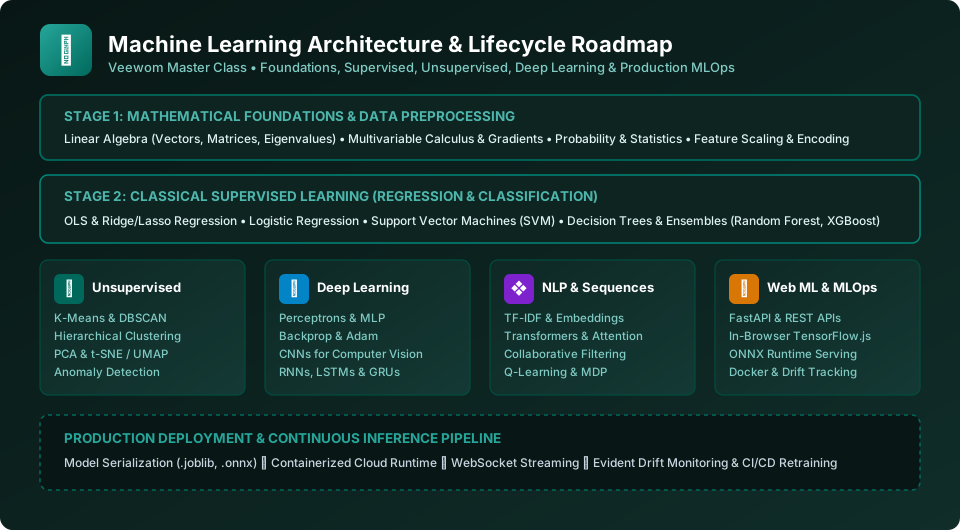
Figure 1.1: Complete Architectural Roadmap of Modern Machine Learning — From Mathematical Foundations to Production MLOps.
Why This Machine Learning Curriculum Stands Out
Most online tutorials fall into two extremes: either dry academic textbooks heavy on abstract proofs without code, or superficial "copy-paste three lines of Scikit-Learn" tutorials that fail to explain how algorithms actually work under the hood. This 52-class master curriculum bridges both worlds. Every class pairs mathematical derivations (vectors, matrices, partial derivatives, loss functions) with executable Python and Scikit-Learn implementations, architectural SVG diagrams, real-world deployment techniques, and university examination review points.
What is Machine Learning? An Engineering Definition
In 1959, computer pioneer Arthur Samuel defined Machine Learning (ML) as the field of study that gives computers the ability to learn without being explicitly programmed. Thirty-eight years later, Professor Tom M. Mitchell formalized this with an engineering definition that remains the gold standard in computer science:
Tom Mitchell's Formal Operational Definition of Machine Learning
"A computer program is said to learn from experience E with respect to some class of tasks T and performance measure P, if its performance at tasks in T, as measured by P, improves with experience E."
- Task (T): Credit card fraud classification, housing price estimation, speech recognition.
- Experience (E): Historical labeled transaction records, sensor readings, or game simulations.
- Performance (P): Classification accuracy, F1-score, Mean Squared Error (MSE), or win-rate.
Traditional Programming vs. Machine Learning Paradigm
To truly understand why Machine Learning is revolutionary, compare the traditional software development flow with the data-driven machine learning workflow:
| Dimension | Traditional Programming (Classical Software) | Machine Learning (Data-Driven Software) |
|---|---|---|
| Core Inputs | Programmer writes manual Business Rules (If/Else logic) + Raw Data. | Raw Data + Expected Output Answers (in Supervised Learning). |
| System Output | Deterministic Answers / Results calculated by code. | Trained Model (Rules & Weights) capable of predicting unseen data. |
| Handling Complexity | Brittle; fails when edge cases or dimensional parameters exceed human capacity. | Scales to millions of features, high-dimensional matrices, and non-linear patterns. |
| Maintenance | Developers manually write, patch, and debug conditional rule files. | Models automatically retrain as new data flows into continuous pipelines. |
The 8 Comprehensive Curriculum Modules (52 Step-by-Step Classes)
This tutorial is organized into eight logical, progressive learning modules designed to take you from initial setup to enterprise production architecture:
Module 1 ML Foundations & Mathematical Prerequisites
Classes 1-7: History of ML, Supervised vs Unsupervised vs RL taxonomy, Linear Algebra vectors & matrices, Calculus gradients, Python NumPy/Pandas stack, Data cleaning, and Feature Scaling with PCA.
Module 2 Supervised Learning: Regression Algorithms
Classes 8-12: Simple Linear Regression & Ordinary Least Squares (OLS), Multiple Regression & Multicollinearity, Polynomial Regression, Bias-Variance tradeoff, Ridge (L2), Lasso (L1), and Gradient Descent.
Module 3 Supervised Learning: Classification Algorithms
Classes 13-20: Logistic Regression, K-Nearest Neighbors (KNN), Support Vector Machines (SVM & Kernel Trick), Naive Bayes, Decision Trees, Random Forests, XGBoost/LightGBM, and ROC-AUC evaluation metrics.
Module 4 Unsupervised Learning & Clustering
Classes 21-26: K-Means Clustering & Elbow Optimization, Hierarchical Clustering with Dendrograms, DBSCAN Density Clustering, Non-linear t-SNE & UMAP, Apriori Association Rules, and Isolation Forest Anomaly Detection.
Module 5 Neural Networks & Deep Learning Foundations
Classes 27-34: Perceptrons, Multi-Layer Perceptrons (MLP), Backpropagation calculus derivation, ReLU/GELU activations, Adam/RMSprop optimizers, Hyperparameter cross-validation, CNNs for computer vision, and LSTMs for sequence data.
Module 6 Specialized Modern ML & Natural Language Processing
Classes 35-39: NLP tokenization & TF-IDF vectorizers, Transformer self-attention mechanism, Collaborative filtering recommendation engines, Time-series forecasting (ARIMA & Prophet), and Reinforcement Learning Q-learning.
Module 7 Advance Machine Learning for Web Developers
Classes 40-46: Building production ML REST APIs with FastAPI, Model serialization with ONNX Runtime & Joblib, In-browser client inference with TensorFlow.js, Real-time WebSocket streaming, Vector DB semantic search, Dockerized MLOps, and Data Drift monitoring.
Module 8 Practice Labs, Q&A, University Viva & Career
Classes 47-52: 35+ Hands-on coding projects, 130+ technical interview questions & answers, University Viva-Voce guide for BCA/CS, Model debugging workflows, Master mathematical formula cheat sheet, and Freelance Consulting Blueprint.
How to Read and Practice This Tutorial
We recommend following the classes sequentially using the Previous and Next navigation buttons. For university students preparing for BCA/MCA examinations, pay close attention to the Exam Tip callouts and viva sections. For software developers and web architects, dive deeply into Module 7, which demonstrates how to turn mathematical Python models into scalable, production-ready web APIs with sub-millisecond latencies.
Frequently Asked Questions (FAQ) - Student & Interview Review
Q1. What is Machine Learning in simple words?
Q2. What are the core prerequisites to start learning Machine Learning?
Q3. Is this Machine Learning tutorial aligned with BCA, MCA, and B.Tech university syllabi?
Q4. What real-world projects will I be able to build after completing this tutorial?
Explore Related Machine Learning Tutorials & Next Steps
Broaden your foundational and advanced Machine Learning knowledge across our curriculum:
Understand Arthur Samuel's definitions, Tom Mitchell's paradigm, and modern categorization.
Master the vectors, matrix multiplication, rank, eigenvalues, and gradient vectors essential for ML.
Build regression lines from scratch using Ordinary Least Squares and gradient descent.
Comprehensive technical interview questions, viva answers, and industry scenarios.


You may also like this!
© Veewom.com. | Managed by PinePL
