
- Home
- Tutorials
- Machine Learning
- Recommender Systems (SVD & Deep)
Recommendation Systems: Collaborative & Content-Based Filtering
Recommendation systems are among the most financially lucrative applications of machine learning in production, directly driving over 35% of Amazon purchases, 70% of YouTube watch-time, and 80% of Netflix streams. Modern recommenders combine Collaborative Filtering and Content-Based Filtering.
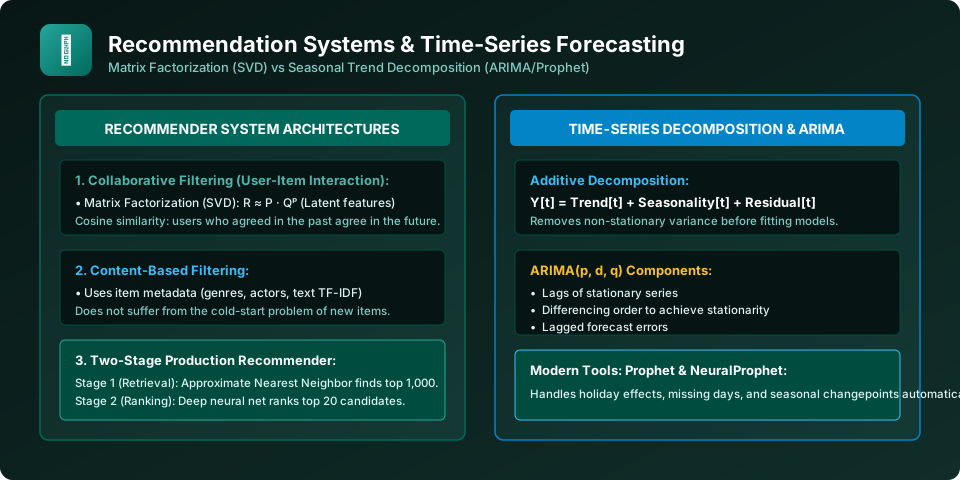
Figure 37.1: Matrix Factorization Recommender Systems vs Time-Series Decomposition Pipelines.
1. Collaborative Filtering: The Wisdom of Shared Behavior
Collaborative filtering relies purely on historical user interaction data (ratings, clicks, purchases) without needing to understand what items actually contain:
- User-Based Collaborative Filtering: "Find users similar to Alice based on past movie ratings, and recommend movies they loved that Alice hasn't seen yet."
- Item-Based Collaborative Filtering: "Find items that are frequently rated similarly by the same users. If Bob liked Inception, recommend Interstellar because fans of Inception consistently rate Interstellar highly."
2. Matrix Factorization via SVD (Singular Value Decomposition)
In production, the User-Item interaction matrix R of size m × n is over 99% sparse (most users have only rated a tiny fraction of products). Matrix Factorization decomposes R into two low-rank dense matrices representing latent feature preferences:
R ≈ P · Qᵖ
P (User Matrix):Sizem × k. Each row represents a user's affinity forklatent dimensions (e.g., preference for Sci-Fi, Action, Romance).Q (Item Matrix):Sizen × k. Each row represents how strongly an item exhibits those sameklatent dimensions.- Predicted rating for User
uon Itemi:r̂_{u,i} = p_u · q_iᵖ.
3. Content-Based Filtering & The Cold-Start Problem
The Achilles' heel of collaborative filtering is the Cold-Start Problem: when a brand-new user registers or a new product is added, there are zero interaction records, rendering collaborative matrix factorization useless!
Content-Based Filtering solves cold-start by building feature profiles from metadata (product categories, brand, actors, text embeddings). Hybrid recommendation systems use content metadata for new items, and transition to collaborative filtering as behavioral interactions accumulate.
Frequently Asked Questions (FAQ) - Student & Interview Review
Q1. What was the Netflix Prize competition?
Q2. What is Implicit vs Explicit Feedback in Recommenders?
Q3. How do two-stage modern industrial recommenders work?
Explore Related Machine Learning Tutorials & Next Steps
Broaden your foundational and advanced Machine Learning knowledge across our curriculum:
Compare itemset co-occurrence with latent factor matrix factorization.
Use ANN search for candidate generation in modern recommenders.
Serve personalized recommendations via fast REST endpoints.
Implement SVD collaborative filtering in Python.


You may also like this!
© Veewom.com. | Managed by PinePL
