
- Home
- Tutorials
- Machine Learning
- NLP Preprocessing & Embeddings
NLP Text Preprocessing: TF-IDF, N-grams & Word Embeddings
Natural Language Processing (NLP) bridges human linguistics and computational machine learning. Because computers cannot perform mathematical matrix operations on raw strings of text, NLP transforms unstructured prose into structured numerical vectors through Text Preprocessing and Vectorization.
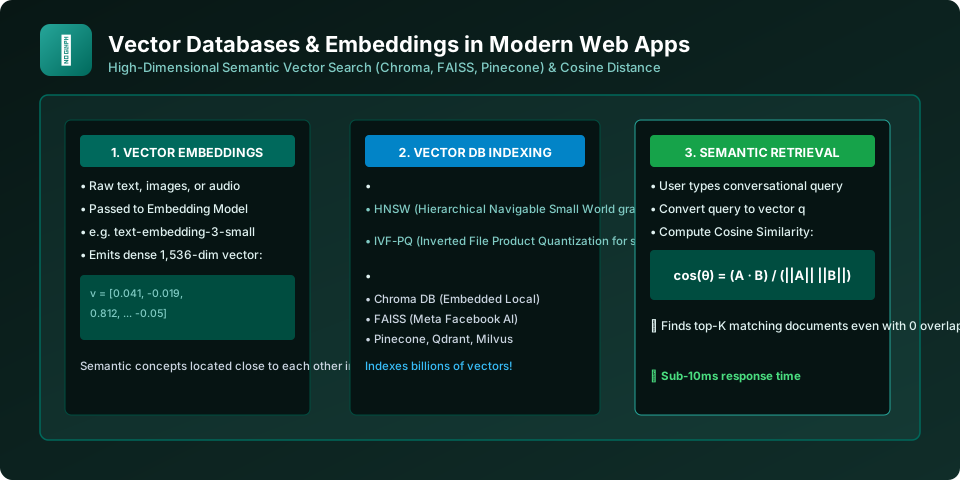
Figure 35.1: The Text Vectorization Pipeline — From Raw Text to Dense Semantic Vector Spaces.
The 4-Stage Text Preprocessing Pipeline
- Normalization & Cleaning: Lowercasing text, stripping HTML tags, removing punctuation, and expanding contractions.
- Tokenization: Breaking continuous strings into discrete linguistic units (words, subwords, or punctuation tokens).
- Stopword Removal: Removing high-frequency, low-information grammatical words (e.g., "the", "is", "at", "which").
- Stemming vs. Lemmatization:
- Stemming (Porter / Snowball): Crude heuristic rule-based chopping of word suffixes (e.g., "running", "runs" ➞ "run"; but "caring" ➞ "car" [Error!]).
- Lemmatization (WordNet): Morphological dictionary lookup that uses parts of speech to return the valid base lemma (e.g., "better" ➞ "good", "caring" ➞ "care").
TF-IDF: Term Frequency - Inverse Document Frequency
The Bag-of-Words (BoW) model simply counts word occurrences, but common words dominate the counts. TF-IDF solves this by scoring words based on how informative they are across an entire corpus:
TF-IDF Mathematical Formula
TF-IDF(t, d, D) = TF(t, d) · IDF(t, D)
- TF(t, d) [Term Frequency]:
Count(t in d) / Total_words(d). Measures how often wordtappears in documentd. - IDF(t, D) [Inverse Document Frequency]:
log( Total_docs(D) / (1 + Count_docs_containing(t)) ). Punishes words that appear in every document (like "the"), while heavily weighting words that only appear in specific topics (like "quantum" or "leukemia").
From Sparse BoW to Dense Word Embeddings (Word2Vec)
TF-IDF vectors are high-dimensional (20,000+ columns) and sparse (99% zeros). Furthermore, they completely ignore word meanings: to TF-IDF, "king" and "queen" have zero similarity! Dense Embeddings (Word2Vec, GloVe) map words into continuous low-dimensional geometric vector spaces (typically 100 to 300 dimensions) where semantic relationships are captured by spatial proximity: Vector("King") - Vector("Man") + Vector("Woman") ≈ Vector("Queen")!
Frequently Asked Questions (FAQ) - Student & Interview Review
Q1. What is an N-Gram and why use them?
Q2. What is Byte-Pair Encoding (BPE)?
Q3. What is the difference between Word2Vec and modern Transformer embeddings?
Explore Related Machine Learning Tutorials & Next Steps
Broaden your foundational and advanced Machine Learning knowledge across our curriculum:
Advance from TF-IDF and static embeddings to contextual tokens.
Store sentence embeddings in vector databases for semantic search.
Classify documents using bag-of-words and n-gram vectors.
Build an end-to-end text classifier with Scikit-Learn.


You may also like this!
© Veewom.com. | Managed by PinePL
