
- Home
- Tutorials
- Machine Learning
- History, Evolution & Core Types of ML
History, Evolution & Core Types of Machine Learning
To become a master Machine Learning engineer or data scientist, you must understand how the field evolved from theoretical mathematical logic into modern computational systems, and how the diverse landscape of algorithms is organized into core learning paradigms.
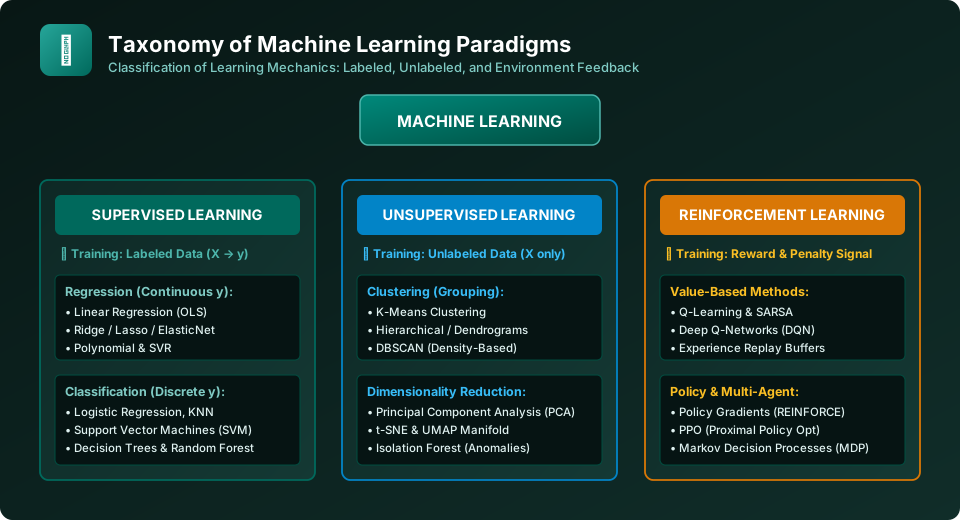
Figure 2.1: The Three Primary Pillars of Machine Learning — Supervised, Unsupervised, and Reinforcement Learning.
Chronological Milestones in Machine Learning History
Machine Learning did not appear overnight; it is the culmination of eight decades of research in statistics, neurobiology, and computing:
| Year / Era | Key Pioneer / Breakthrough | Historical Significance |
|---|---|---|
| 1943 | Warren McCulloch & Walter Pitts | Created the first mathematical model of a biological neuron (threshold logic). |
| 1950 | Alan Turing | Published Computing Machinery and Intelligence, proposing the Turing Test. |
| 1957 | Frank Rosenblatt | Invented the Perceptron hardware at Cornell, the foundation of modern artificial neural nets. |
| 1969 | Marvin Minsky & Seymour Papert | Published Perceptrons, proving single layers cannot learn XOR, triggering the first "AI Winter". |
| 1986 | Geoffrey Hinton, Rumelhart & Williams | Popularized the Backpropagation algorithm, enabling deep multi-layer neural network training. |
| 1995 | Corinna Cortes & Vladimir Vapnik | Invented Support Vector Machines (SVM), which dominated statistical ML for two decades. |
| 2001 | Leo Breiman | Introduced Random Forests, combining bagging with random feature selection. |
| 2012 | Alex Krizhevsky, Sutskever & Hinton | AlexNet crushed ImageNet error rates using GPU-accelerated CNNs, starting the modern Deep Learning revolution. |
| 2017–Present | Vaswani et al. (Google Brain) | Introduced the Transformer architecture, sparking the current era of LLMs, Foundation Models, and autonomous agents. |
The Three Main Paradigms of Machine Learning
1. Supervised Learning (Learning with a Teacher)
In Supervised Learning, the algorithm is provided with a training dataset consisting of paired input features X and corresponding ground-truth target labels y. The objective is to learn a mapping function f(X) → y that accurately predicts outputs for previously unseen inputs.
Supervised learning is divided into two broad subcategories based on the nature of the target variable y:
- Regression: The target
yis a continuous real-valued number (e.g., predicting house prices, temperature, stock valuation, or patient blood pressure). Core algorithms include Linear Regression, Ridge/Lasso, and Support Vector Regression. - Classification: The target
yis a discrete categorical class label (e.g., detecting spam vs. not-spam, classifying medical tumors as benign vs. malignant, or identifying handwriting digits 0-9). Core algorithms include Logistic Regression, Decision Trees, Random Forests, and SVMs.
2. Unsupervised Learning (Discovering Hidden Structure)
In Unsupervised Learning, the training data contains only input features X without any supervisor labels y. The model's objective is to explore the underlying geometric or probabilistic structure of the data and discover natural groupings, density patterns, or latent representations.
- Clustering: Grouping similar observations together based on distance metrics (e.g., K-Means customer segmentation, DBSCAN spatial anomaly detection, Hierarchical clustering).
- Dimensionality Reduction: Compressing high-dimensional feature spaces into fewer dimensions while preserving variance and geometric topology (e.g., PCA, t-SNE, UMAP).
- Association Rule Learning: Identifying interesting relationships and co-occurrence rules between items in transactional databases (e.g., Apriori algorithm in retail basket analysis).
3. Reinforcement Learning (Learning through Trial & Reward)
In Reinforcement Learning (RL), an autonomous agent interacts with a dynamic environment through sequential actions. The agent receives feedback in the form of numerical rewards (positive reinforcement) or penalties (negative reinforcement). The agent's goal is to learn an optimal policy π(s) that maximizes cumulative discounted future rewards over time. Applications include self-driving vehicles, chess/Go engines (AlphaZero), robotics manipulation, and LLM alignment via RLHF.
University Exam Point: What is Semi-Supervised Learning?
In many real-world domains (e.g., medical imaging or protein folding), acquiring unlabeled data is cheap and automated, but acquiring expert ground-truth labels is extremely expensive and time-consuming. Semi-Supervised Learning trains on a small set of labeled data combined with a massive pool of unlabeled data, leveraging the structural distribution of the unlabeled data to dramatically boost classification boundary accuracy.
Frequently Asked Questions (FAQ) - Student & Interview Review
Q1. What is the key difference between Supervised and Unsupervised learning?
Q2. What is the difference between Regression and Classification?
Q3. How does Reinforcement Learning differ from Supervised Learning?
Explore Related Machine Learning Tutorials & Next Steps
Broaden your foundational and advanced Machine Learning knowledge across our curriculum:
Connect learning definitions with the underlying matrix calculus.
Prepare raw datasets for training by handling nulls, outliers, and scales.
Transition from continuous regression to categorical classification.
Jump straight into executable code labs and end-to-end projects.


You may also like this!
© Veewom.com. | Managed by PinePL
