
Java Exception Handling: Throwable Architecture & Checked vs Unchecked
In mission-critical enterprise systems, applications must handle unexpected runtime errors gracefully without abruptly crashing. Java provides a robust, object-oriented Exception Handling Framework rooted in the java.lang.Throwable class.
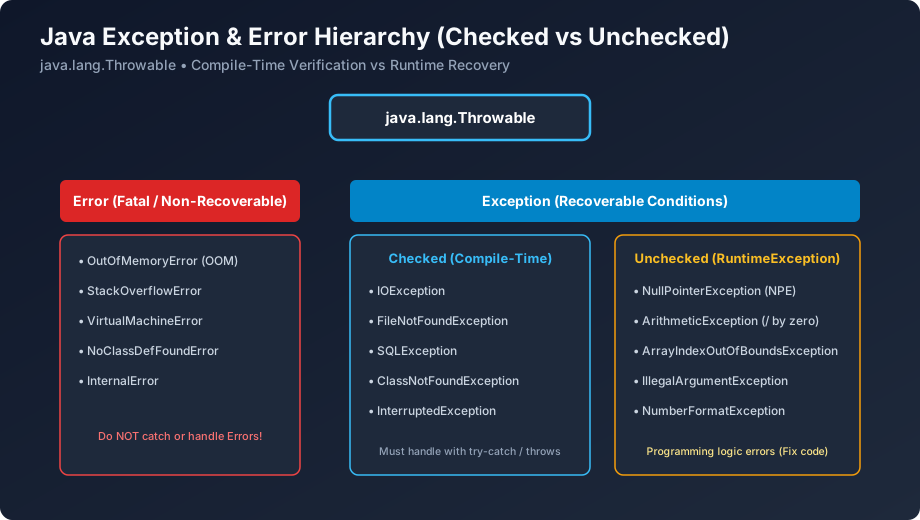
Figure 8: Complete Java Exception Hierarchy: Throwable branching into Error and Exception (Checked vs RuntimeException).
The Anatomy of java.lang.Throwable
Every exception in Java is an Object that directly or indirectly inherits from Throwable, which splits into two major branches:
1. Error (Fatal / System Failures)
Errors indicate catastrophic internal JVM failures or system resource exhaustion that typical applications cannot anticipate or recover from. Never catch an Error! Examples include:
OutOfMemoryError: The JVM Heap has exhausted all available RAM.StackOverflowError: Infinite recursion has consumed the thread Call Stack.VirtualMachineError: Internal corruption within the JVM native engine.
2. Exception (Recoverable Application Conditions)
Exceptions represent conditions that a well-written application can catch, log, and recover from:
- Checked Exceptions (Compile-Time): Classes that extend
Exception(excludingRuntimeException). The compiler forces you to handle them (e.g.IOException,SQLException,FileNotFoundException). - Unchecked Exceptions (Runtime): Classes that extend
java.lang.RuntimeException. Caused by logical programming mistakes (e.g.NullPointerException,ArithmeticException,ArrayIndexOutOfBoundsException).
Checked vs. Unchecked Exceptions Comparison
| Parameter | Checked Exceptions | Unchecked (RuntimeException) |
|---|---|---|
| Compiler Check | Verified strictly at compile-time by javac |
Ignored at compile-time; occurs at runtime |
| Handling Requirement | Mandatory: Must use try-catch or throws |
Optional: Best practice is to fix the underlying code bug |
| Inherits From | Directly from java.lang.Exception |
Directly from java.lang.RuntimeException |
| Common Examples | IOException, ClassNotFoundException |
NullPointerException, ClassCastException |
University Exam Corner (BCA / B.Sc CS)
Exam Question: "State the 5 keywords used for exception handling in Java."
The 5 Exception Keywords:
1. try: Wraps guarded code that might throw an exception.
2. catch: Catches and handles a specific exception type.
3. finally: Clean-up block guaranteed to execute regardless of errors.
4. throw: Explicitly triggers an exception instance.
5. throws: Declares potential checked exceptions in a method signature.
Next Step
Now let us examine how to catch exceptions using Try, Catch, Finally, and Multi-Catch blocks. Proceed to: Java Try, Catch & Finally →
Frequently Asked Questions (FAQ)
Explore Related Java Tutorials
Accelerate your Java mastery by studying these tightly connected core tutorials:
Handling exception blocks.
Throwing and declaring exceptions.
User-defined exception classes.
Automatic resource cleanup.


You may also like this!
© Veewom.com. | Managed by PinePL
