
Java Tutorial: Complete Step-by-Step Guide for Beginners to Advanced
Java is a high-level, class-based, object-oriented, platform-independent, and robust programming language. Designed around the revolutionary philosophy of "Write Once, Run Anywhere" (WORA), Java enables compiled bytecode to execute without modification across any operating system equipped with a compatible Java Virtual Machine (JVM).
Welcome to the Updated Veewom Java Master Course
Engineered for BCA Students, Computer Science Undergraduates, Self-Taught Programmers, and Enterprise Engineers. Every lesson delivers verified source code, architecture diagrams, dry-run memory traces (Stack vs Heap), and university exam tips.
What is Java? (Architectural Definition)
Unlike purely compiled languages like C/C++ (which generate machine-specific machine code binaries) or purely interpreted scripting languages like Python or JavaScript, Java employs a hybrid two-stage compilation and execution architecture:
- Stage 1 (javac Compiler): Source code (
.java) is parsed, checked for type safety, and translated into compact, architectural-neutral bytecode instructions stored inside.classfiles. - Stage 2 (JVM Execution Engine): The Java Virtual Machine loads the bytecode, verifies security constraints, interprets instructions, and employs the Just-In-Time (JIT) compiler to compile performance-critical code directly into native CPU machine instructions.
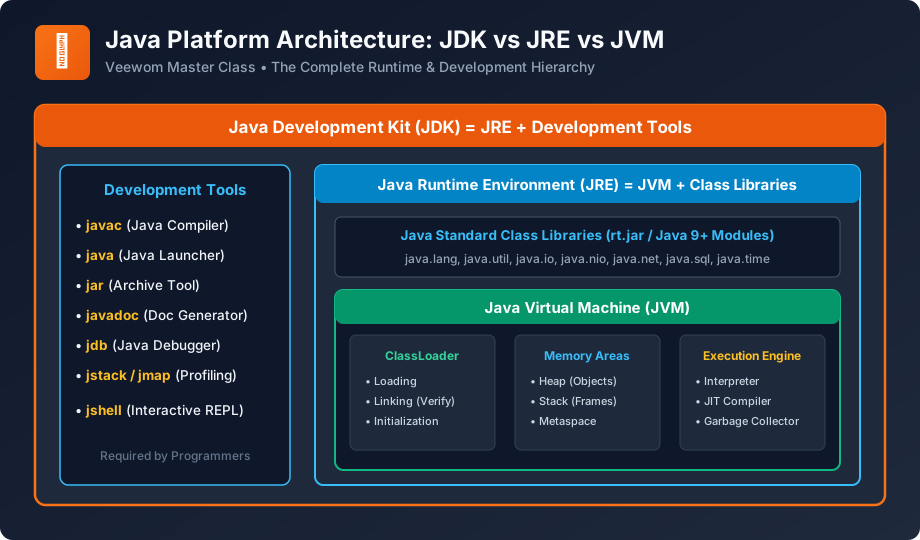
Figure 1: High-Level Java Platform Architecture: JDK (Development Tools + JRE) wrapping JRE (Class Libraries + JVM).
Why Learn Java in 2026? Academic & Industry Relevance
For over three decades, Java has consistently maintained its top-tier rank in global software engineering. Here is why Java is indispensable for university students and developers alike:
| Feature | Significance for Students, Engineers & Bloggers |
|---|---|
| Platform Independence (WORA) | Bytecode runs identically on Windows, Linux, macOS, and cloud containers without recompilation. |
| Strict Object-Oriented Design | Teaches industry-standard software design patterns, encapsulation, polymorphism, and maintainable enterprise architecture. |
| Automatic Memory Management | Robust garbage collection (G1, ZGC) manages heap memory, completely eliminating manual pointer deallocation and memory leak crashes common in C++. |
| Massive Ecosystem & Libraries | Frameworks like Spring Boot, Hibernate, Apache Kafka, and Android SDK power the modern global internet infrastructure. |
| Modern Concurrency (Virtual Threads) | Java 21 Project Loom introduces lightweight Virtual Threads, handling millions of concurrent HTTP requests with minimal memory overhead. |
| Core University Curricula (BCA/MCA/CS) | Mandatory core subject in Indian and global universities for Object-Oriented Software Engineering and Advanced Programming labs. |
Your Very First Java Program: "Hello, World!"
Let us examine the foundational structure of every Java program. In Java, every executable statement must reside inside a class:
// HelloWorld.java - Traditional First Program
public class HelloWorld {
    // Execution starts at the main method
    public static void main(String[] args) {
        System.out.println("Hello, Welcome to Veewom Java Masterclass!");
    }
}
Line-by-Line Code Breakdown:
public class HelloWorld: Defines a publicly accessible class namedHelloWorld. In Java, if a class is public, the filename must exactly match the class name with a.javaextension.public static void main(String[] args): The standardized entry point called by the JVM:public: Access modifier allowing the JVM runtime to invoke this method from outside the class package.static: Allows the JVM to invoke the method without creating an instance/object ofHelloWorld.void: Return type indicating the method returns no value upon completion.main: The reserved method name sought by the JVM launcher.String[] args: Array of strings that captures command-line arguments passed during invocation.
System.out.println(...): Standard output utility:Systemis a built-in class injava.lang,outis a staticPrintStreamobject, andprintlnoutputs text followed by a newline.
University Exam Corner (BCA / B.Sc CS)
Frequent Exam Question: "Can we swap public and static in the main method? Can we write static public void main?"
Answer: Yes! The order of modifiers in Java does not matter. Both public static void main and static public void main are 100% syntactically valid and execute identically in the JVM.
Next Step
Ready to begin your journey? Let us explore how Java was invented by James Gosling at Sun Microsystems and how it evolved into modern Java 21 LTS. Proceed to: Java History, Versions & Features →
Frequently Asked Questions (FAQ)
Explore Related Java Tutorials
Accelerate your Java mastery by studying these tightly connected core tutorials:
Discover how Oak evolved into Java 21+ LTS.
Step-by-step installation for Windows, Mac, and Linux.
Understand the Java execution and development architecture.
Structure of a Java program, main method, and conventions.
Encapsulation, Inheritance, Abstraction, and Polymorphism.
BCA viva questions and senior developer coding interview prep.


You may also like this!
© Veewom.com. | Managed by PinePL
