
Java 21 Virtual Threads: Lightweight User-Space Concurrency (Project Loom)
Finalized in Java 21 LTS (Project Loom), Virtual Threads represent the most profound evolution in Java concurrency since the language's inception. They allow high-throughput web servers and microservices to run millions of concurrent connections using simple, synchronous code without complex reactive programming.
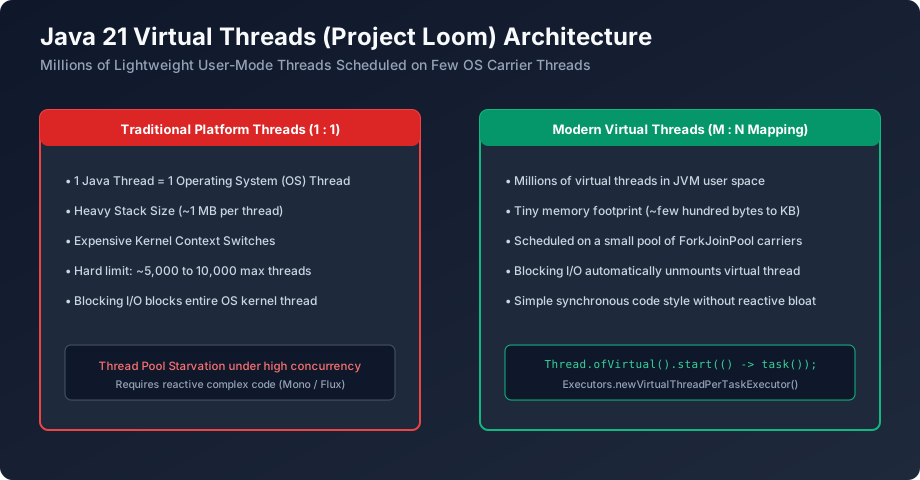
Figure 12: Architectural Mapping: Millions of lightweight Virtual Threads scheduled onto a small pool of OS Carrier Threads.
Creating Virtual Threads in Java 21+
import java.util.concurrent.Executors;
import java.time.Duration;

public class VirtualThreadDemo {
    public static void main(String[] args) throws Exception {
        // 1. Spawning a single virtual thread
        Thread vThread = Thread.ofVirtual().name("VThread-1").start(() -> {
            System.out.println("Running inside: " + Thread.currentThread());
        });
        vThread.join();

        // 2. Launching 100,000 Concurrent Virtual Threads with Ease!
        try (var executor = Executors.newVirtualThreadPerTaskExecutor()) {
            for (int i = 1; i <= 100_000; i++) {
                final int taskId = i;
                executor.submit(() -> {
                    Thread.sleep(Duration.ofMillis(500)); // Non-blocking sleep!
                    return taskId;
                });
            }
        } // Automatically awaits completion of all 100,000 tasks!
        System.out.println("Successfully executed 100,000 virtual threads without crashing RAM!");
    }
}
Next Step
Congratulations on completing Concurrency! Let us now enter Section 7: File I/O, NIO.2 & JVM Internals. Proceed to: Java File I/O Streams →
Frequently Asked Questions (FAQ)
Explore Related Java Tutorials
Accelerate your Java mastery by studying these tightly connected core tutorials:
Virtual thread executors.
Platform threads comparison.
JVM execution engine.
Entering Section 7: File I/O.


You may also like this!
© Veewom.com. | Managed by PinePL
