
JVM Internal Architecture: ClassLoader, Execution Engine & JIT
The Java Virtual Machine (JVM) is the abstract computing machine that makes Java platform-independent ("Write Once, Run Anywhere"). Understanding JVM architecture separates junior coders from senior software engineers and is a favorite interview subject for tech giants and university exams.
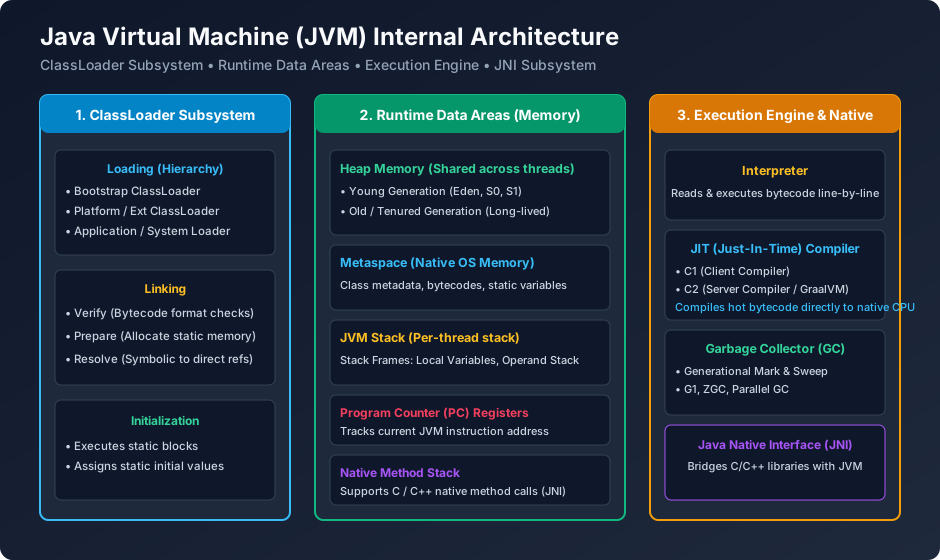
The Three Pillars of the JVM
- ClassLoader Subsystem: Responsible for locating, reading, and loading
.classbytecode files into memory. - Run-Time Data Areas (Memory): Where data and program instructions are stored during execution (Heap, Stack, Metaspace, PC registers).
- Execution Engine: The component that reads bytecode and executes it as machine instructions on the underlying CPU hardware.
1. The ClassLoader Subsystem
Class loading occurs in three sequential phases: Loading, Linking, and Initialization.
Phase A: Loading & Delegation Hierarchy
Java employs three built-in ClassLoaders operating under the Delegation Principle:
| ClassLoader | Source of Classes | Implementation |
|---|---|---|
| Bootstrap ClassLoader | Core Java runtime classes (java.lang.*, java.util.*). Root of hierarchy. | C/C++ native code (returns null in Java) |
| Platform ClassLoader (formerly Extension) | Platform modules and standard extensions (java.sql, java.xml). | Java code |
| Application ClassLoader (System) | Your custom application classes from the application CLASSPATH or module path. | Java code |
public class ClassLoaderInspection {
    public static void main(String[] args) {
        // Application ClassLoader loads your application class
        ClassLoader appLoader = ClassLoaderInspection.class.getClassLoader();
        System.out.println("App ClassLoader: " + appLoader);

        // Parent of App ClassLoader is Platform ClassLoader
        ClassLoader platformLoader = appLoader.getParent();
        System.out.println("Platform ClassLoader: " + platformLoader);

        // Parent of Platform ClassLoader is Bootstrap (written in C/C++, represented as null)
        ClassLoader bootstrapLoader = platformLoader.getParent();
        System.out.println("Bootstrap ClassLoader: " + bootstrapLoader);

        // String belongs to core java.lang, loaded by Bootstrap
        System.out.println("String ClassLoader: " + String.class.getClassLoader());
    }
}
Phase B: Linking
- Verification: The Bytecode Verifier checks that bytecode adheres to JVM specifications and does not violate memory safety or stack limits.
- Preparation: JVM allocates memory for static variables and initializes them to their default values (e.g.,
intgets 0, references getnull). - Resolution: Symbolic memory references are replaced with direct memory addresses.
Phase C: Initialization
This is where static initializers and explicit static variable assignments are executed in source code order (e.g., static int x = 100;).
2. The Execution Engine & JIT Compiler
The Execution Engine contains three vital components:
- Interpreter: Reads bytecode instructions one by one and translates them to native machine code. It starts quickly, but executing repetitive loops through the interpreter is inefficient.
- JIT (Just-In-Time) Compiler: The JIT compiler monitors code execution frequency. When a method or loop is executed repeatedly (a "hot spot"), the JIT compiles the entire bytecode block directly into optimized native machine code. Subsequent calls run at bare-metal native CPU speed.
- Garbage Collector (GC): Automatically tracks and reclaims unreferenced heap objects to prevent memory exhaustion.
- Viva Question: Why does
String.class.getClassLoader()returnnull?
Answer: Core system classes injava.baseare loaded by the Bootstrap ClassLoader, which is implemented in native C/C++ inside the JVM binary. In Java code, the Bootstrap ClassLoader is represented bynull. - Exam Concept: The HotSpot JVM uses adaptive optimization with two JIT tiers: C1 (Client Compiler for fast startup) and C2 (Server Compiler for deep optimization of long-running server workloads).
Frequently Asked Questions (FAQ)
Explore Related Java Tutorials
Accelerate your Java mastery by studying these tightly connected core tutorials:
Heap, Stack, Metaspace, and Memory Areas.
Generational GC and memory reclamation.
Inspecting loaded classes at runtime.
JDK, JRE, and WORA philosophy.


You may also like this!
© Veewom.com. | Managed by PinePL
