
PHP OOP Inheritance: Code Reuse, Method Overriding & Final Classes
One of the greatest benefits of Object-Oriented Programming is the elimination of code duplication. Instead of creating distinct classes from scratch that share 80% of the same properties and methods, Inheritance allows a child class to inherit all functionality from an existing parent class using the extends keyword. You can then add new specialized features or override existing behaviors.
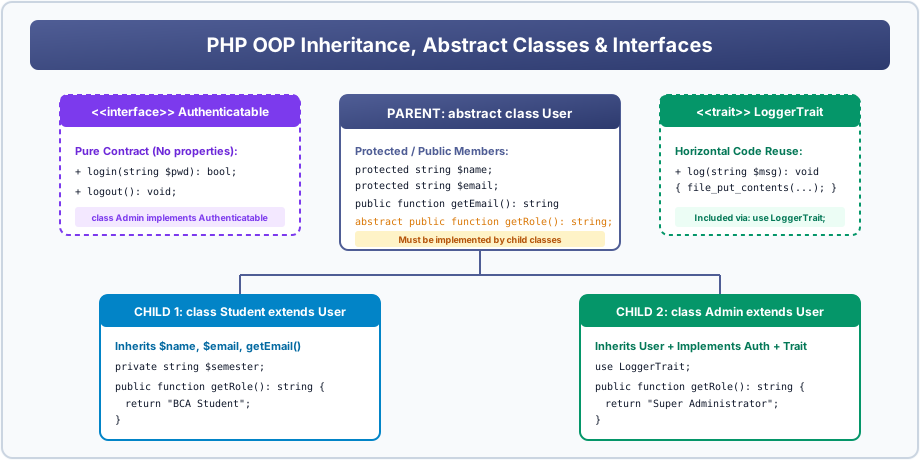
Figure 8: Class hierarchy showing Parent Base Class, Child Derived Classes, and Trait horizontal inclusion.
Basic Inheritance with extends
<?php
    // Parent Base Class
    class Person {
        public function __construct(
            public string $name,
            public string $email
        ) {}

        public function getGeneralInfo(): string {
            return "Name: {$this->name} | Email: {$this->email}";
        }
    }

    // Child Derived Class inheriting Person
    class Student extends Person {
        public string $rollNumber;

        public function setRollNumber(string $roll): void {
            $this->rollNumber = $roll;
        }

        public function study(): void {
            echo "{$this->name} is currently preparing for BCA Semester Exams.<br>";
        }
    }

    $student = new Student("Aakash Verma", "aakash@veewom.com");
    $student->setRollNumber("BCA-2026-05");

    // Inherited from Person:
    echo $student->getGeneralInfo() . "<br>";
    // Specific to Student:
    $student->study();
?>
Method Overriding & Calling parent::__construct()
When a child class defines a method with the exact same name as a parent class method, it overrides the parent's implementation. If the child defines its own constructor, it should call parent::__construct() to ensure base properties are initialized:
<?php
    class Teacher extends Person {
        public string $department;

        public function __construct(string $name, string $email, string $department) {
            // Call parent constructor to initialize $name and $email
            parent::__construct($name, $email);
            $this->department = $department;
        }

        // Method Overriding: Customizing getGeneralInfo() for teachers
        public function getGeneralInfo(): string {
            $baseInfo = parent::getGeneralInfo(); // Calls parent method
            return $baseInfo . " | Department: {$this->department}";
        }
    }

    $prof = new Teacher("Dr. Sharma", "sharma@veewom.com", "Computer Applications");
    echo $prof->getGeneralInfo();
?>
The final Keyword: Preventing Overriding & Extension
When building secure software, you may want to prevent subclasses from altering critical security logic:
<?php
    // Preventing class extension: No other class can extend FinalPaymentGateway
    final class FinalPaymentGateway {
        public function charge(): void {
            echo "Processing secure payment.";
        }
    }

    // class HackedGateway extends FinalPaymentGateway {}
    // Fatal Error: Class HackedGateway cannot extend final class FinalPaymentGateway

    class SecurityVault {
        // Preventing method overriding
        final public function getMasterEncryptionKey(): string {
            return "secret-token-10294";
        }
    }
?>
BCA / CS University Exam Corner
High-Frequency Exam Question:
Q: What is the Scope Resolution Operator in PHP?
A: The double colon (::) is the Scope Resolution Operator (Paamayim Nekudotayim). It is used to access parent:: methods, static properties/methods (ClassName::method()), and class constants (ClassName::CONSTANT).
Interactive Student Practice Session
Exercise 36.1: Create a base Vehicle class with properties brand and speed. Extend it with a Car class that adds numberOfDoors and overrides a drive() method.
Exercise 36.2: Create an application where a child class calls its parent's constructor using parent::__construct().


You may also like this!
© Veewom.com. | Managed by PinePL
