
PHP OOP Basics: Classes, Object Instances, Properties & Constructors
As web applications grow from simple scripts into enterprise software platforms, procedural code quickly becomes unmanageable. Object-Oriented Programming (OOP) solves this by bundling data (properties) and functions (methods) into cohesive, self-contained units called Objects. All modern PHP frameworks—including Laravel, Symfony, and WordPress—are architected entirely on OOP principles.
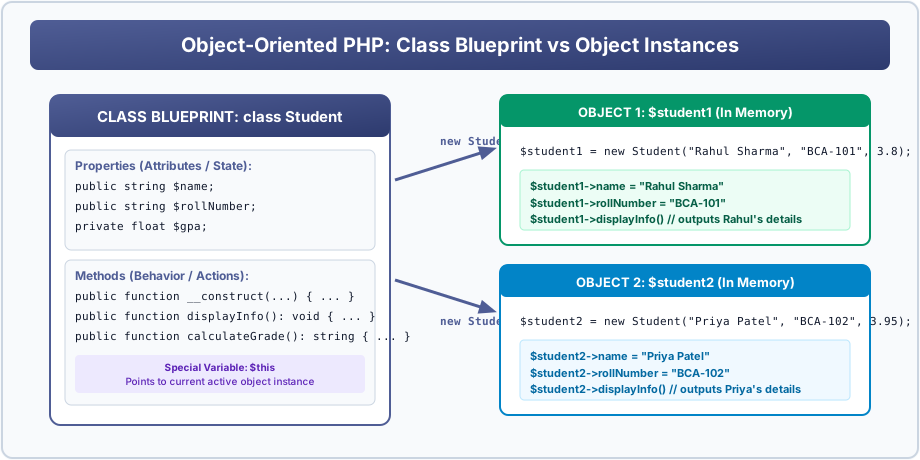
Figure 7: The Class Blueprint defines properties and methods, while multiple unique Objects exist in memory.
Anatomy of a Class: Properties & Methods
A Class is declared using the class keyword. Variables declared inside a class are called Properties, and functions declared inside a class are called Methods:
<?php
    class Student {
        // Properties (Attributes)
        public string $name;
        public string $rollNumber;
        public float $marks;

        // Method (Behavior)
        public function displayDetails(): void {
            // $this refers to the current calling object instance
            echo "Student: " . $this->name . " (Roll: " . $this->rollNumber . ") - Marks: " . $this->marks . "%<br>";
        }
    }

    // Creating (instantiating) object instances using 'new'
    $student1 = new Student();
    $student1->name = "Vikram Aditya";
    $student1->rollNumber = "BCA-101";
    $student1->marks = 94.5;
    $student1->displayDetails();

    $student2 = new Student();
    $student2->name = "Anjali Rao";
    $student2->rollNumber = "BCA-102";
    $student2->marks = 91.0;
    $student2->displayDetails();
?>
Constructors (__construct) and Destructors (__destruct)
Manually setting properties one-by-one is tedious. A Constructor is a special magic method that PHP executes automatically the moment an object is instantiated:
<?php
    class Course {
        public string $title;
        public string $instructor;
        public int $durationWeeks;

        // Constructor executed automatically on 'new Course(...)'
        public function __construct(string $title, string $instructor, int $durationWeeks = 12) {
            $this->title = $title;
            $this->instructor = $instructor;
            $this->durationWeeks = $durationWeeks;
            echo "Course '{$this->title}' successfully initialized.<br>";
        }

        // Destructor executed when object is destroyed or script ends
        public function __destruct() {
            echo "Closing course session for: '{$this->title}'<br>";
        }
    }

    // Instantiate with arguments passed directly to the constructor
    $phpCourse = new Course("PHP 8 Master Class", "Veewom Faculty", 16);
?>
Modern PHP 8 Game Changer: Constructor Property Promotion
In PHP 8, you can combine property declaration, parameter definitions, and assignment into a single line, eliminating dozens of lines of repetitive boilerplate code:
<?php
    // OLD verbose PHP 7 way required declaring properties, parameters, and $this assignments
    // MODERN PHP 8 Way: Constructor Property Promotion
    class UserAccount {
        public function __construct(
            public string $username,
            public string $email,
            public string $role = "Student"
        ) {} // Empty body! PHP automatically creates and assigns the properties!
    }

    $user = new UserAccount("rohan_m", "rohan@veewom.com");
    echo "User created: " . $user->username;
?>
BCA / CS University Exam Corner
High-Frequency Exam Question:
Q: What is the purpose of the instanceof operator in PHP?
A: The instanceof operator checks whether a specific object is an instance of a given class or implements a specific interface:
if ($student1 instanceof Student) { /* valid object */ }.
Interactive Student Practice Session
Exercise 35.1: Create a BankAccount class with properties for account number and balance, and methods deposit(float $amount) and withdraw(float $amount).
Exercise 35.2: Implement the class using PHP 8's Constructor Property Promotion feature.


You may also like this!
© Veewom.com. | Managed by PinePL
