
- Home
- Difference
- Python vs Java
Difference Between Python and Java Programming
Quick Summary: Python is a dynamically typed, interpreted programming language renowned for its ultra-concise, readable syntax, making it the premier choice for Artificial Intelligence, Data Science, and automation. Java is a statically typed, compiled-to-bytecode language running on the Java Virtual Machine (JVM), celebrated for its "Write Once, Run Anywhere" (WORA) philosophy, robust type safety, and massive enterprise-grade scalability.
Both Python and Java consistently rank among the most widely used programming languages in the global software industry. However, they approach software architecture from opposite ends of the typing and execution spectrum.
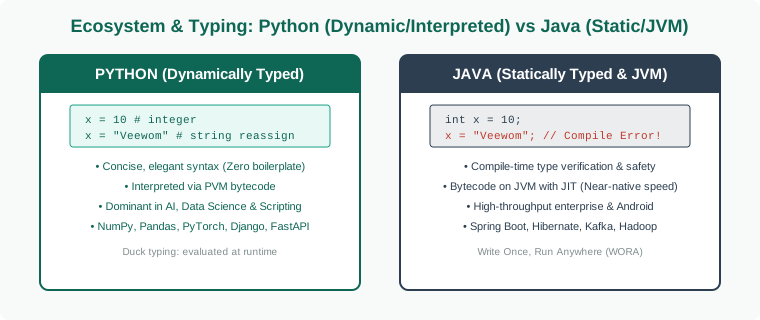
Detailed Comparison Table: Python vs Java
FEATURE |
PYTHON |
JAVA |
|---|---|---|
Typing System |
Dynamically Typed: Variables do not have fixed types; types are checked and resolved at runtime. |
Statically Typed: Every variable must have an explicitly declared type checked at compile-time. |
Syntax & Readability |
Concise, clean, and elegant. Uses whitespace indentation instead of curly braces and semicolons. |
Verbose and structured. Requires explicit class definitions, access specifiers, curly braces, and semicolons. |
Execution Architecture |
CPython interprets bytecode line-by-line via the Python Virtual Machine (PVM). |
Compiles to bytecode ( |
Runtime Speed & Performance |
Slower CPU execution due to dynamic type dispatch and interpreter overhead. |
Significantly faster (often 5x to 10x faster) thanks to JIT optimization and direct machine code generation. |
Concurrency & Multi-Threading |
Constrained by the Global Interpreter Lock (GIL) in CPython; true parallelism requires multiprocessing. |
True multi-threading with native OS thread mapping and modern Virtual Threads (Project Loom). |
Memory Management |
Automatic memory management using reference counting and a generational garbage collector. |
High-throughput generational garbage collection (G1, ZGC, Shenandoah) optimized for heavy server heaps. |
Database & Enterprise Tooling |
Fast development via SQLAlchemy, Django ORM, and lightweight microservices (FastAPI). |
Massive enterprise frameworks (Spring Boot, Hibernate, Quarkus) supporting complex distributed systems. |
Primary Use Cases |
Machine Learning (TensorFlow, PyTorch), Data Science (Pandas), AI Agents, Scripting, DevOps. |
Large-scale enterprise banking backends, Android app development, Big Data (Apache Spark, Kafka, Hadoop). |
Code Comparison: Class Definition & Printing
Compare the lines of code needed to define a simple entity and print output in both languages:
1. Python Implementation (3 Lines)
# Python: Dynamic, minimal boilerplate
class Greeter:
    def greet(self, name: str) -> None:
        print(f"Welcome to Veewom, {name}!")

Greeter().greet("Developer")
2. Java Implementation (13 Lines)
// Java: Static, explicit types and mandatory enclosing class
public class Greeter {
    public void greet(String name) {
        System.out.println("Welcome to Veewom, " + name + "!");
    }

    public static void main(String[] args) {
        Greeter g = new Greeter();
        g.greet("Developer");
    }
}
Architectural Decision Matrix:
- Choose Python: For AI, Deep Learning, quick MVPs, financial data analysis, automation scripts, and rapid API development.
- Choose Java: For large multi-developer enterprise architectures, high-concurrency microservices, Android mobile applications, and mission-critical banking transactions where static typing prevents unexpected runtime errors.
Practice Session & Self-Assessment Quiz
Q1: What happens in Python when you assign a string to a variable previously holding an integer?
Click to Reveal Answer & Explanation
Correct Answer: B
In Python, variables are simply references (names) bound to objects in memory. You can freely re-bind a variable name to an object of a completely different type at any time.
Q2: What is the primary function of the Java Virtual Machine (JVM)?
Click to Reveal Answer & Explanation
Correct Answer: B
The JVM provides an abstraction layer over native hardware, executing compiled .class bytecode so that Java programs run identically across Windows, Linux, and macOS.
Q3: Why can Java achieve true parallel multi-threading while standard Python (CPython) cannot for CPU-bound tasks?
Click to Reveal Answer & Explanation
Correct Answer: B
The Global Interpreter Lock (GIL) ensures thread-safe memory management in CPython by permitting only one native thread to hold the Python interpreter lock at a time, limiting CPU-bound parallelism.
Top Viva & Technical Interview Questions
1. What does Java's "Write Once, Run Anywhere" (WORA) mean?
WORA means compiled Java bytecode (.class file) can execute without recompilation on any computing architecture that has a compatible JVM implementation installed.
2. What is Duck Typing in Python?
Duck typing is a programming concept derived from the phrase: "If it walks like a duck and quacks like a duck, it is a duck." Python checks for the presence of methods and properties at runtime rather than verifying an explicit class inheritance hierarchy or interface.
3. How do Python Virtual Environments differ from the Java Classpath?
Python virtual environments (venv, conda) isolate distinct copies of third-party package dependencies per project. The Java Classpath is an environment parameter telling the JVM where to look for user-defined classes and packages (JAR files).
Frequently Asked Questions (FAQs)
Is Java completely object-oriented?
Java is not 100% purely object-oriented because it retains 8 primitive data types (int, float, boolean, char, etc.) for performance reasons, although wrapper classes (Integer, Float) exist.
Why has Python become the undisputed leader in Artificial Intelligence?
Python's clear mathematical syntax, seamless integration with C/C++ backend libraries (like BLAS, CUDA), and immense ecosystem of specialized machine learning packages (PyTorch, TensorFlow, Scikit-Learn, HuggingFace) make it unbeatable for AI researchers and developers.
Can Python and Java work together in one application?
Yes. Many enterprise systems run high-throughput Java microservices (Spring Boot) on the backend while orchestrating machine learning inference or ETL data pipelines in Python, communicating via gRPC or REST APIs.
Related Difference Classes to Explore


You may also like this!
© Veewom.com. | Managed by PinePL
