
- Home
- Difference
- Array vs Linked List
Difference Between Array and Linked List
Quick Summary: An Array is a linear data structure storing elements of identical types in contiguous, sequential memory locations, offering lightning-fast O(1) random access via indices. A Linked List is a dynamic linear data structure composed of standalone nodes scattered across heap memory, where each node stores data and a pointer referencing the next node, offering effortless O(1) insertions without memory shifting.
In computer programming and algorithm design, deciding between an array and a linked list is the fundamental memory allocation trade-off: Contiguous Indexing & Cache Efficiency versus Dynamic Resizing & Pointer Flexibility.
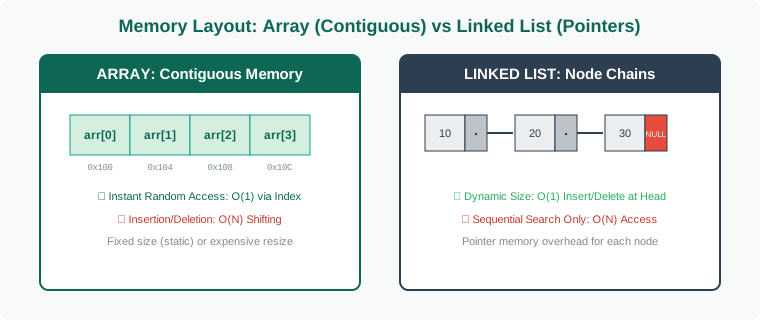
Side-by-Side Comparison: Array vs Linked List
FEATURE |
ARRAY |
LINKED LIST |
|---|---|---|
Memory Allocation |
Elements occupy contiguous (consecutive) memory blocks allocated statically on stack or dynamically via |
Nodes are stored at non-contiguous, random locations across heap memory connected via pointer addresses. |
Access Time (Random Access) |
O(1) Constant Time: Direct access to any element via mathematical indexing: |
O(N) Linear Time: Sequential traversal required from the head pointer node-by-node. |
Insertion & Deletion |
O(N) Time: Inserting or removing elements at arbitrary positions requires shifting all subsequent elements. |
O(1) Time: Inserting or deleting a node at the head (or given a pointer) simply updates two pointer addresses. |
Size & Resizing |
Fixed capacity in static arrays; dynamic arrays (like |
Dynamic and flexible: grows and shrinks seamlessly at runtime node-by-node as memory is needed. |
Memory Overhead |
Zero pointer overhead: allocates memory strictly for data payloads. |
High memory overhead: each node must store one (or two in doubly linked lists) pointer addresses (4 to 8 bytes each). |
CPU Cache Locality |
Excellent spatial locality: consecutive memory preloads into L1/L2 CPU cache lines, minimizing cache misses. |
Poor cache locality: dispersed heap nodes cause frequent CPU cache misses and bus stalls. |
Searching Complexity |
O(N) for linear search; O(log N) for sorted arrays using Binary Search. |
O(N) always: binary search cannot be efficiently performed due to lack of random access. |
Code Comparison in C: Structure & Traversal
1. Array Declaration and Element Access
#include <stdio.h>

int main() {
    int arr[5] = {10, 20, 30, 40, 50};

    // Instant O(1) random access by index
    printf("Third element: %d\n", arr[2]);
    return 0;
}
2. Singly Linked List Node and Traversal
#include <stdio.h>
#include <stdlib.h>

struct Node {
    int data;
    struct Node *next; // Pointer to next scattered heap node
};

void traverseList(struct Node *head) {
    struct Node *current = head;
    while (current != NULL) { // O(N) sequential traversal
        printf("%d -> ", current->data);
        current = current->next;
    }
    printf("NULL\n");
}
When to Use Which:
- Choose an Array when: You know the element count in advance, frequent read operations and random lookups are required, memory efficiency is critical, or hardware cache performance matters.
- Choose a Linked List when: Total count is unpredictable, frequent insertions and deletions occur at the beginning or middle, or you are implementing complex non-linear structures like graphs, adjacency lists, or hash table buckets.
Practice Session & Self-Assessment Quiz
Q1: What is the time complexity to insert an element at the beginning of an array of size N?
Click to Reveal Answer & Explanation
Correct Answer: C
Inserting at index 0 requires shifting all existing N elements one position to the right to make room, taking O(N) time.
Q2: Why can't Binary Search be applied directly to a sorted singly linked list in O(log N) time?
Click to Reveal Answer & Explanation
Correct Answer: B
Binary search requires jumping instantly to index (low + high) / 2 in O(1) time. In a linked list, reaching the middle element takes O(N/2) traversal steps, negating binary search benefits.
Q3: On a 64-bit architecture, what is the memory overhead of a Singly Linked List holding 10,000 integer elements compared to a 32-bit integer array?
Click to Reveal Answer & Explanation
Correct Answer: B
On a 64-bit system, each pointer occupies 8 bytes. For 10,000 nodes, 10,000 * 8 bytes = 80 KB of pure pointer overhead is consumed in addition to the data integers.
Top Viva & Technical Interview Questions
1. What is the difference between a Singly, Doubly, and Circular Linked List?
A Singly Linked List contains a single pointer to the next node. A Doubly Linked List contains two pointers per node (next and prev), allowing bidirectional traversal. A Circular Linked List connects the tail node's next pointer back to the head node instead of pointing to NULL.
2. How does a Dynamic Array (e.g., C++ vector or Java ArrayList) handle resizing?
When a dynamic array exceeds its allocated capacity, it allocates a new contiguous memory buffer (typically 1.5x or 2x the previous capacity), copies all existing elements over, and frees the old block. While an individual resize takes O(N) time, the amortized cost per insertion remains O(1).
3. How do you detect a cycle or loop in a Linked List?
Use Floyd's Cycle-Finding Algorithm (the "Tortoise and Hare" algorithm). Maintain two pointers: a slow pointer moving 1 step at a time and a fast pointer moving 2 steps. If a cycle exists, both pointers will eventually meet at the same node in O(N) time with O(1) space.
Frequently Asked Questions (FAQs)
Does an array always consume less memory than a linked list?
In almost all cases, yes. Arrays store data elements contiguously with zero metadata overhead per element. Linked lists require additional pointer storage (4-8 bytes per node) and memory allocator fragmentation padding.
Can we implement a Stack or Queue using both Arrays and Linked Lists?
Yes. Both stacks and queues can be implemented using either fixed/dynamic arrays or linked lists. Linked list implementations avoid size limits, while circular array implementations deliver superior cache speed.
What causes memory leaks in a linked list?
Failing to call free() or delete on deleted nodes causes memory leaks. In languages like C, orphan nodes remain allocated on the heap if pointers referencing them are overwritten before freeing.
Related Difference Classes to Explore


You may also like this!
© Veewom.com. | Managed by PinePL
