
- Home
- Difference
- SQL vs NoSQL
Difference Between SQL and NoSQL Databases
Quick Summary: SQL databases are relational databases that store structured data in fixed tables with predefined schemas, utilizing declarative Structured Query Language (SQL) and enforcing strict ACID compliance. NoSQL databases (Not Only SQL) are non-relational distributed databases that store unstructured or semi-structured data as dynamic JSON documents, key-value pairs, wide-column stores, or graph nodes, engineered for horizontal scaling across cloud clusters.
Selecting the appropriate database paradigm is one of the most critical software architecture decisions. While SQL ensures rock-solid transactional safety for financial systems, NoSQL provides the agility and massive horizontal throughput required by modern web apps and big data streams.
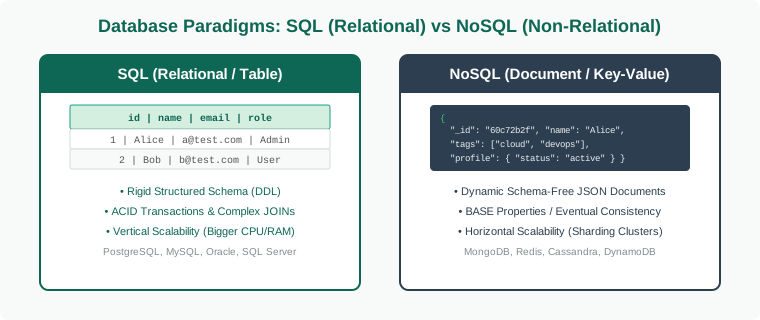
Side-by-Side Comparison: SQL vs NoSQL
FEATURE |
SQL DATABASES |
NOSQL DATABASES |
|---|---|---|
Data Model & Structure |
Relational model: data is organized in structured 2D tables composed of rows (records) and columns (attributes). |
Non-relational models: Document (JSON/BSON), Key-Value, Wide-Column, or Graph data models. |
Schema Flexibility |
Rigid, Predefined Schema: Altering table structure requires explicit DDL schema migrations ( |
Dynamic / Schema-Free: Documents in the same collection can have completely different fields and structures on the fly. |
Scalability Architecture |
Vertical Scaling (Scale-Up): Handled by upgrading hardware (faster CPU, more RAM, SSDs) on a single database server. |
Horizontal Scaling (Scale-Out): Handled by distributing and sharding partitions across clusters of commodity servers. |
Query Language |
Standardized declarative SQL (Structured Query Language) supporting complex JOINs and aggregations. |
Unstandardized; uses object-based APIs, document query languages (MQL in MongoDB), or RESTful HTTP endpoints. |
Transaction Model |
Emphasizes ACID properties (Atomicity, Consistency, Isolation, Durability) for exact data correctness. |
Follows the BASE model (Basically Available, Soft-state, Eventual consistency) based on Brewer's CAP Theorem. |
Relationships & Joins |
Excellent: native support for INNER, LEFT, RIGHT, and FULL OUTER relational JOINs across multiple tables. |
Limited/Poor: data is typically denormalized and embedded directly into single documents to avoid costly network JOINs. |
Popular Examples |
PostgreSQL, MySQL, Oracle Database, Microsoft SQL Server, MariaDB, SQLite. |
MongoDB, Redis, Apache Cassandra, Amazon DynamoDB, CouchDB, Neo4j. |
Code Comparison: Fetching a User Record
1. Relational SQL Query
-- SQL: Declarative query joining users with orders
SELECT u.username, o.order_id, o.amount
FROM Users u
INNER JOIN Orders o ON u.user_id = o.user_id
WHERE u.status = 'active';
2. NoSQL (MongoDB Document Query)
// NoSQL: Fetching embedded document in MongoDB
db.users.find(
    { status: "active" },
    { username: 1, "orders.order_id": 1, "orders.amount": 1 }
);
Architectural Cheat-Sheet:
- Choose SQL When: Data is highly structured, financial transactions demand strict ACID guarantees, data integrity cannot be compromised, and relations/reporting require complex multi-table JOINs.
- Choose NoSQL When: Dealing with rapidly evolving data models, big data ingestion, real-time analytics, caching (Redis), social networks (Graph DBs), or global write-heavy applications.
Practice Session & Self-Assessment Quiz
Q1: Which type of database scaling involves adding more servers to a distributed cluster?
Click to Reveal Answer & Explanation
Correct Answer: B
Horizontal scaling (Scale-Out) expands capacity by distributing data across multiple physical machines or nodes via sharding, which is a native design strength of NoSQL systems.
Q2: According to Brewer's CAP Theorem, what three guarantees cannot all be simultaneously achieved in a distributed system?
Click to Reveal Answer & Explanation
Correct Answer: A
The CAP Theorem states that in the event of a network partition (P), a distributed data store can guarantee either Consistency (C) or Availability (A), but never both simultaneously.
Q3: Which category of NoSQL database is Apache Cassandra?
Click to Reveal Answer & Explanation
Correct Answer: C
Cassandra is a distributed wide-column store designed to handle massive write volumes across multiple data centers with no single point of failure.
Top Viva & Technical Interview Questions
1. What are the four primary categories of NoSQL databases?
The four categories are: 1. Document Stores (MongoDB, CouchDB), 2. Key-Value Stores (Redis, Memcached), 3. Wide-Column Stores (Cassandra, ScyllaDB), and 4. Graph Databases (Neo4j, Amazon Neptune).
2. What is Sharding in database management?
Sharding is a horizontal partitioning technique where a large database is broken down into smaller, faster, and more manageable subsets called shards, distributed across different physical server nodes.
3. What is Polyglot Persistence?
Polyglot Persistence is the architectural practice of utilizing different database technologies within the same application to solve specific problems—such as using PostgreSQL for orders, Redis for caching, Elasticsearch for full-text search, and Neo4j for social connections.
Frequently Asked Questions (FAQs)
Does NoSQL support ACID transactions?
Historically NoSQL prioritized performance over multi-document ACID transactions. However, modern NoSQL databases (like MongoDB 4.0+) have added multi-document ACID transactions within replica sets.
Can PostgreSQL store JSON like a NoSQL database?
Yes! Modern PostgreSQL includes powerful JSONB data types with binary indexing, enabling developers to query dynamic schema-free documents alongside traditional relational tables.
Which is better for real-time leaderboards and caching?
Redis (an in-memory key-value NoSQL data store) is the global industry standard for caching and real-time leaderboards because all operations occur in RAM with sub-millisecond latency.
Related Difference Classes to Explore


You may also like this!
© Veewom.com. | Managed by PinePL
