
- Home
- Difference
- Compiler vs Interpreter
Difference Between Compiler and Interpreter
Quick Summary: A Compiler transforms human-readable high-level source code into standalone machine code or object files in one single batch prior to execution. An Interpreter reads, translates, and executes the source code line-by-line in real time without creating a permanent intermediate executable.
Computers can only execute native binary instructions (0s and 1s) understood by the CPU. To bridge human-written code and machine hardware, software relies on language translators. The two primary translation mechanisms are compilers and interpreters, each engineered with distinct trade-offs in speed, memory usage, and debugging ergonomics.
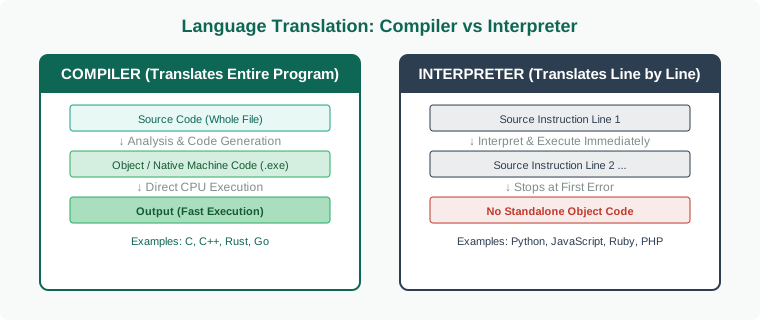
Side-by-Side Comparison: Compiler vs Interpreter
FEATURE |
COMPILER |
INTERPRETER |
|---|---|---|
Translation Process |
Translates the entire program as a single batch into machine code before running. |
Translates and executes instructions line-by-line sequentially at runtime. |
Intermediate Object Code |
Generates an intermediate object file ( |
Does not generate a standalone executable; executes instructions directly in memory. |
Execution Speed |
Extremely fast runtime execution because native machine instructions run directly on the CPU. |
Slower execution speed because each instruction must be parsed and translated on every pass. |
Memory Consumption |
Requires higher memory during compilation phase to maintain symbol tables, parse trees, and generate object code. |
Lower memory footprint because only active instructions are loaded into memory. |
Error Reporting & Detection |
Scans whole program and displays all syntax and semantic errors together after compilation fails. |
Stops execution immediately at the very first line containing a syntax error. |
Debugging Ease |
Harder for beginners because errors may cascade across interdependent files. |
Much easier and interactive because the program pauses precisely at the error line. |
Code Optimization |
High optimization capability (loop unrolling, dead-code elimination, inlining) performed by compiler passes. |
Minimal optimization possible during single-pass line-by-line interpretation. |
Platform Dependency |
Compiled machine code is hardware and OS specific (an x86 Windows |
Source code is portable and machine-independent; it runs anywhere the interpreter is installed. |
Typical Programming Languages |
C, C++, Rust, Go, Fortran, Ada, Swift. |
Python, JavaScript, PHP, Ruby, Perl, Bash. |
How Modern Languages Bridge the Gap: JIT Compilation
While traditional computer science draws a strict boundary between compilers and interpreters, modern production systems frequently employ a hybrid model known as Just-In-Time (JIT) Compilation:
- Java: The
javaccompiler translates.javasource files into intermediate.classbytecode. The Java Virtual Machine (JVM) interprets bytecode, but uses the HotSpot JIT compiler to dynamically compile hot loops into native assembly. - JavaScript (V8 / Node.js): Google's V8 engine takes JavaScript scripts, parses them into bytecode (Ignition interpreter), and compiles high-frequency functions into optimized machine code (TurboFan compiler).
- Python (PyPy): The PyPy implementation replaces CPython's standard interpreter with a tracing JIT compiler, speeding up numeric Python code up to 7x.
Summary Guide: Which Model is Best for What?
- Use Compiled Languages When: You need maximum CPU throughput, low latency, predictability, and minimal battery consumption (Operating Systems, Game Engines, Robotics, Audio DSP).
- Use Interpreted Languages When: You need rapid prototyping, dynamic scripting, web automation, data analysis, or interactive REPL shells.
Practice Session & Self-Assessment Quiz
Q1: Why does a compiled C++ binary run significantly faster than a purely interpreted script?
Click to Reveal Answer & Explanation
Correct Answer: A
A compiler performs lexical analysis, optimization, and code generation ahead of time. When the resulting binary is executed, the CPU executes raw machine code with zero translation overhead.
Q2: If line 50 of a 100-line script has a syntax error, what happens in an interpreter?
Click to Reveal Answer & Explanation
Correct Answer: A
Because interpreters execute code line-by-line sequentially, instructions prior to the error line execute until execution reaches the invalid syntax.
Q3: Which file is produced after compiling a C source file?
Click to Reveal Answer & Explanation
Correct Answer: B
The compilation pipeline generates intermediate object files containing compiled symbols, which the linker binds into a native executable binary.
Top Viva & Technical Interview Questions
1. What are the main phases of a compiler?
A standard compiler operates in six sequential phases: 1. Lexical Analysis (tokenization), 2. Syntax Analysis (parse tree generation), 3. Semantic Analysis (type checking), 4. Intermediate Code Generation (three-address code), 5. Code Optimization, and 6. Code Generation (target machine code).
2. What is Cross-Compilation?
Cross-compilation is the process where a compiler running on one architecture (e.g., an x86_64 Intel laptop) produces executable machine code for an entirely different target architecture (e.g., an ARM Cortex microcontroller or Raspberry Pi).
3. What is an Assembler and how does it differ from a Compiler?
An assembler translates low-level symbolic Assembly language (mnemonic instructions like MOV, ADD, JMP) directly into 1:1 machine code. A compiler translates complex, high-level abstract logic (like loops, classes, and expressions) into many machine instructions.
Frequently Asked Questions (FAQs)
Is Python purely interpreted or compiled?
Python uses a hybrid approach. When you run a script, CPython compiles it into bytecode (saved in __pycache__ as .pyc), which is then interpreted by the Python Virtual Machine (PVM).
Can an interpreted language be compiled?
Yes! Any programming language is merely a specification of syntax and semantics. A language can have multiple implementations; for example, Python has PyPy (JIT) and Nuitka (compiler), while C has Ch (C interpreter).
Why do compilers take longer to build large projects?
Compilers perform heavy static analysis, symbol resolution across hundreds of header files, macro expansion, and aggressive mathematical optimizations (vectorization, register allocation) to generate the most efficient binary possible.
Related Difference Classes to Explore


You may also like this!
© Veewom.com. | Managed by PinePL
