
- Home
- Difference
- REST API vs SOAP
Difference Between REST API and SOAP Web Services
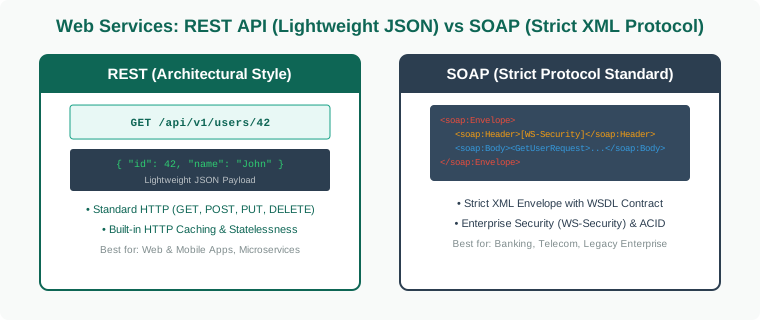
Quick Summary: REST (Representational State Transfer) is a lightweight, stateless architectural style that uses standard HTTP methods (GET, POST, PUT, DELETE) and flexible data formats (primarily JSON) for high-performance web and mobile communications. SOAP (Simple Object Access Protocol) is a formal, strictly standardized protocol that transmits XML envelopes over HTTP, SMTP, or TCP, featuring rigid WSDL contracts, built-in WS-Security, and ACID-compliant transaction handling for enterprise banking.
When engineering web services or microservices, deciding between REST and SOAP fundamentally impacts developer velocity, network bandwidth, security posture, and client compatibility. While REST powers over 85% of modern public APIs, SOAP remains heavily entrenched in legacy enterprise, financial clearance, and telecommunications backbones.
What is a REST API?
Defined by Dr. Roy Fielding in his 2000 doctoral dissertation, REST is an architectural pattern based on resources, where each resource is identified by a unique URI (Uniform Resource Identifier). Key constraints of REST include:
- Statelessness: Each client request must contain all necessary authentication and context data; the server stores no session state.
- Uniform Interface: Standardized operations mapped directly to HTTP verbs:
GET: Retrieve a resourcePOST: Create a new resourcePUT / PATCH: Update an existing resourceDELETE: Remove a resource
- Cacheability: Responses explicitly define whether they can be cached by browsers or edge reverse proxies (via
Cache-Controlheaders).
What is SOAP?
Developed by Microsoft and standardized by the W3C, SOAP is an XML-based messaging protocol. It operates with a formal XML envelope comprising:
<soap:Envelope>: The mandatory root element identifying the XML as a SOAP message.<soap:Header>: Optional metadata for routing, security tokens (WS-Security), and transaction IDs.<soap:Body>: The actual request or response payload.<soap:Fault>: Standardized error reporting structure.
SOAP relies on a WSDL (Web Services Description Language) file—a strict XML contract that specifies all available endpoints, functions, parameters, and return types before any communication can occur.
Side-by-Side Comparison: REST vs SOAP
Comparison Parameter |
REST (Representational State Transfer) |
SOAP (Simple Object Access Protocol) |
|---|---|---|
Fundamental Nature |
An Architectural Style (set of design guidelines). |
A strict, standardized Protocol with formal specifications. |
Data Formats Supported |
Highly flexible: JSON (most common), XML, HTML, Plain Text, YAML. |
Strictly XML only. |
Underlying Transport |
Exclusively HTTP / HTTPS. |
Transport-independent: HTTP, HTTPS, SMTP (email), JMS, TCP. |
Bandwidth & Overhead |
Very Lightweight: Compact JSON payloads require minimal network bandwidth. |
Heavy & Verbose: Massive XML tags, namespaces, and envelope structures increase payload size. |
Caching Support |
Built-in HTTP Caching: Idempotent |
Cannot be cached: SOAP uses |
Security Model |
Transport-level security via TLS/HTTPS, with token-based auth (JWT, OAuth 2.0). |
Built-in message-level security via WS-Security (digital signatures and element-level encryption). |
Contract Requirement |
Optional (commonly documented via OpenAPI / Swagger specifications). |
Mandatory: Requires a strict WSDL contract that client and server must both implement. |
ACID Compliance |
Requires custom application-level handling (e.g., Saga pattern for distributed transactions). |
Built-in enterprise two-phase commit via WS-AtomicTransaction. |
Client Ease of Use |
Extremely easy: can be consumed directly by frontend JavaScript using |
Complex: requires client-side SOAP stubs and XML serialization libraries. |
Key Conceptual Takeaways
- Style vs Protocol: REST is an architectural style giving you freedom over payloads and endpoints; SOAP is a strict protocol with fixed XML envelopes.
- JSON Efficiency: REST's use of JSON gives it dramatic performance and memory advantages on mobile devices and browser applications.
- Enterprise Strength: SOAP shines when multi-hop messaging requires security tokens to stay encrypted across intermediary proxy hops (WS-Security).
Payload Comparison: REST JSON vs SOAP XML
Compare the simplicity of fetching a customer's balance in REST versus SOAP:
1. RESTful JSON Response (Fast, Human-Readable, Lightweight)
{
  "status": "success",
  "accountNumber": "ACC-98231",
  "accountHolder": "Sarah Jenkins",
  "balance": 14250.75,
  "currency": "USD"
}
2. SOAP XML Response (Structured, Verbose, Envelope-Wrapped)
<?xml version="1.0" encoding="utf-8"?>
<soap:Envelope xmlns:soap="http://schemas.xmlsoap.org/soap/envelope/"
               xmlns:bank="http://api.veewom.com/bankservices">
    <soap:Header>
        <wsse:Security xmlns:wsse="http://docs.oasis-open.org/wss/2004/01/...">
            <wsse:BinarySecurityToken>QWxhZGRpbjpvcGVuIHNlc2FtZQ==</wsse:BinarySecurityToken>
        </wsse:Security>
    </soap:Header>
    <soap:Body>
        <bank:GetAccountBalanceResponse>
            <bank:accountNumber>ACC-98231</bank:accountNumber>
            <bank:accountHolder>Sarah Jenkins</bank:accountHolder>
            <bank:balance>14250.75</bank:balance>
            <bank:currency>USD</bank:currency>
        </bank:GetAccountBalanceResponse>
    </soap:Body>
</soap:Envelope>
Interactive Practice Session (MCQs)
1. Which HTTP method is considered "Idempotent" in RESTful API design?
A) POST
B) GET and PUT
C) PATCH only
D) CONNECT
Explanation: An HTTP method is idempotent if executing it multiple times produces the exact same server state as executing it once.
GET, PUT, and DELETE are idempotent; POST is not.
2. What role does WSDL play in SOAP web services?
A) It compresses XML payloads using GZIP
B) It acts as a formal machine-readable contract defining operations, datatypes, and endpoints
C) It serves as a NoSQL database for SOAP caching
D) It generates CSS styles for SOAP envelopes
Explanation: WSDL (Web Services Description Language) provides strict interface contracts enabling automated client stub generation.
3. Why is SOAP capable of message-level security across intermediate network proxies?
A) Because SOAP encrypts the entire TCP packet
B) Because WS-Security encrypts specific XML nodes inside the payload itself, not just the transport tunnel
C) Because SOAP disables firewall inspections
D) Because SOAP uses UDP broadcast
Explanation: TLS/HTTPS only protects data point-to-point during transit. WS-Security encrypts the XML nodes directly, keeping them secure even when routed through intermediate forward proxies.
Viva Voce & Technical Interview Questions
Q1: Why is REST described as "Stateless"?
Answer: REST statelessness means that the server retains no client context or session state between requests. Every individual request sent by the client must contain all necessary data (such as an OAuth JWT Bearer token in the Authorization header) for the server to process it completely.
Q2: What is the Richardson Maturity Model in REST?
Answer: Devised by Leonard Richardson, it breaks REST architecture into 4 levels: Level 0 (The Swamp of POX - single URI via HTTP POST), Level 1 (Resources - individual URIs for entities), Level 2 (HTTP Verbs - proper usage of GET, POST, PUT, DELETE with status codes), and Level 3 (HATEOAS - Hypermedia As The Engine Of Application State).
Q3: What are WS-* standards in SOAP?
Answer: WS-* refers to a comprehensive suite of enterprise specifications governing SOAP, including WS-Security (encryption and signatures), WS-ReliableMessaging (guaranteed end-to-end delivery), WS-Addressing (transport-independent routing), and WS-AtomicTransaction (distributed ACID transactions).
Q4: Can a REST API return XML instead of JSON?
Answer: Yes! REST does not mandate JSON. A RESTful API can return XML, JSON, Protobuf, or CSV. In fact, a properly designed REST API utilizes Content Negotiation via the Accept request header (e.g., Accept: application/xml or application/json) to serve the format requested by the client.
Q5: Why can't SOAP requests typically be cached by web browsers?
Answer: Caching in web standards is natively built around the idempotent HTTP GET method. Because SOAP almost universally sends all operations—including data retrieval queries—via HTTP POST with an XML envelope payload, web browsers and intermediary CDNs do not cache the response.
Related Difference Classes
Explore synchronized companion classes across our web architecture series:
Frequently Asked Questions (FAQ)


You may also like this!
© Veewom.com. | Managed by PinePL
