
- Home
- Difference
- TCP vs UDP
Difference Between TCP and UDP Protocols
Quick Summary: At Layer 4 (Transport Layer) of the OSI model, TCP (Transmission Control Protocol) and UDP (User Datagram Protocol) are the two core protocols that route data between network applications. TCP is a connection-oriented, reliable protocol that guarantees in-order, error-checked delivery via a 3-way handshake and automatic retransmission. UDP is a connectionless, lightweight datagram protocol that prioritizes speed and minimal latency over reliability, allowing packet loss in exchange for instant real-time throughput.
Every internet interaction depends on this tradeoff: downloading an executable file or loading a web page mandates TCP's 100% data fidelity, whereas watching a live football broadcast, making a VoIP call, or playing a competitive FPS game demands UDP's low latency.
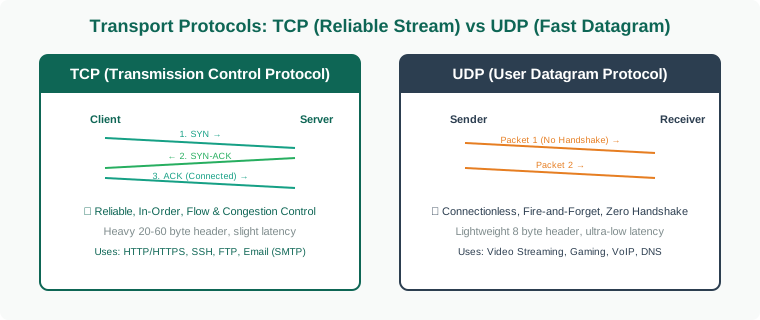
What is TCP (Transmission Control Protocol)?
Defined in RFC 793, TCP establishes an end-to-end dedicated virtual connection before any application data is sent. It guarantees that:
- Connection-Oriented: Established via a 3-Way Handshake (
SYN→SYN-ACK→ACK). - Reliable Delivery: Every segment has a sequence number; missing segments are detected and retransmitted automatically.
- In-Order Assembly: Out-of-order packets arriving across divergent internet routes are reordered by the receiver's TCP stack.
- Congestion & Flow Control: Algorithms like Sliding Window, Slow Start, and Congestion Avoidance prevent network collapse.
What is UDP (User Datagram Protocol)?
Defined in RFC 768, UDP is a minimal, connectionless transport protocol that operates on a "best-effort" delivery model. Its characteristics include:
- Connectionless: No handshake or connection setup required; data packets (datagrams) are transmitted immediately.
- Unreliable (No Retransmissions): Dropped or corrupted packets are simply discarded without acknowledgment or retry.
- No Sequence Ordering: Packets can arrive in any order; the application layer is responsible for sequencing if needed.
- Ultra-Low Overhead: Carries a tiny 8-byte header with zero state tracking, minimizing CPU and memory utilization on routers and endpoints.
Side-by-Side Comparison: TCP vs UDP
Comparison Parameter |
TCP (Transmission Control Protocol) |
UDP (User Datagram Protocol) |
|---|---|---|
Connection Model |
Connection-Oriented: Requires 3-way handshake prior to data exchange. |
Connectionless: Fire-and-forget; transmits immediately without establishing a session. |
Reliability Guarantee |
Guaranteed Delivery: All lost or damaged packets are automatically retransmitted. |
Best-Effort: No retransmissions; packets can be lost, duplicated, or dropped. |
Data Ordering |
Strictly In-Order: Bytes are sequenced and assembled in their original transmitted sequence. |
Unordered: Packets arrive in whichever order the network routes deliver them. |
Header Size |
20 to 60 Bytes: Contains sequence numbers, ACK numbers, control flags, and window sizing. |
Fixed 8 Bytes: Only Source Port, Destination Port, Length, and Checksum. |
Speed & Latency |
Slower: Connection setup, acknowledgments, and congestion control add latency. |
Fastest: Near-zero latency overhead; ideal for real-time applications. |
Flow & Congestion Control |
Yes: Implements dynamic sliding window and congestion avoidance algorithms. |
No: Sends data as fast as the application generates it, regardless of network load. |
Broadcast & Multicast |
Unicast Only: Point-to-point connection between exactly one sender and one receiver. |
Unicast, Multicast, & Broadcast: Can send a single packet to multiple recipients simultaneously. |
Common Protocols |
HTTP/HTTPS (Web), SSH, FTP, SMTP (Email), MySQL/PostgreSQL. |
DNS, DHCP, VoIP (SIP/RTP), Video Streaming (WebRTC), NTP, Online Gaming. |
Key Conceptual Takeaways
- Reliability vs Speed: TCP trades transmission speed for absolute data integrity. UDP trades data guarantees for real-time responsiveness.
- Header Overhead: UDP's fixed 8-byte header saves substantial bandwidth over high-frequency packet transmissions compared to TCP's 20-60 byte header.
- Next-Gen QUIC (HTTP/3): Modern web architectures use Google's QUIC protocol, which implements reliable multiplexed streams on top of UDP to bypass TCP head-of-line blocking.
Packet Header Breakdown: TCP vs UDP
Understanding the internals of packet headers illustrates why UDP is so lightweight and why TCP provides bulletproof reliability:
================================================================================
TCP Header Structure (20 - 60 Bytes):
--------------------------------------------------------------------------------
 0                   1                   2                   3
 0 1 2 3 4 5 6 7 8 9 0 1 2 3 4 5 6 7 8 9 0 1 2 3 4 5 6 7 8 9 0 1
+-+-+-+-+-+-+-+-+-+-+-+-+-+-+-+-+-+-+-+-+-+-+-+-+-+-+-+-+-+-+-+-+
|          Source Port          |       Destination Port        |
+-+-+-+-+-+-+-+-+-+-+-+-+-+-+-+-+-+-+-+-+-+-+-+-+-+-+-+-+-+-+-+-+
|                        Sequence Number                        |
+-+-+-+-+-+-+-+-+-+-+-+-+-+-+-+-+-+-+-+-+-+-+-+-+-+-+-+-+-+-+-+-+
|                    Acknowledgment Number                      |
+-+-+-+-+-+-+-+-+-+-+-+-+-+-+-+-+-+-+-+-+-+-+-+-+-+-+-+-+-+-+-+-+
|  Data |           |U|A|P|R|S|F|                               |
| Offset| Reserved  |R|C|S|S|Y|I|            Window             |
|       |           |G|K|H|T|N|N|                               |
+-+-+-+-+-+-+-+-+-+-+-+-+-+-+-+-+-+-+-+-+-+-+-+-+-+-+-+-+-+-+-+-+
|           Checksum            |        Urgent Pointer         |
+-+-+-+-+-+-+-+-+-+-+-+-+-+-+-+-+-+-+-+-+-+-+-+-+-+-+-+-+-+-+-+-+
|                    Options                    |    Padding    |
+-+-+-+-+-+-+-+-+-+-+-+-+-+-+-+-+-+-+-+-+-+-+-+-+-+-+-+-+-+-+-+-+

================================================================================
UDP Header Structure (Strictly 8 Bytes Fixed):
--------------------------------------------------------------------------------
 0                   1                   2                   3
 0 1 2 3 4 5 6 7 8 9 0 1 2 3 4 5 6 7 8 9 0 1 2 3 4 5 6 7 8 9 0 1
+-+-+-+-+-+-+-+-+-+-+-+-+-+-+-+-+-+-+-+-+-+-+-+-+-+-+-+-+-+-+-+-+
|          Source Port          |       Destination Port        |
+-+-+-+-+-+-+-+-+-+-+-+-+-+-+-+-+-+-+-+-+-+-+-+-+-+-+-+-+-+-+-+-+
|            Length             |           Checksum            |
+-+-+-+-+-+-+-+-+-+-+-+-+-+-+-+-+-+-+-+-+-+-+-+-+-+-+-+-+-+-+-+-+
Interactive Practice Session (MCQs)
1. Which flags are exchanged during the initial TCP 3-Way Handshake?
A) PSH → RST → FIN
B) SYN → SYN-ACK → ACK
C) URG → ACK → FIN
D) ECHO → REPLY → ACK
Explanation: The client sends a SYN (Synchronize) with an initial sequence number, the server replies with SYN-ACK, and the client finishes with an ACK (Acknowledge) to establish the connection.
2. What happens when a UDP packet is corrupted or dropped in transit?
A) The sender's kernel automatically retransmits it
B) The router requests an ICMP retransmission
C) The packet is silently discarded with no retransmission
D) The connection resets
Explanation: UDP provides best-effort datagram service without acknowledgments, sequence numbers, or retransmission mechanisms.
3. Why does standard DNS resolution prefer UDP port 53 for queries?
A) Because DNS records require 256-bit encryption
B) Because a single request and response fit inside one packet, avoiding handshake latency
C) Because TCP cannot route across the public Internet
D) Because UDP prevents DDoS attacks
Explanation: DNS queries are small enough to fit within a single 512-byte datagram, making the overhead of establishing a 3-way TCP handshake unnecessary.
Viva Voce & Technical Interview Questions
Q1: What is "Head-of-Line Blocking" (HoL) in TCP?
Answer: Because TCP guarantees strict in-order delivery, if a single packet is delayed or dropped in the network, all subsequent packets already received must sit in the buffer and wait until the missing packet is retransmitted. This phenomenon delays the entire application stream.
Q2: Can UDP ever be reliable?
Answer: Yes, by implementing reliability at Layer 7 (Application Layer). Protocols like Google's QUIC (HTTP/3), TFTP, and proprietary gaming engines run on top of UDP but maintain their own custom sequence numbers, selective acknowledgments, and retransmission logic.
Q3: When does DNS switch from UDP to TCP?
Answer: DNS switches from UDP to TCP when the response payload exceeds 512 bytes (or EDNS0 limits), during DNS zone transfers between primary and secondary name servers (AXFR/IXFR), or when DNSSEC digital signatures exceed standard datagram limits.
Q4: How does TCP handle Congestion Control?
Answer: TCP maintains a Congestion Window (cwnd). It starts in Slow Start (exponential window growth), transitions to Congestion Avoidance (additive increase linear growth), and rapidly throttles throughput (multiplicative decrease) upon detecting packet loss.
Q5: Why is Multicast impossible over TCP?
Answer: TCP requires a dedicated point-to-point stateful session with synchronized sequence numbers between exactly two endpoints. Tracking acknowledgments and retransmissions for millions of recipients simultaneously is architecturally incompatible with TCP's design.
Related Difference Classes
Explore synchronized companion classes across our networking and web engineering series:
Frequently Asked Questions (FAQ)
192.168.1.10:8080). TCP uses Stream Sockets (SOCK_STREAM), while UDP uses Datagram Sockets (SOCK_DGRAM).


You may also like this!
© Veewom.com. | Managed by PinePL
