
Python Comprehensions: List, Dictionary & Set Comprehensions Masterclass
One of Python's most celebrated and elegant features is comprehensions. Comprehensions offer a compact, declarative syntax to construct new lists, dictionaries, and sets from existing iterables in a single line of code, replacing boilerplate multi-line for loops and .append() calls.
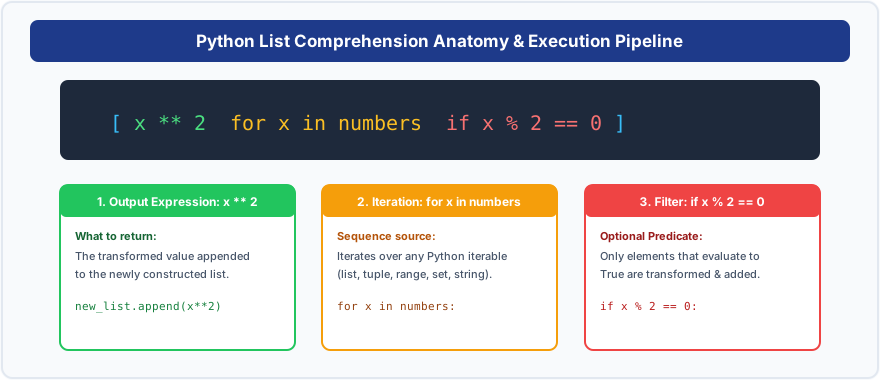
Figure 34.1: Anatomy of a list comprehension: Output Expression < Iteration Loop < Conditional Filter.
1. List Comprehensions: Syntax & Comparison
# Task: Get squares of even numbers from 1 to 10

# Traditional for loop:
even_squares = []
for x in range(1, 11):
    if x % 2 == 0:
        even_squares.append(x ** 2)

# Pythonic List Comprehension:
even_squares_comp = [x ** 2 for x in range(1, 11) if x % 2 == 0]

print("Loop result:         ", even_squares)       # [4, 16, 36, 64, 100]
print("Comprehension result:", even_squares_comp)  # [4, 16, 36, 64, 100]
2. Dictionary Comprehensions ({k: v for ...})
Construct dictionaries dynamically from sequences:
# Create a student score lookup dictionary:
names = ["Aman", "Rhea", "Vikram", "Pooja"]
marks = [85, 92, 78, 95]

# Zip into dictionary with comprehension:
student_scores = {name: mark for name, mark in zip(names, marks) if mark >= 80}
print("Honors Students:", student_scores)
# {'Aman': 85, 'Rhea': 92, 'Pooja': 95}
3. Set Comprehensions ({x for ...})
Extract unique, deduplicated elements in one step:
text = "veewom python programming masterclass"
# Extract unique vowels:
unique_vowels = {char for char in text if char in "aeiou"}
print("Unique Vowels in Text:", unique_vowels)  # {'a', 'e', 'i', 'o'}
4. Flattening a 2D Matrix (Nested Comprehensions)
matrix = [
    [1, 2, 3],
    [4, 5, 6],
    [7, 8, 9]
]

# Flatten 2D grid into a 1D list:
flattened = [val for row in matrix for val in row]
print("Flattened List:", flattened)
# [1, 2, 3, 4, 5, 6, 7, 8, 9]
Frequently Asked Questions (FAQ)
What is the difference between [x for x in iterable] and (x for x in iterable)?
Square brackets
[] create an in-memory list comprehension that evaluates immediately. Parentheses () create a lazy generator expression that yields items one by one on demand, saving massive memory on large datasets.


You may also like this!
© Veewom.com. | Managed by PinePL
