
Python Decorators: Function Wrappers, Closures & Metaprogramming
In Python, functions are first-class citizens. This means functions can be assigned to variables, passed as arguments into other functions, and returned from functions just like integers or strings. A decorator leverages this capability to wrap another function, extending or modifying its behavior without altering its underlying code.
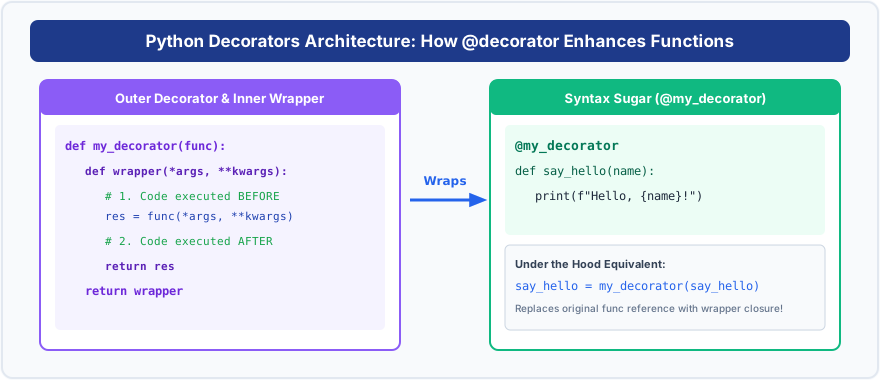
Figure 35.1: Decorator wrapping execution: pre-execution setup -> target function invocation -> post-execution cleanup.
1. Building Your First Decorator from Scratch
Let us write a decorator that logs when a function starts and finishes:
import functools

def log_execution(func):
    @functools.wraps(func)
    def wrapper(*args, **kwargs):
        print(f"[LOG] Executing function: '{func.__name__}'...")
        result = func(*args, **kwargs)
        print(f"[LOG] Completed '{func.__name__}' successfully!")
        return result
    return wrapper

# Applying the decorator using @ syntax:
@log_execution
def generate_bill(customer_name: str, total_amount: float):
    print(f"Generating invoice for {customer_name}: ₹{total_amount}")
    return True

# Call decorated function:
generate_bill("Deepak Kumar", 4500.0)
Output:
[LOG] Executing function: 'generate_bill'...
Generating invoice for Deepak Kumar: ₹4500.0
[LOG] Completed 'generate_bill' successfully!
2. Real-World Decorator: Execution Timing Benchmark
import time
import functools

def benchmark(func):
    @functools.wraps(func)
    def wrapper(*args, **kwargs):
        start_time = time.perf_counter()
        result = func(*args, **kwargs)
        elapsed = time.perf_counter() - start_time
        print(f"[BENCHMARK] {func.__name__}() took {elapsed:.6f} seconds to run.")
        return result
    return wrapper

@benchmark
def calculate_large_sum():
    return sum(x ** 2 for x in range(1_000_000))

calculate_large_sum()
Frequently Asked Questions (FAQ)
Can you apply multiple decorators to a single function?
Yes! Multiple decorators can be stacked on a function. They are applied from the bottom up (closest to the function first) and executed in reverse order.


You may also like this!
© Veewom.com. | Managed by PinePL
