
C++20 Concepts & Ranges: Expressive Constraints & Functional Pipelines
C++20 introduced two revolutionary pillars that modernized template metaprogramming and algorithmic data processing: Concepts (type constraints) and Ranges (composable functional pipelines).
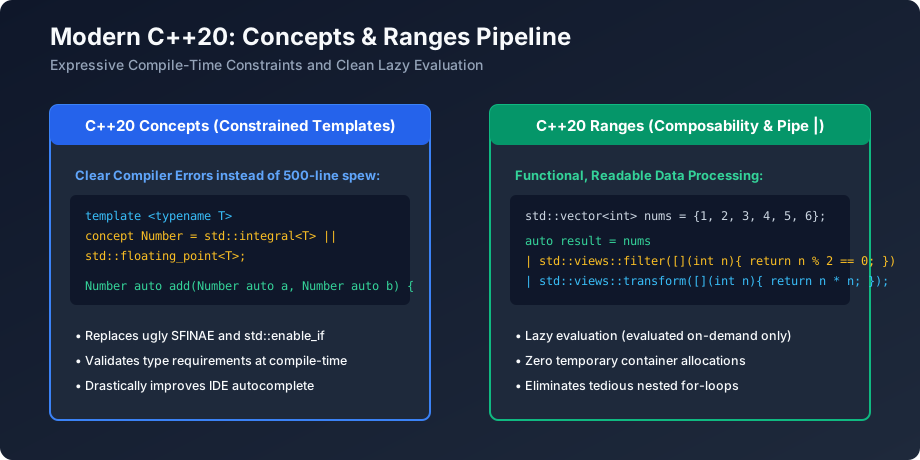
Figure 15: C++20 Concepts (Type Constraints) & Ranges (Lazy Evaluated Pipelines)
1. C++20 Concepts in Action
#include <iostream>
#include <concepts>

// Define a Concept restricting T to numeric types only
template <typename T>
concept Numeric = std::integral<T> || std::floating_point<T>;

// Function constrained by the Numeric concept
Numeric auto calculateAverage(Numeric auto a, Numeric auto b) {
    return (a + b) / 2.0;
}

int main() {
    std::cout << calculateAverage(10, 20) << "\n";       // OK: 15.0
    std::cout << calculateAverage(4.5, 9.5) << "\n";     // OK: 7.0

    // calculateAverage("Hello", "World"); // COMPILE ERROR! String does NOT satisfy Numeric!
    return 0;
}
2. C++20 Ranges Pipeline Composition
#include <iostream>
#include <vector>
#include <ranges>

int main() {
    std::vector<int> numbers = {1, 2, 3, 4, 5, 6, 7, 8, 9, 10};

    // Lazy pipeline: Filter even numbers, square them, take first 3
    auto view = numbers
        | std::views::filter([](int n) { return n % 2 == 0; })
        | std::views::transform([](int n) { return n * n; })
        | std::views::take(3);

    std::cout << "Transformed: ";
    for (int val : view) {
        std::cout << val << " "; // Prints: 4 (2^2), 16 (4^2), 36 (6^2)
    }
    std::cout << "\n";
    return 0;
}
Frequently Asked Questions (FAQ) - Student & Interview Review
Q1. What problem do C++20 Concepts solve?
Before C++20, passing an invalid type to a template resulted in 500 lines of incomprehensible compiler error spew deep inside template headers. Concepts enforce type requirements upfront at compile-time with crystal-clear, one-line error diagnostics.
Q2. What makes C++20 Ranges superior to traditional algorithms?
Ranges support lazy evaluation and clean pipeline composition via the pipe operator (|). You can filter, transform, and slice data without writing nested loops or allocating intermediate temporary vectors.
Explore Related C++ Tutorials & Next Steps
Boost your C++ proficiency by studying these closely connected core modules:
C++ Templates
How concepts constrain generic templates.
STL Algorithms
Traditional algorithms vs modern range pipelines.
C++20 Modules
The next big pillar of C++20.


You may also like this!
© Veewom.com. | Managed by PinePL
