
C++ Virtual Functions, VTable, VPtr Internals & Pure Virtual Abstract Classes
When an object is manipulated through a pointer or reference to its base class, C++ uses Virtual Functions to ensure the derived class's implementation is executed at runtime.
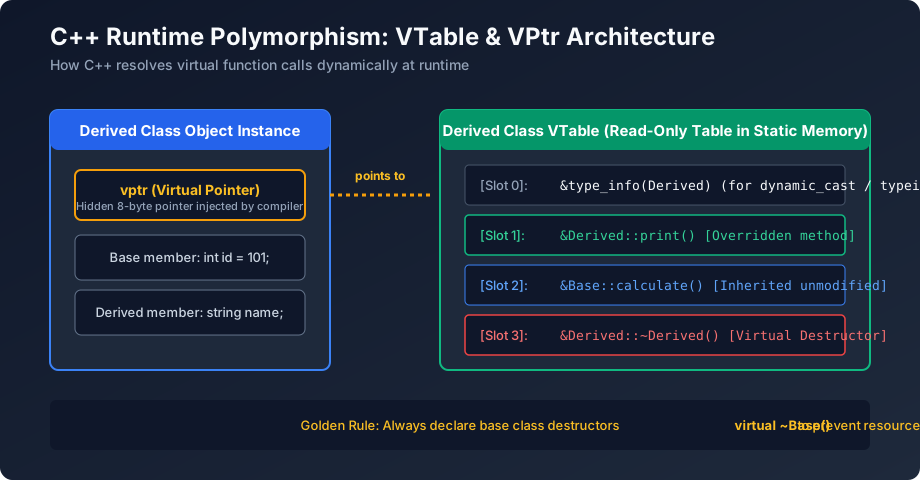
Figure 11: Dynamic Dispatch Mechanics: Object Instance vptr → Class VTable Function Array
Abstract Classes & Pure Virtual Functions
#include <iostream>

// Abstract Base Class (Cannot be directly instantiated!)
class Shape {
public:
    // Pure virtual function
    virtual void draw() const = 0;

    // MANDATORY: Virtual Destructor
    virtual ~Shape() { std::cout << "Shape destroyed\n"; }
};

class Circle : public Shape {
public:
    void draw() const override {
        std::cout << "Drawing a smooth Circle\n";
    }
    ~Circle() override { std::cout << "Circle cleaned up\n"; }
};

int main() {
    Shape* s = new Circle();
    s->draw(); // Dispatches dynamically to Circle::draw()!

    delete s;  // Safely calls Circle destructor then Shape destructor!
    return 0;
}
Frequently Asked Questions (FAQ) - Student & Interview Review
Q1. How does the VTable (Virtual Method Table) work in C++?
For every class containing virtual functions, the compiler creates a static array of function pointers called the VTable. Each object instance of that class contains an invisible pointer (vptr, 8 bytes) pointing to this VTable. When a virtual function is called via a base pointer, C++ dereferences vptr to look up the correct derived address.
Q2. Why MUST base class destructors be declared 'virtual'?
If a base destructor is not virtual, calling 'delete basePtr' on a derived object calls ONLY the base destructor. The derived class destructor is skipped, leaking all dynamic memory and resources held by the child class.
Explore Related C++ Tutorials & Next Steps
Boost your C++ proficiency by studying these closely connected core modules:
C++ Polymorphism
Overview of dynamic vs static dispatch.
Constructors & Destructors
Understanding destructor chains.
Dynamic Cast
How dynamic_cast uses VTable RTTI information.


You may also like this!
© Veewom.com. | Managed by PinePL
