
C++ Standard Template Library (STL): The 4 Core Architectural Components
The Standard Template Library (STL) is a powerful collection of generic C++ template classes and algorithms providing pre-built, production-tested data structures with mathematical complexity guarantees.
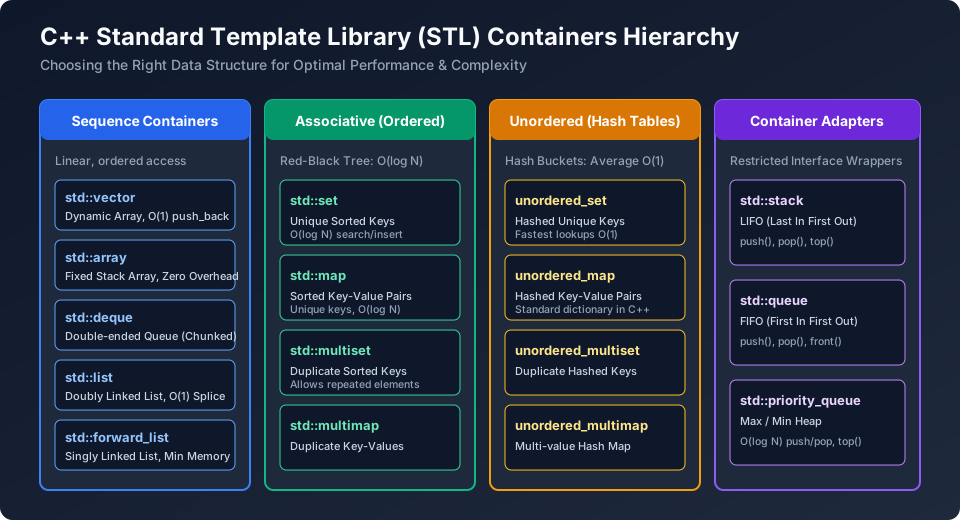
Figure 12: Comprehensive Taxonomy of C++ STL Containers
The 4 Pillars of the C++ STL
- Containers: Data structures that store collections of objects in memory (e.g.,
std::vector,std::map,std::unordered_set). - Iterators: Pointer-like objects used to traverse through elements of containers sequentially.
- Algorithms: Standalone generic functions for sorting, searching, counting, and transforming data (e.g.,
std::sort,std::binary_search). - Functors / Lambdas: Objects that act like functions (overloading
operator()) to customize algorithmic operations.
Frequently Asked Questions (FAQ) - Student & Interview Review
Q1. Who designed the C++ Standard Template Library (STL)?
The STL was designed by Alexander Stepanov and Meng Lee at Hewlett-Packard in the early 1990s, and was integrated into the ISO C++ standard in 1998.
Q2. What is the primary design philosophy of the STL?
Decoupling data structures from algorithms! Instead of embedding algorithms into each container, STL algorithms operate via Iterators, allowing 100+ algorithms to work seamlessly across all containers with optimal algorithmic complexity.
Explore Related C++ Tutorials & Next Steps
Boost your C++ proficiency by studying these closely connected core modules:
std::vector
The most important STL sequence container.
STL Iterators
The bridge between containers and algorithms.
STL Algorithms
Pre-built search, sort, and transform functions.


You may also like this!
© Veewom.com. | Managed by PinePL
