
C++ Move Semantics & Move Constructors: Stealing Resources with Rvalues
Before C++11, returning a large container (like an array or vector) from a function required making an expensive Deep Copy ($O(N)$ time). Move Semantics revolutionized C++ by enabling the transfer of resource ownership from temporary objects in $O(1)$ constant time.
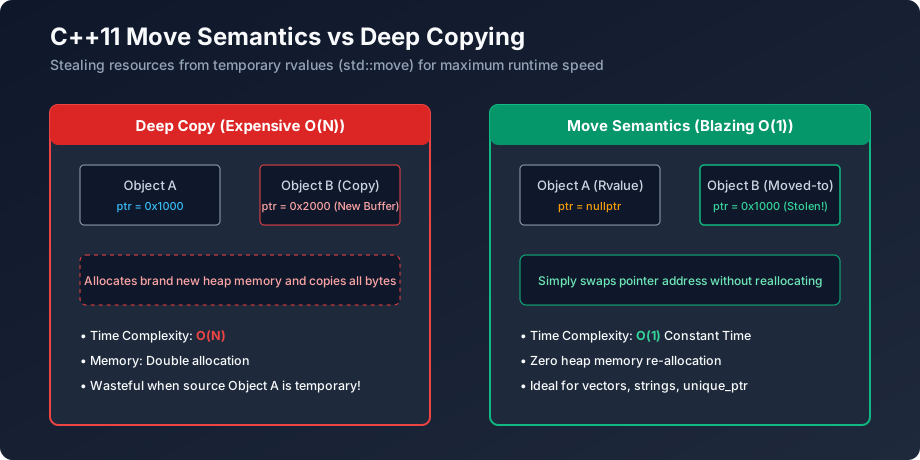
Figure 10: Deep Copy (Slow O(N)) vs Move Semantics (Pointer Stealing O(1))
Implementing a Move Constructor
#include <iostream>
#include <utility>

class Buffer {
private:
    int* data;
    int size;

public:
    Buffer(int s) : size(s), data(new int[s]{}) {}

    // Move Constructor (noexcept is best practice for STL vector realloc)
    Buffer(Buffer&& other) noexcept : data(other.data), size(other.size) {
        // STEAL the pointer!
        other.data = nullptr;
        other.size = 0;
        std::cout << "Move Constructor executed: O(1) pointer swap!\n";
    }

    ~Buffer() {
        delete[] data;
    }
};

int main() {
    Buffer b1(1000000); // 1 million integers
    Buffer b2 = std::move(b1); // Blazing fast! Zero integers copied!
    return 0;
}
Frequently Asked Questions (FAQ) - Student & Interview Review
Q1. What does std::move() actually do in C++?
std::move() does NOT move anything at all! It is simply an unconditional static_cast that casts an lvalue expression into an rvalue reference (T&&), signaling to the compiler that the object can be moved from (its resources can be stolen).
Q2. What is the Rule of 5 in modern C++?
If a class customizes any one of the following, it should explicitly define all five: 1. Destructor, 2. Copy Constructor, 3. Copy Assignment Operator, 4. Move Constructor, 5. Move Assignment Operator.
Explore Related C++ Tutorials & Next Steps
Boost your C++ proficiency by studying these closely connected core modules:
Constructors & Destructors
Copy constructors and the Rule of Five.
Smart Pointers
How std::unique_ptr relies entirely on move semantics.
C++ std::vector
Move semantics inside std::vector reallocation.


You may also like this!
© Veewom.com. | Managed by PinePL
