
C++ RAII (Resource Acquisition Is Initialization): The Core Philosophy
RAII (Resource Acquisition Is Initialization) is the single most important architectural idiom in the C++ programming language. Invented by Bjarne Stroustrup, it completely eliminates resource leaks without requiring a garbage collector.
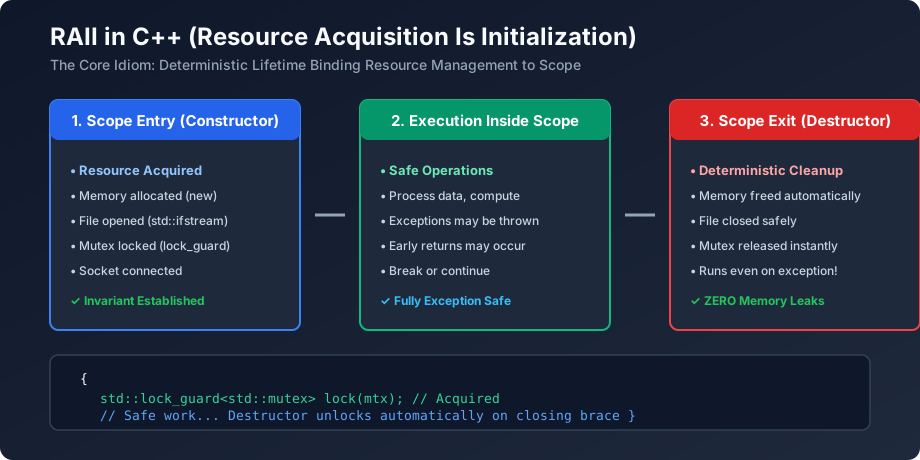
Figure 8: The RAII Lifecycle: Constructor Resource Acquisition → Scope Exit Deterministic Destructor
Building a Custom RAII File Handle Wrapper
#include <iostream>
#include <fstream>
#include <string>

class SafeFile {
private:
    std::ofstream fileStream;
public:
    // 1. Acquire resource in constructor
    explicit SafeFile(const std::string& filename) {
        fileStream.open(filename);
        std::cout << "File opened successfully.\n";
    }

    // 2. Deterministically release resource in destructor
    ~SafeFile() {
        if (fileStream.is_open()) {
            fileStream.close();
            std::cout << "File closed deterministically on scope exit!\n";
        }
    }

    void writeLine(const std::string& text) {
        fileStream << text << "\n";
    }
};

int main() {
    {
        SafeFile log("audit.log");
        log.writeLine("User logged in at 10:00 AM");
    } // File is closed automatically right here! No manual close() needed!

    return 0;
}
Frequently Asked Questions (FAQ) - Student & Interview Review
Q1. What does RAII stand for and what is its core rule?
RAII stands for 'Resource Acquisition Is Initialization'. Its core rule is: Bind the lifecycle of any system resource (heap memory, file handles, network sockets, thread mutexes) to the lifetime of a local stack object. Acquire the resource in the constructor, and release it in the destructor.
Q2. Why does RAII guarantee exception safety in C++?
When an exception is thrown in C++, the runtime executes Stack Unwinding, which deterministically calls the destructors of all local stack objects in reverse order of construction. This guarantees resources are released even if a function terminates prematurely.
Explore Related C++ Tutorials & Next Steps
Boost your C++ proficiency by studying these closely connected core modules:
Smart Pointers
The premier standard library implementation of RAII.
Exception Handling
How stack unwinding guarantees destructor calls.
Mutex & Lock Guards
RAII thread lock guards (std::lock_guard).


You may also like this!
© Veewom.com. | Managed by PinePL
