
C++ Exception Handling: try/catch/throw, std::exception & Stack Unwinding
Exception Handling provides a structured mechanism to detect, transmit, and resolve unexpected runtime errors (such as network loss, missing files, or out-of-memory errors) without abruptly crashing the application.
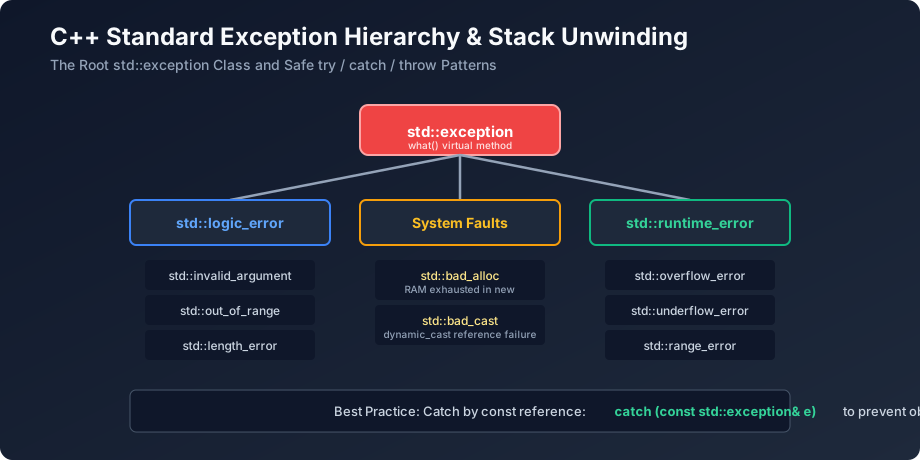
Figure 17: The Standard C++ Exception Class Hierarchy (std::exception)
Custom Exception Class Implementation
#include <iostream>
#include <stdexcept>
#include <string>

// Custom domain exception deriving from std::runtime_error
class InsufficientFundsException : public std::runtime_error {
public:
    explicit InsufficientFundsException(double deficit)
        : std::runtime_error("Withdrawal rejected: Shortfall of $" + std::to_string(deficit)) {}
};

class BankAccount {
private:
    double balance;
public:
    BankAccount(double b) : balance(b) {}

    void withdraw(double amount) {
        if (amount > balance) {
            throw InsufficientFundsException(amount - balance); // Throw custom exception
        }
        balance -= amount;
        std::cout << "Withdrawal successful. Remaining: $" << balance << "\n";
    }
};

int main() {
    BankAccount account(500.0);

    try {
        account.withdraw(200.0);
        account.withdraw(450.0); // Throws InsufficientFundsException!
    } catch (const InsufficientFundsException& e) {
        std::cerr << "[ACCOUNT ERROR]: " << e.what() << "\n";
    } catch (const std::exception& e) {
        std::cerr << "[STANDARD ERROR]: " << e.what() << "\n";
    }

    return 0;
}
Frequently Asked Questions (FAQ) - Student & Interview Review
Q1. Why should you always catch exceptions by const reference (catch (const std::exception& e))?
Catching by value causes Object Slicing (derived exception data is stripped away) and copies the exception object. Catching by pointer requires manual deletion. Catching by 'const reference' preserves full polymorphism and avoids copying.
Q2. What does the 'noexcept' keyword do in C++11?
The 'noexcept' specifier guarantees that a function will never throw an exception. If an exception escapes a noexcept function, std::terminate() is called immediately. Marking move constructors noexcept enables STL containers like vector to use move operations during reallocation.
Explore Related C++ Tutorials & Next Steps
Boost your C++ proficiency by studying these closely connected core modules:
C++ RAII
How RAII prevents leaks during stack unwinding.
File Streams
Handling I/O stream exceptions.
Multithreading
Exception safety across thread boundaries.


You may also like this!
© Veewom.com. | Managed by PinePL
