
C++ Data Types, Sizes and Value Ranges: Complete 64-Bit Memory Matrix
Every value stored in a computer's memory must have a clearly defined Data Type. The data type instructs the compiler how many bytes of RAM to reserve and how to interpret the binary bit patterns stored inside.
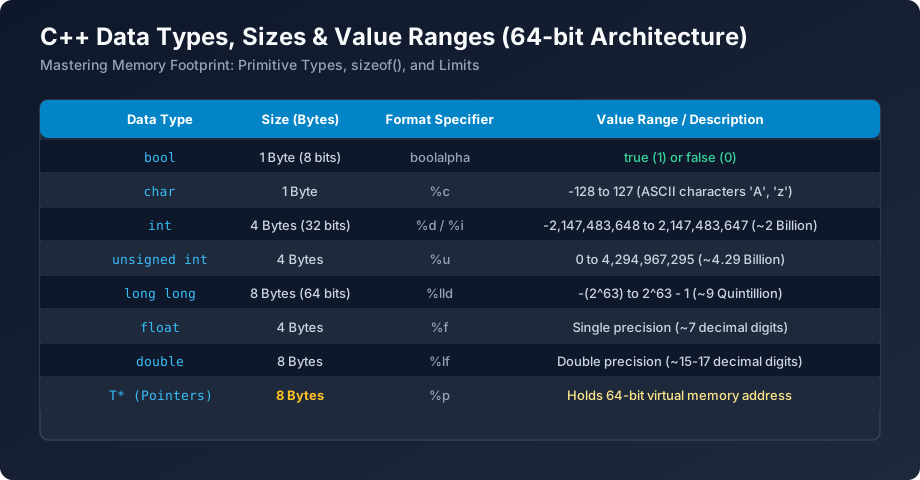
Figure 4: Complete C++ Data Types and Memory Footprint Matrix
Classification of C++ Data Types
- Primitive / Built-in Types:
int,char,float,double,bool,void. - Derived Types: Arrays, Pointers, References, Functions.
- User-Defined Types:
struct,class,union,enum,typedef/using.
Complete Primitive Types & Sizes Reference
| Data Type | Size (Bytes) | Bits | Approximate Value Range | Typical Real-World Use Case |
|---|---|---|---|---|
bool |
1 | 8 | true (1) or false (0) |
Flags, logic conditionals |
char |
1 | 8 | -128 to 127 (or 0 to 255 unsigned) | Single ASCII character ('A') |
short |
2 | 16 | -32,768 to 32,767 | Small numbers, audio samples |
int |
4 | 32 | -2.14 Billion to +2.14 Billion | General-purpose counters, loop indices |
unsigned int |
4 | 32 | 0 to 4,294,967,295 (~4.29 Billion) | Quantities that cannot be negative (sizes) |
long long |
8 | 64 | -(2^63) to 2^63 - 1 (~9 Quintillion) | Large IDs, database keys, high-precision time |
float |
4 | 32 | ~1.18e-38 to 3.40e+38 (7 digits precision) | Graphics shaders, physics engines |
double |
8 | 64 | ~2.23e-308 to 1.79e+308 (15-17 digits) | Scientific simulations, financial math |
Practical Example: Verifying Sizes with sizeof
#include <iostream>

int main() {
    std::cout << "Size of bool:      " << sizeof(bool) << " byte\n";
    std::cout << "Size of char:      " << sizeof(char) << " byte\n";
    std::cout << "Size of int:       " << sizeof(int) << " bytes\n";
    std::cout << "Size of long long: " << sizeof(long long) << " bytes\n";
    std::cout << "Size of double:    " << sizeof(double) << " bytes\n";
    return 0;
}
Frequently Asked Questions (FAQ) - Student & Interview Review
Q1. What is the size of an int in C++ on 64-bit systems?
Under the standard LP64 and LLP64 data models used by 64-bit Windows and Linux systems, a standard 'int' is 4 bytes (32 bits), holding values from -2,147,483,648 to 2,147,483,647.
Q2. What is the difference between float and double in C++?
A float occupies 4 bytes and provides single precision (~7 decimal digits of accuracy). A double occupies 8 bytes and provides double precision (~15 to 17 decimal digits of accuracy). Modern CPUs handle double calculations at nearly identical speed, making double the industry default.
Explore Related C++ Tutorials & Next Steps
Boost your C++ proficiency by studying these closely connected core modules:
C++ Variables
Understanding variable naming and initialization.
C++ Type Casting
Converting safely between different types.
C++ std::array
Fixed-size container data types.


You may also like this!
© Veewom.com. | Managed by PinePL
